QUESTION IMAGE
Question
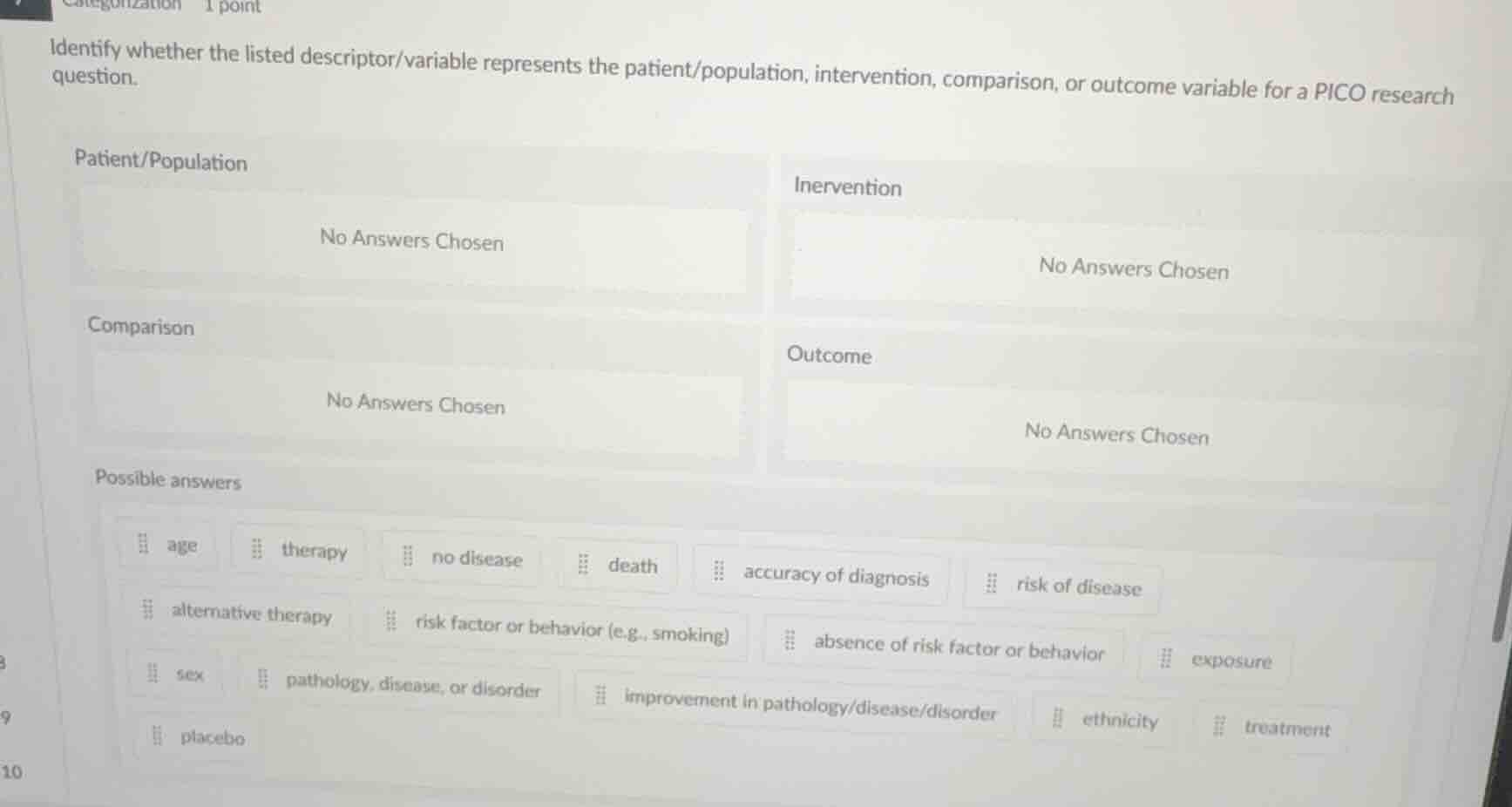
identify whether the listed descriptor/variable represents the patient/population, intervention, comparison, or outcome variable for a pico research question.
patient/population
inervention
comparison
outcome
possible answers
- age
- therapy
- no disease
- death
- accuracy of diagnosis
- risk of disease
- alternative therapy
- risk factor or behavior (e.g., smoking)
- absence of risk factor or behavior
- exposure
- sex
- pathology, disease, or disorder
- improvement in pathology/disease/disorder
- ethnicity
- treatment
- placebo
Define the PICO framework components
Using the Evidence-Based Practice knowledge point, we define the four elements of a PICO question:
- P (Patient/Population/Problem): Characteristics of the patients or population (e.g., demographics, clinical conditions).
- I (Intervention/Exposure): The therapeutic strategy, risk factor, or exposure being investigated.
- C (Comparison): The alternative control, placebo, or absence of the risk factor being compared.
- O (Outcome): The clinical effects, measurements, or consequences of interest.
Categorize Patient/Population variables
We identify descriptors representing patient characteristics or their underlying clinical state:
- age (demographic descriptor)
- sex (demographic descriptor)
- ethnicity (demographic descriptor)
- pathology, disease, or disorder (the baseline clinical problem)
Categorize Intervention variables
We identify active exposures, treatments, or risk factors applied to the population:
- therapy (active treatment)
- treatment (active treatment)
- exposure (active exposure)
- risk factor or behavior (e.g., smoking) (active baseline exposure)
Categorize Comparison variables
We identify the control conditions or alternative baselines compared against the intervention:
- placebo (standard control)
- alternative therapy (alternative active control)
- no disease (baseline control state)
- absence of risk factor or behavior (control exposure state)
Categorize Outcome variables
We identify the clinical endpoints, measurements, or consequences of interest:
- death (clinical endpoint)
- accuracy of diagnosis (diagnostic performance measure)
- risk of disease (epidemiological outcome measure)
- improvement in pathology/disease/disorder (clinical response measure)

Snap & solve any problem in the app
Get step-by-step solutions on Sovi AI
Photo-based solutions with guided steps
Explore more problems and detailed explanations
- Patient/Population: age, sex, ethnicity, pathology, disease, or disorder
- Intervention: therapy, treatment, exposure, risk factor or behavior (e.g., smoking)
- Comparison: placebo, alternative therapy, no disease, absence of risk factor or behavior
- Outcome: death, accuracy of diagnosis, risk of disease, improvement in pathology/disease/disorder