QUESTION IMAGE
Question
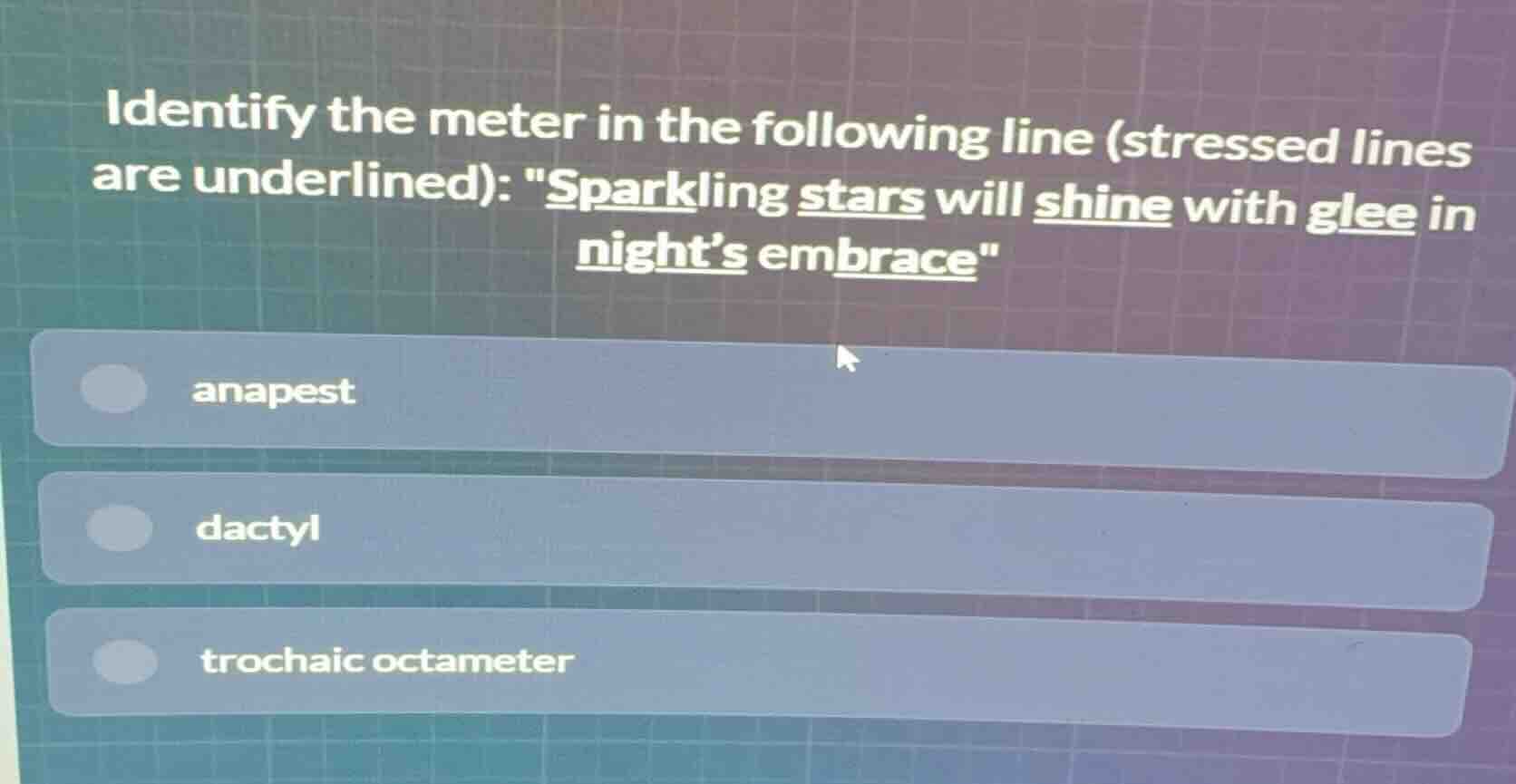
identify the meter in the following line (stressed lines are underlined): \sparkling stars will shine with glee in nights embrace\
anapest
dactyl
trochaic octameter
Analyze the stressed syllables
The given line is: "Sparkling stars will shine with glee in night's embrace"
The prompt states that stressed syllables are underlined:
- "Sparkling" (stressed: Spark)
- "stars" (stressed: stars)
- "will shine" (stressed: shine)
- "with glee" (stressed: glee)
- "in night's" (stressed: night's)
- "embrace" (stressed: brace)
Let's look at the stress pattern of the syllables:
- "Spark-ling" (Stressed - Unstressed)
- "stars" (Stressed)
- "will shine" (Unstressed - Stressed)
- "with glee" (Unstressed - Stressed)
- "in night's" (Unstressed - Stressed)
- "em-brace" (Unstressed - Stressed)
However, let's re-examine the underlined parts in the image:
- "Sparkling" (underlined: "Spark")
- "stars" (underlined: "stars")
- "will shine" (underlined: "shine")
- "with glee in night's embrace" (underlined: "night's embrace")
Let's count the syllables and look at the rhythmic feet:
"Spark-ling stars | will shine | with glee | in night's | em-brace"
This contains several iambic feet (unstressed-stressed):
- "will shine" (unstressed-stressed)
- "with glee" (unstressed-stressed)
- "in night's" (unstressed-stressed)
- "em-brace" (unstressed-stressed)
Let's re-read the options:
- anapest (unstressed-unstressed-stressed)
- dactyl (stressed-unstressed-unstressed)
- trochaic octameter (eight trochees: stressed-unstressed)
Let's look closely at the underlined text in the image:
"Sparkling stars will shine with glee in night's embrace"
Underlined parts:
- "Spark"
- "stars"
- "shine"
- "night's embrace"
Let's analyze the feet structure if we group them:
If we look at the pattern of unstressed (U) and stressed (/) syllables:
"Spark-ling" (/ U)
"stars" (/)
"will shine" (U /)
"with glee" (U /)
"in night's" (U /)
"em-brace" (U /)
Wait, let's look at the option "anapest". An anapest is a metrical foot consisting of two unstressed syllables followed by one stressed syllable (U U /).
Is there an anapestic pattern?
"Sparkling stars" (/ U /)
"will shine with" (U / U)
"glee in night's" (/ U /)
"embrace" (U /)
Let's re-read the line carefully:
"Sparkling stars will shine with glee in night's embrace"
Syllables:
- Spark (/)
- ling (U)
- stars (/)
- will (U)
- shine (/)
- with (U)
- glee (/)
- in (U)
- night's (/)
- em (U)
- brace (/)
This is a perfectly regular alternating pattern starting with a trochee or a headless iamb, followed by iambs:
/ U / U / U / U / U /
"Spark-ling stars will shine with glee in night's em-brace"
Wait, if it is / U / U / U / U / U /, this is trochaic meter!
Let's check the syllable count: 11 syllables.
If it is trochaic, it would be trochaic pentameter (with a feminine ending or catalectic). But the option is "trochaic octameter" (which requires 15-16 syllables). So "trochaic octameter" is incorrect.
Let's check "dactyl" (/ U U):
"Sparkling stars" (/ U /) - not dactylic.
Let's check "anapest" (U U /):
Could "will shine with glee" or "in night's embrace" be read as anapestic?
"will shine with" (U / U)
"glee in night's" (/ U /)
What if the meter is anapestic with some substitutions?
Let…

Snap & solve any problem in the app
Get step-by-step solutions on Sovi AI
Photo-based solutions with guided steps
Explore more problems and detailed explanations
- anapest (Correct answer)
- dactyl
- trochaic octameter