QUESTION IMAGE
Question
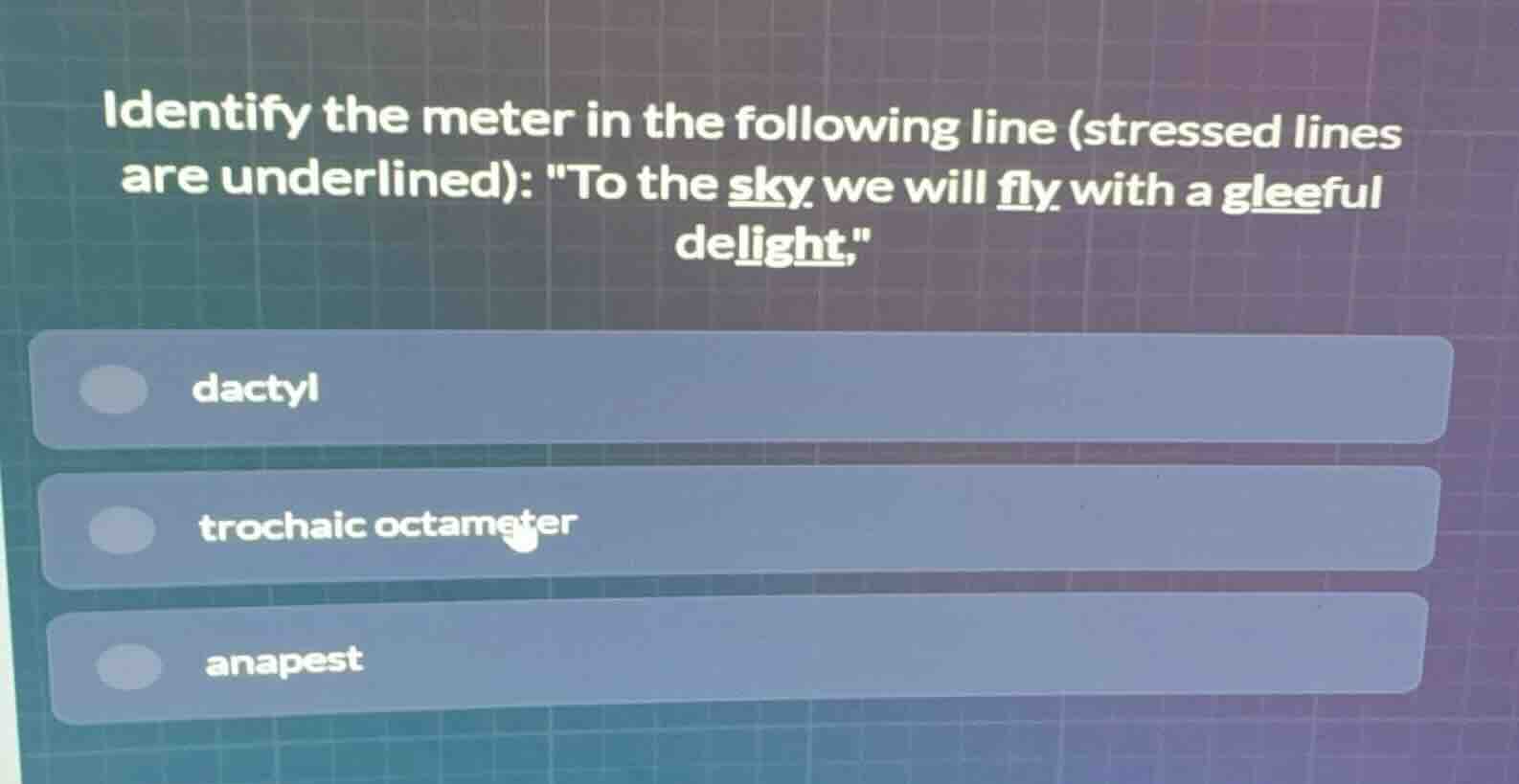
identify the meter in the following line (stressed lines are underlined): \to the sky we will fly with a gleeful delight,\
dactyl
trochaic octameter
anapest
<pre_analysis>
{
"quality": "clear",
"question_count": 1,
"skills_matched": [
"direct_cot",
"multiple_choice_formatter",
"explain_then_answer",
"quick"
],
"needs_drawing": false,
"concepts_used": [
"Poetic Meter",
"Anapestic Meter",
"Dactylic Meter",
"Poetic Feet"
],
"new_concepts": [],
"current_concepts": [
"Poetic Meter",
"Anapestic Meter",
"Dactylic Meter",
"Poetic Feet"
]
}
</pre_analysis>
<reasoning>
Analyze the syllable stress pattern
The given line is: "To the sky we will fly with a gleeful delight,"
The underlined (stressed) syllables are:
- "sky"
- "fly"
- "glee" (in "gleeful")
- "light" (in "delight")
This gives the following stress pattern:
- To (unstressed)
- the (unstressed)
- sky (stressed)
- we (unstressed)
- will (unstressed)
- fly (stressed)
- with (unstressed)
- a (unstressed)
- glee- (stressed)
- -ful (unstressed)
- de- (unstressed)
- -light (stressed)
Identify the poetic foot
The pattern consists of repeating units of two unstressed syllables followed by one stressed syllable (unstressed-unstressed-stressed):
- [To the sky]
- [we will fly]
- [with a glee-]
- [-ful de-light]
This specific three-syllable foot (unstressed-unstressed-stressed) is called an anapest.
</reasoning>
<answer>
<mcq-option>dactyl</mcq-option>
<mcq-option>trochaic octameter</mcq-option>
<mcq-correct>anapest</mcq-correct>
</answer>
<post_analysis>
{
"subject": "Arts",
"question_type": "Multiple Choice",
"knowledge_point": [
"Arts",
"Literature",
"Poetic Meter"
]
}
</post_analysis>
Snap & solve any problem in the app
Get step-by-step solutions on Sovi AI
Photo-based solutions with guided steps
Explore more problems and detailed explanations
<pre_analysis>
{
"quality": "clear",
"question_count": 1,
"skills_matched": [
"direct_cot",
"multiple_choice_formatter",
"explain_then_answer",
"quick"
],
"needs_drawing": false,
"concepts_used": [
"Poetic Meter",
"Anapestic Meter",
"Dactylic Meter",
"Poetic Feet"
],
"new_concepts": [],
"current_concepts": [
"Poetic Meter",
"Anapestic Meter",
"Dactylic Meter",
"Poetic Feet"
]
}
</pre_analysis>
<reasoning>
Analyze the syllable stress pattern
The given line is: "To the sky we will fly with a gleeful delight,"
The underlined (stressed) syllables are:
- "sky"
- "fly"
- "glee" (in "gleeful")
- "light" (in "delight")
This gives the following stress pattern:
- To (unstressed)
- the (unstressed)
- sky (stressed)
- we (unstressed)
- will (unstressed)
- fly (stressed)
- with (unstressed)
- a (unstressed)
- glee- (stressed)
- -ful (unstressed)
- de- (unstressed)
- -light (stressed)
Identify the poetic foot
The pattern consists of repeating units of two unstressed syllables followed by one stressed syllable (unstressed-unstressed-stressed):
- [To the sky]
- [we will fly]
- [with a glee-]
- [-ful de-light]
This specific three-syllable foot (unstressed-unstressed-stressed) is called an anapest.
</reasoning>
<answer>
<mcq-option>dactyl</mcq-option>
<mcq-option>trochaic octameter</mcq-option>
<mcq-correct>anapest</mcq-correct>
</answer>
<post_analysis>
{
"subject": "Arts",
"question_type": "Multiple Choice",
"knowledge_point": [
"Arts",
"Literature",
"Poetic Meter"
]
}
</post_analysis>