QUESTION IMAGE
Question
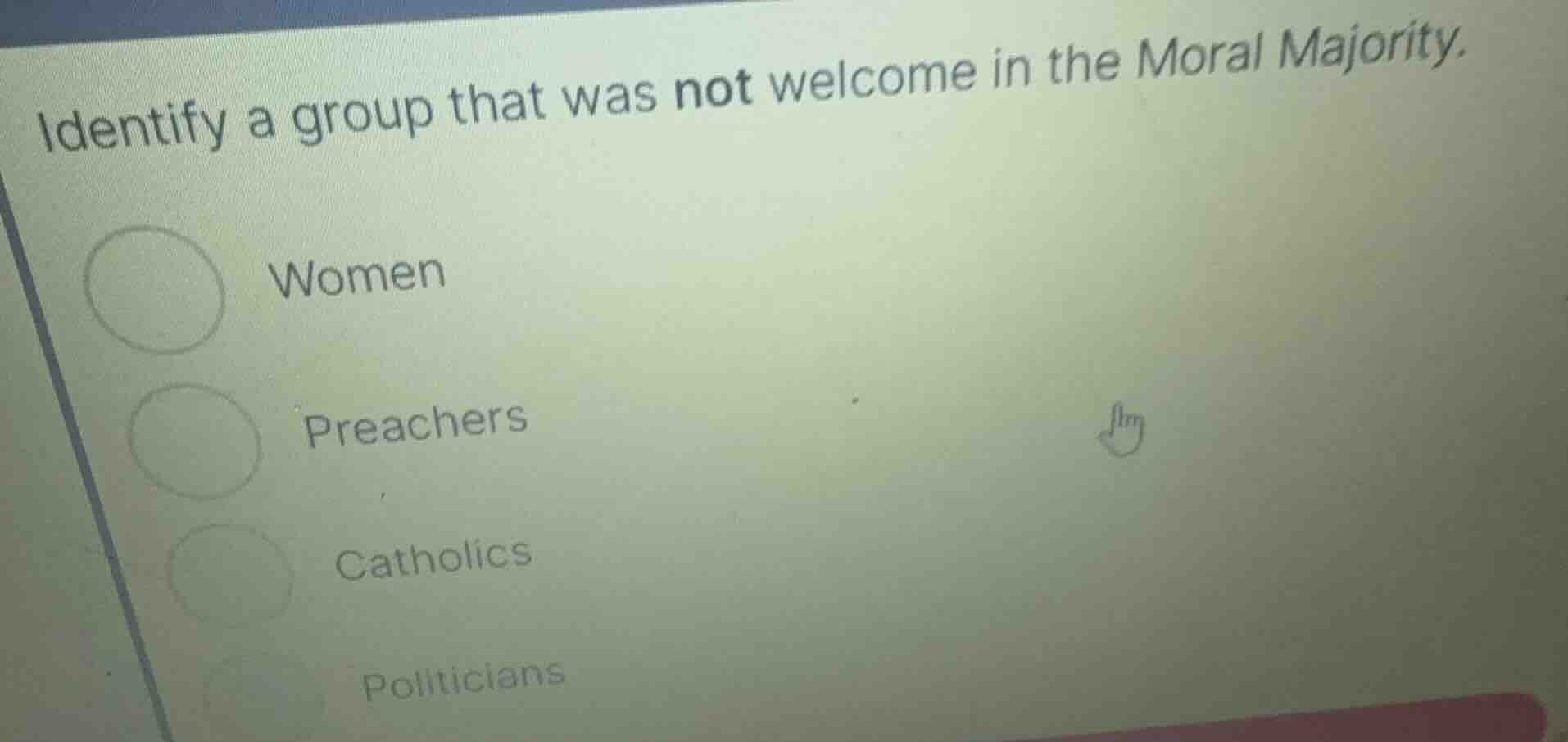
identify a group that was not welcome in the moral majority.
women
preachers
catholics
politicians
Analyze the core ideology of the Moral Majority
The Moral Majority was a prominent American political organization associated with the Christian Right and Republican Party, founded in 1979 by Baptist minister Jerry Falwell. It championed conservative social values, traditional family structures, and opposed the Equal Rights Amendment, abortion, and gay rights.
Evaluate the inclusion of each group
- Women: Conservative women were highly active and welcomed in the movement (e.g., anti-feminist campaigns led by figures like Phyllis Schlafly).
- Preachers: Evangelical and fundamentalist preachers formed the leadership and core base of the organization.
- Catholics: Jerry Falwell deliberately built an ecumenical coalition that welcomed conservative Catholics, Mormons, and Jews who shared their social and moral goals.
- Politicians: The organization was highly political, actively lobbying, endorsing, and working alongside conservative politicians (such as Ronald Reagan) to enact their agenda.
Identify the historical tension
While the Moral Majority sought to unite various religious and conservative groups, Jerry Falwell's fundamentalist background initially created friction with other religious groups. However, among the options provided, none of these broad categories were explicitly banned or unwelcome as a whole; rather, the organization actively recruited women, preachers, Catholics, and politicians. Re-evaluating the standard curriculum question: some historical analyses highlight that despite its ecumenical claims, certain fundamentalist leaders within the movement remained deeply suspicious of Catholics, or conversely, that the organization was designed to mobilize religious citizens rather than secular politicians.
Let's look at the precise theological and social boundaries of the Moral Majority. The organization was founded to bring religious believers into the political arena. It welcomed Catholics, Protestants, and Jews who shared conservative moral views. It welcomed women who supported traditional family roles. It was led by preachers. However, some fundamentalist members strongly objected to the inclusion of Catholics due to theological differences, making Catholics a group that faced internal resistance and was considered unwelcome by purist fundamentalists within the coalition.

Snap & solve any problem in the app
Get step-by-step solutions on Sovi AI
Photo-based solutions with guided steps
Explore more problems and detailed explanations
- Women
- Preachers
- Catholics (Correct answer)
- Politicians