QUESTION IMAGE
Question
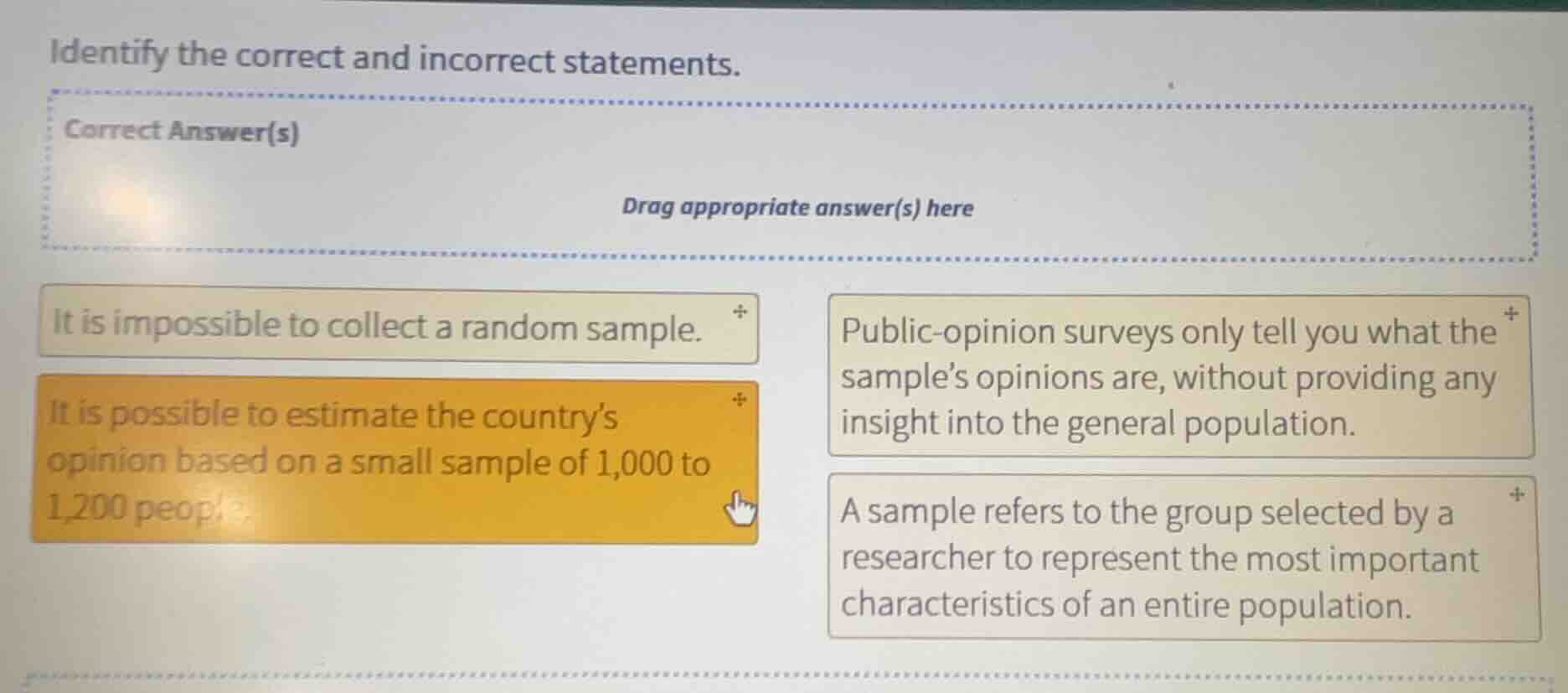
identify the correct and incorrect statements.
correct answer(s)
drag appropriate answer(s) here
- it is impossible to collect a random sample.
- it is possible to estimate the countrys opinion based on a small sample of 1,000 to 1,200 people.
- public-opinion surveys only tell you what the samples opinions are, without providing any insight into the general population.
- a sample refers to the group selected by a researcher to represent the most important characteristics of an entire population.
Evaluate statements on scientific polling and sampling
- "It is impossible to collect a random sample": Incorrect. Random digit dialing and other probability sampling methods allow researchers to obtain random samples.
- "It is possible to estimate the country's opinion based on a small sample of 1,000 to 1,200 people": Correct. Standard scientific polls use samples of this size to estimate national opinion within a small margin of error (typically \(\pm 3\%\)).
- "Public-opinion surveys only tell you what the sample's opinions are, without providing any insight into the general population": Incorrect. Through probability theory, a representative sample provides highly accurate estimates of the broader population's opinions.
- "A sample refers to the group selected by a researcher to represent the most important characteristics of an entire population": Correct. This is the fundamental definition of a representative sample in social science research.

Snap & solve any problem in the app
Get step-by-step solutions on Sovi AI
Photo-based solutions with guided steps
Explore more problems and detailed explanations
- It is impossible to collect a random sample.
- It is possible to estimate the country's opinion based on a small sample of 1,000 to 1,200 people. (Correct answer)
- Public-opinion surveys only tell you what the sample's opinions are, without providing any insight into the general population.
- A sample refers to the group selected by a researcher to represent the most important characteristics of an entire population. (Correct answer)