QUESTION IMAGE
Question
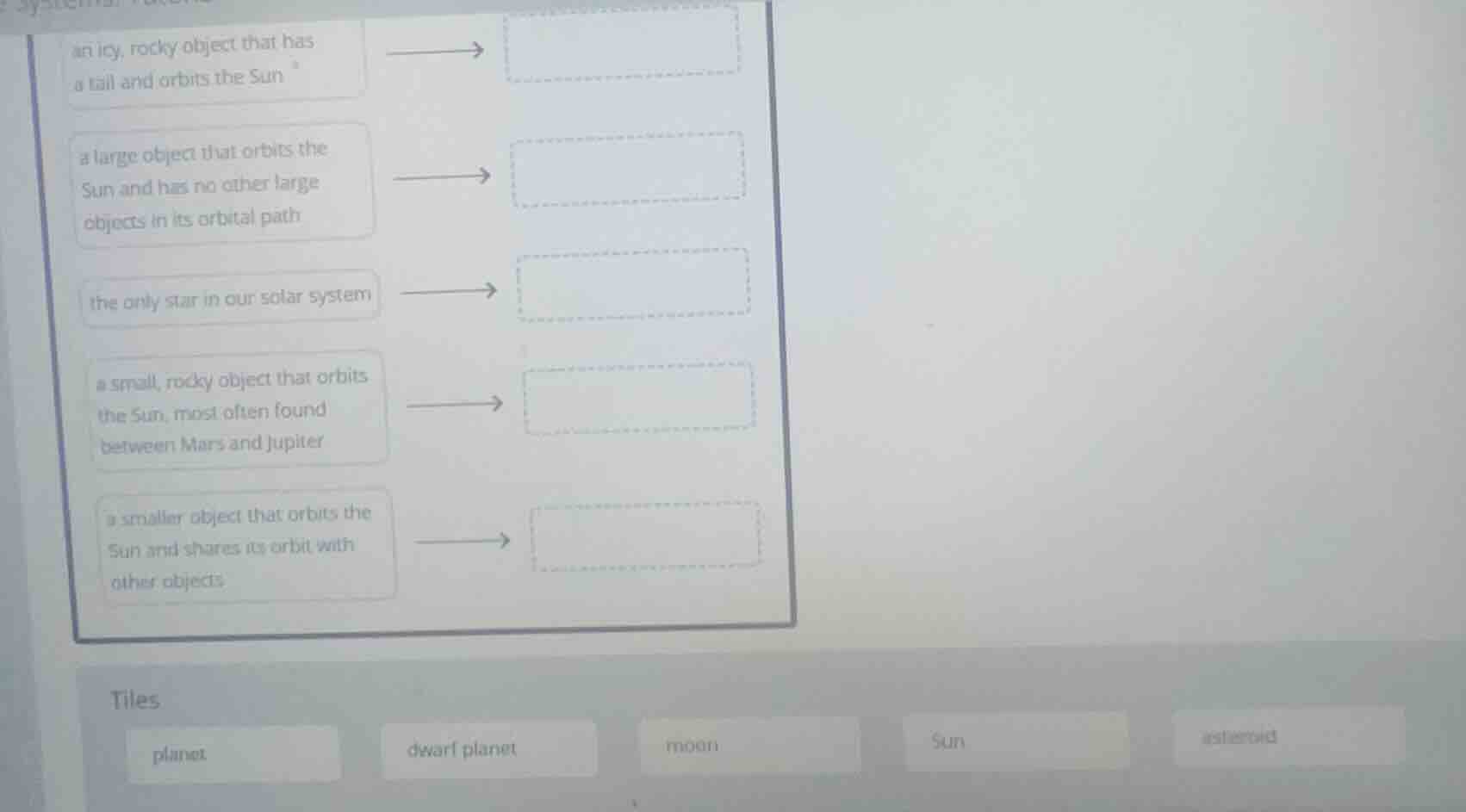
an icy, rocky object that has a tail and orbits the sun
a large object that orbits the sun and has no other large objects in its orbital path
the only star in our solar system
a small, rocky object that orbits the sun, most often found between mars and jupiter
a smaller object that orbits the sun and shares its orbit with other objects
tiles:
planet
dwarf planet
moon
sun
asteroid
<pre_analysis>
{
"quality": "clear",
"question_count": 1,
"skills_matched": [
"direct_cot",
"blank_filling_formatter",
"explain_then_answer",
"tutor"
],
"needs_drawing": false,
"concepts_used": [
"Solar System Structure",
"Inner and Outer Planets"
],
"new_concepts": [
"Celestial Bodies",
"Comets and Asteroids",
"Dwarf Planets"
],
"current_concepts": [
"Solar System Structure",
"Celestial Bodies",
"Comets and Asteroids",
"Dwarf Planets"
]
}
</pre_analysis>
<reasoning>
Identify the first celestial body
The first description is "an icy, rocky object that has a tail and orbits the Sun". This describes a comet. Looking at the available tiles at the bottom, we have: "planet", "dwarf planet", "moon", "Sun", "asteroid", and "comet" (which is cut off or implied by the description of an icy, rocky object with a tail). Let's match the descriptions to the standard astronomical definitions of these tiles.
- "an icy, rocky object that has a tail and orbits the Sun" $
ightarrow$ comet
Identify the second celestial body
The second description is "a large object that orbits the Sun and has no other large objects in its orbital path". This is the official IAU definition of a planet (having cleared its neighborhood).
- "a large object that orbits the Sun and has no other large objects in its orbital path" $
ightarrow$ planet
Identify the third celestial body
The third description is "the only star in our solar system". This is the Sun.
- "the only star in our solar system" $
ightarrow$ Sun
Identify the fourth celestial body
The fourth description is "a small, rocky object that orbits the Sun, most often found between Mars and Jupiter". This refers to the asteroid belt.
- "a small, rocky object that orbits the Sun, most often found between Mars and Jupiter" $
ightarrow$ asteroid
Identify the fifth celestial body
The fifth description is "a smaller object that orbits the Sun and shares its orbit with other objects". This is the definition of a dwarf planet (which has not cleared its neighborhood).
- "a smaller object that orbits the Sun and shares its orbit with other objects" $
ightarrow$ dwarf planet
</reasoning>
<answer>
- an icy, rocky object that has a tail and orbits the Sun $
ightarrow$ <blank>comet</blank>
- a large object that orbits the Sun and has no other large objects in its orbital path $
ightarrow$ <blank>planet</blank>
- the only star in our solar system $
ightarrow$ <blank>Sun</blank>
- a small, rocky object that orbits the Sun, most often found between Mars and Jupiter $
ightarrow$ <blank>asteroid</blank>
- a smaller object that orbits the Sun and shares its orbit with other objects $
ightarrow$ <blank>dwarf planet</blank>
</answer>
<post_analysis>
{
"subject": "Natural Science",
"question_type": "Fill-in-the-blank",
"knowledge_point": [
"Natural Science",
"Astronomy",
"Solar System Structure"
]
}
</post_analysis>
Snap & solve any problem in the app
Get step-by-step solutions on Sovi AI
Photo-based solutions with guided steps
Explore more problems and detailed explanations
<pre_analysis>
{
"quality": "clear",
"question_count": 1,
"skills_matched": [
"direct_cot",
"blank_filling_formatter",
"explain_then_answer",
"tutor"
],
"needs_drawing": false,
"concepts_used": [
"Solar System Structure",
"Inner and Outer Planets"
],
"new_concepts": [
"Celestial Bodies",
"Comets and Asteroids",
"Dwarf Planets"
],
"current_concepts": [
"Solar System Structure",
"Celestial Bodies",
"Comets and Asteroids",
"Dwarf Planets"
]
}
</pre_analysis>
<reasoning>
Identify the first celestial body
The first description is "an icy, rocky object that has a tail and orbits the Sun". This describes a comet. Looking at the available tiles at the bottom, we have: "planet", "dwarf planet", "moon", "Sun", "asteroid", and "comet" (which is cut off or implied by the description of an icy, rocky object with a tail). Let's match the descriptions to the standard astronomical definitions of these tiles.
- "an icy, rocky object that has a tail and orbits the Sun" $
ightarrow$ comet
Identify the second celestial body
The second description is "a large object that orbits the Sun and has no other large objects in its orbital path". This is the official IAU definition of a planet (having cleared its neighborhood).
- "a large object that orbits the Sun and has no other large objects in its orbital path" $
ightarrow$ planet
Identify the third celestial body
The third description is "the only star in our solar system". This is the Sun.
- "the only star in our solar system" $
ightarrow$ Sun
Identify the fourth celestial body
The fourth description is "a small, rocky object that orbits the Sun, most often found between Mars and Jupiter". This refers to the asteroid belt.
- "a small, rocky object that orbits the Sun, most often found between Mars and Jupiter" $
ightarrow$ asteroid
Identify the fifth celestial body
The fifth description is "a smaller object that orbits the Sun and shares its orbit with other objects". This is the definition of a dwarf planet (which has not cleared its neighborhood).
- "a smaller object that orbits the Sun and shares its orbit with other objects" $
ightarrow$ dwarf planet
</reasoning>
<answer>
- an icy, rocky object that has a tail and orbits the Sun $
ightarrow$ <blank>comet</blank>
- a large object that orbits the Sun and has no other large objects in its orbital path $
ightarrow$ <blank>planet</blank>
- the only star in our solar system $
ightarrow$ <blank>Sun</blank>
- a small, rocky object that orbits the Sun, most often found between Mars and Jupiter $
ightarrow$ <blank>asteroid</blank>
- a smaller object that orbits the Sun and shares its orbit with other objects $
ightarrow$ <blank>dwarf planet</blank>
</answer>
<post_analysis>
{
"subject": "Natural Science",
"question_type": "Fill-in-the-blank",
"knowledge_point": [
"Natural Science",
"Astronomy",
"Solar System Structure"
]
}
</post_analysis>