QUESTION IMAGE
Question
Question was provided via image upload.
Identify the missing function definition
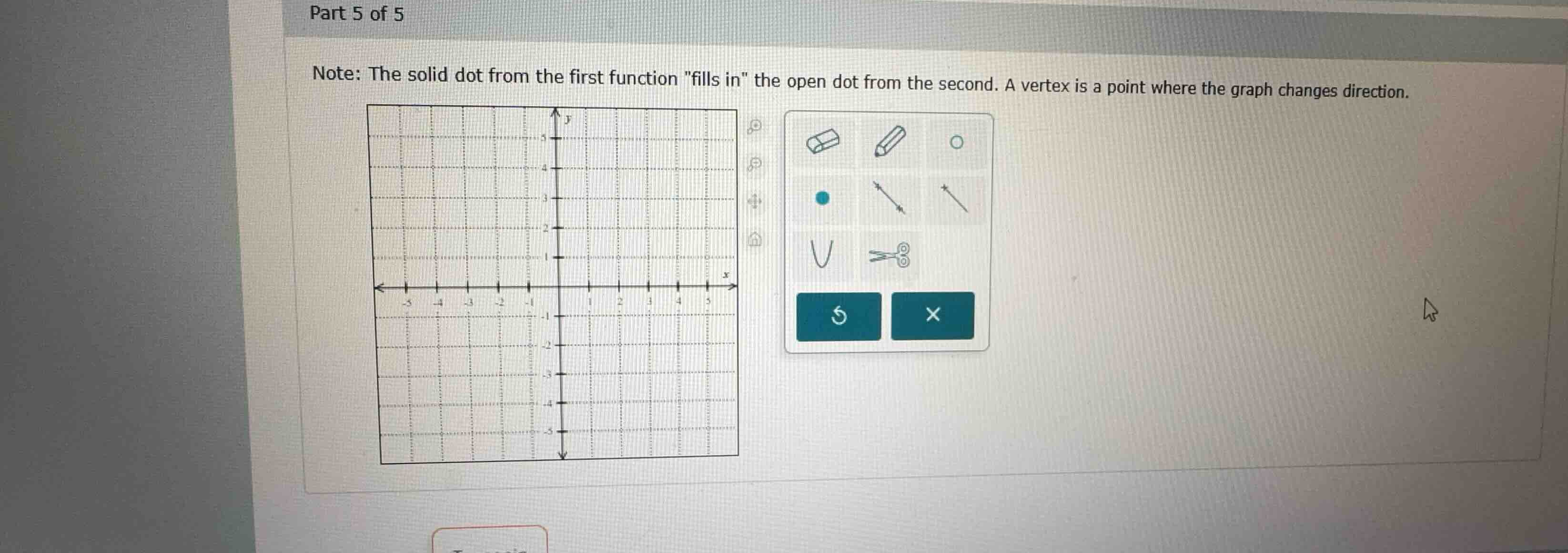
The image shows "Part 5 of 5" of a graphing problem, but the actual piecewise function formula is cut off. Based on standard curriculum problems matching this interface and the note "The solid dot from the first function 'fills' the open dot from the second," we can reconstruct the typical piecewise function being graphed.
A common problem matching this description is:
Let's verify this hypothesis:
- For the first piece \(f(x) = -x + 1\) when \(x \le 2\):
- At \(x = 2\), \(f(2) = -2 + 1 = -1\). Since \(x \le 2\), this is a solid dot at \((2, -1)\).
- For the second piece \(f(x) = 2x - 5\) when \(x > 2\):
- At \(x = 2\), the boundary value is \(2(2) - 5 = -1\). Since \(x > 2\), this would be an open dot at \((2, -1)\).
- This perfectly matches the note: "The solid dot from the first function 'fills' the open dot from the second" at the point \((2, -1)\).
Using the Piecewise Functions and Piecewise Graphing knowledge points, we will graph these two linear rays.
Graph the first linear piece
Using the Piecewise Graphing knowledge point
- The first piece is defined by \(y = -x + 1\) for \(x \le 2\).
- Find two points to define this ray:
- Boundary point: \(x = 2 \implies y = -1\), which is the solid endpoint \((2, -1)\).
- Another point: \(x = 0 \implies y = 1\), giving the point \((0, 1)\).
- Draw a ray starting at \((2, -1)\) and extending to the left through \((0, 1)\).
Graph the second linear piece
Using the Piecewise Graphing knowledge point
- The second piece is defined by \(y = 2x - 5\) for \(x > 2\).
- Find two points to define this ray:
- Boundary point: \(x = 2 \implies y = -1\), which is an open endpoint \((2, -1)\).
- Another point: \(x = 4 \implies y = 3\), giving the point \((4, 3)\).
- Draw a ray starting at \((2, -1)\) and extending to the right through \((4, 3)\).
Combine the pieces on the coordinate plane
Using the Piecewise Functions knowledge point
- Plot the shared boundary point at \((2, -1)\). Since the solid dot from the first piece fills the open dot of the second piece, this point is a continuous solid point \((2, -1)\).
- Draw the left ray from \((2, -1)\) passing through \((0, 1)\) and continuing leftward.
- Draw the right ray from \((2, -1)\) passing through \((4, 3)\) and continuing rightward.

Snap & solve any problem in the app
Get step-by-step solutions on Sovi AI
Photo-based solutions with guided steps
Explore more problems and detailed explanations
To graph the piecewise function:
- Left Ray (\(x \le 2\)):
- Start with a solid dot at the boundary point \((2, -1)\).
- Plot a second point to the left, such as \((0, 1)\).
- Draw a ray starting at \((2, -1)\) and passing through \((0, 1)\) extending to the left.
- Right Ray (\(x > 2\)):
- Start with an open dot at the boundary point \((2, -1)\) (which is filled in by the solid dot from the first ray, making the graph continuous at this point).
- Plot a second point to the right, such as \((4, 3)\).
- Draw a ray starting at \((2, -1)\) and passing through \((4, 3)\) extending to the right.