QUESTION IMAGE
Question
Question was provided via image upload.
Analyze the student's response
Using the Finite Differences and Polynomial Model Selection knowledge points
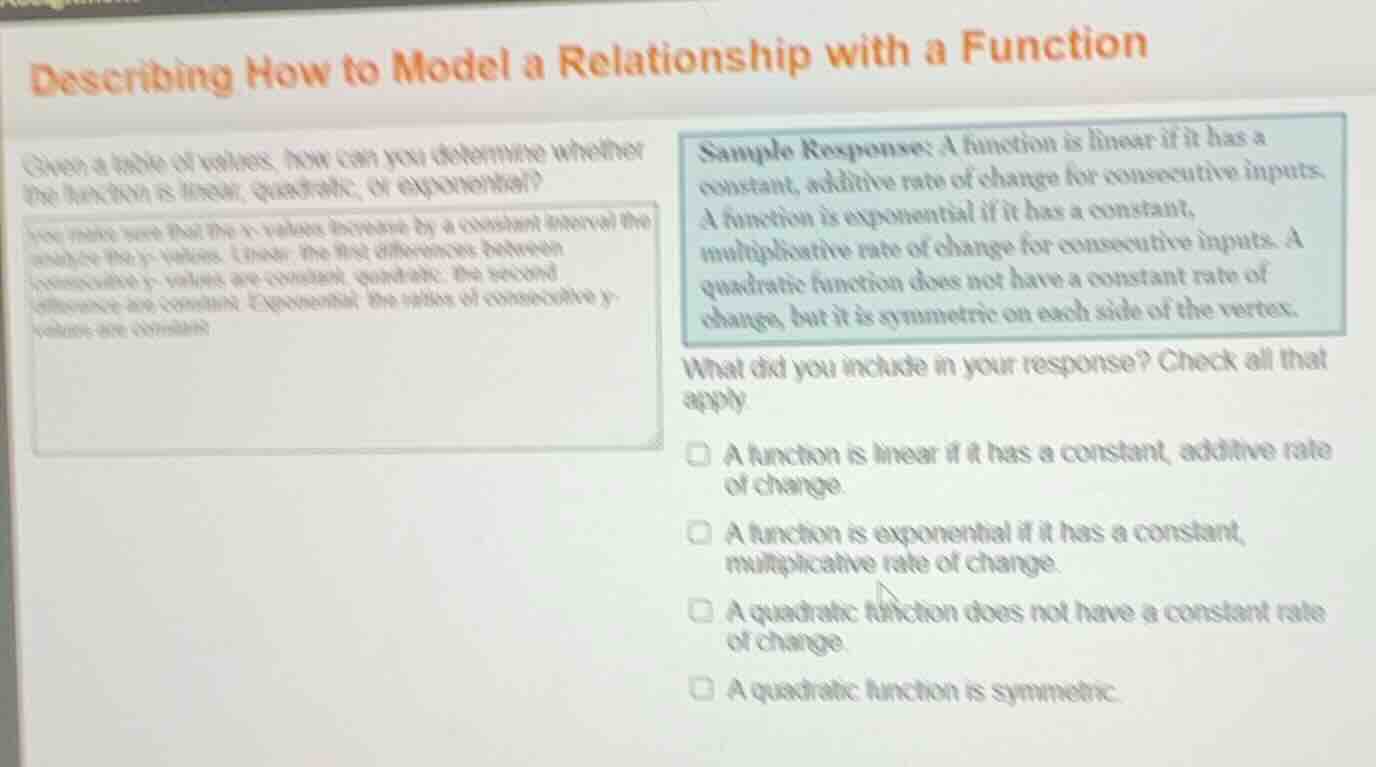
The student's response is visible in the left text box:
"First make sure that the x-values increase by a constant interval then analyze the y-values. Linear: the first differences between consecutive y-values are constant. quadratic: the second difference are constant. Exponential: the ratios of consecutive y-values are constant."
We compare this response to the checklist options:
- "A function is linear if it has a constant, additive rate of change."
- The student wrote: "Linear: the first differences between consecutive y-values are constant." Constant first differences correspond directly to a constant, additive rate of change. Thus, this is included.
- "A function is exponential if it has a constant, multiplicative rate of change."
- The student wrote: "Exponential: the ratios of consecutive y-values are constant." A constant ratio corresponds directly to a constant, multiplicative rate of change. Thus, this is included.
- "A quadratic function does not have a constant rate of change."
- The student wrote: "quadratic: the second difference are constant." By specifying that the second differences are constant (rather than the first), the student implicitly states that the first differences (the rate of change) are not constant. Thus, this is included.
- "A quadratic function is symmetric."
- The student's response only mentions "the second difference are constant" for quadratic functions. It does not mention symmetry or a vertex. Thus, this is not included.
Match checklist items to student response
- Option 1: Included (corresponds to "Linear: the first differences... are constant").
- Option 2: Included (corresponds to "Exponential: the ratios... are constant").
- Option 3: Included (corresponds to "quadratic: the second difference are constant", which means the first differences/rate of change are not constant).
- Option 4: Not included (symmetry is not mentioned in the student's text).

Snap & solve any problem in the app
Get step-by-step solutions on Sovi AI
Photo-based solutions with guided steps
Explore more problems and detailed explanations
- [x] A function is linear if it has a constant, additive rate of change. (Correct answer)
- [x] A function is exponential if it has a constant, multiplicative rate of change. (Correct answer)
- [x] A quadratic function does not have a constant rate of change. (Correct answer)
- [ ] A quadratic function is symmetric.