QUESTION IMAGE
Question
Question was provided via image upload.
Analyze the visible graphs
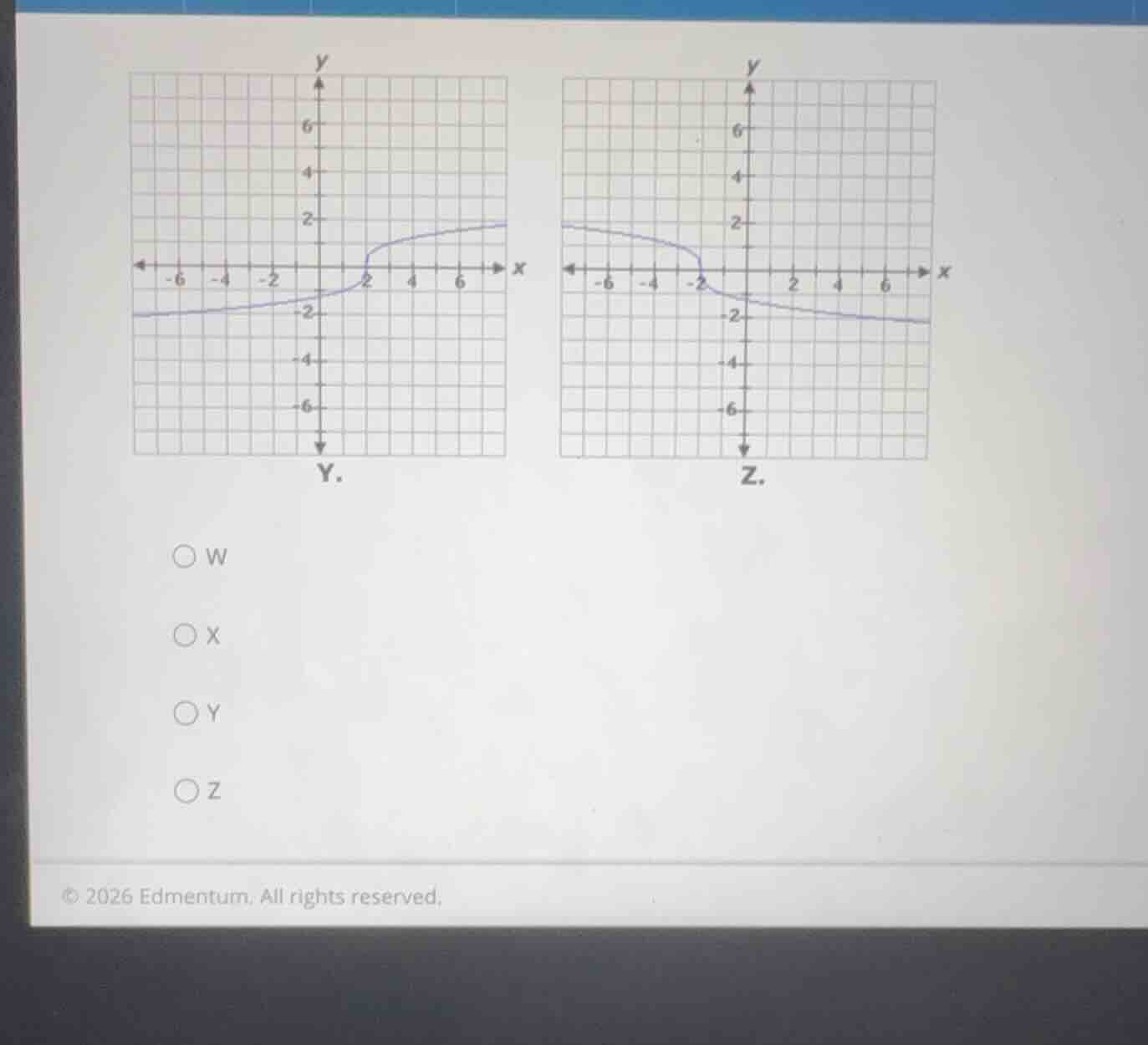
The image displays two graphs labeled Y and Z.
- Graph Y represents a cube root function of the form \(f(x) = \sqrt[3]{x-h} + k\). The inflection point (or center point) is located at \((2, 0)\). As \(x\) increases, \(y\) increases, meaning it is a standard, non-reflected cube root curve: \(y = \sqrt[3]{x-2}\).
- Graph Z represents a reflected cube root function. The inflection point is located at \((-2, 0)\). As \(x\) increases, \(y\) decreases, indicating a vertical reflection: \(y = -\sqrt[3]{x+2}\).
Infer the missing question stem
Although the question text is cropped out, standard curriculum questions of this type (from Edmentum) present four graphs (W, X, Y, Z) and ask the student to identify which graph corresponds to a given function.
- A common function paired with these options is \(f(x) = \sqrt[3]{x-2}\), which corresponds to Graph Y.
- Another common function is \(f(x) = -\sqrt[3]{x+2}\), which corresponds to Graph Z.
- Let us evaluate the most standard positive parent transformation: \(f(x) = \sqrt[3]{x-2}\). A horizontal shift to the right by 2 units of the parent function \(y = \sqrt[3]{x}\) yields the inflection point at \((2,0)\), which is precisely Graph Y.
Match the correct option
Based on standard algebraic transformations:
- Graph Y has its inflection point shifted 2 units to the right: \((2,0)\).
- Therefore, Graph Y represents the function \(f(x) = \sqrt[3]{x-2}\).

Snap & solve any problem in the app
Get step-by-step solutions on Sovi AI
Photo-based solutions with guided steps
Explore more problems and detailed explanations
- W
- X
- Y (Correct answer)
- Z