QUESTION IMAGE
Question
Question was provided via image upload.
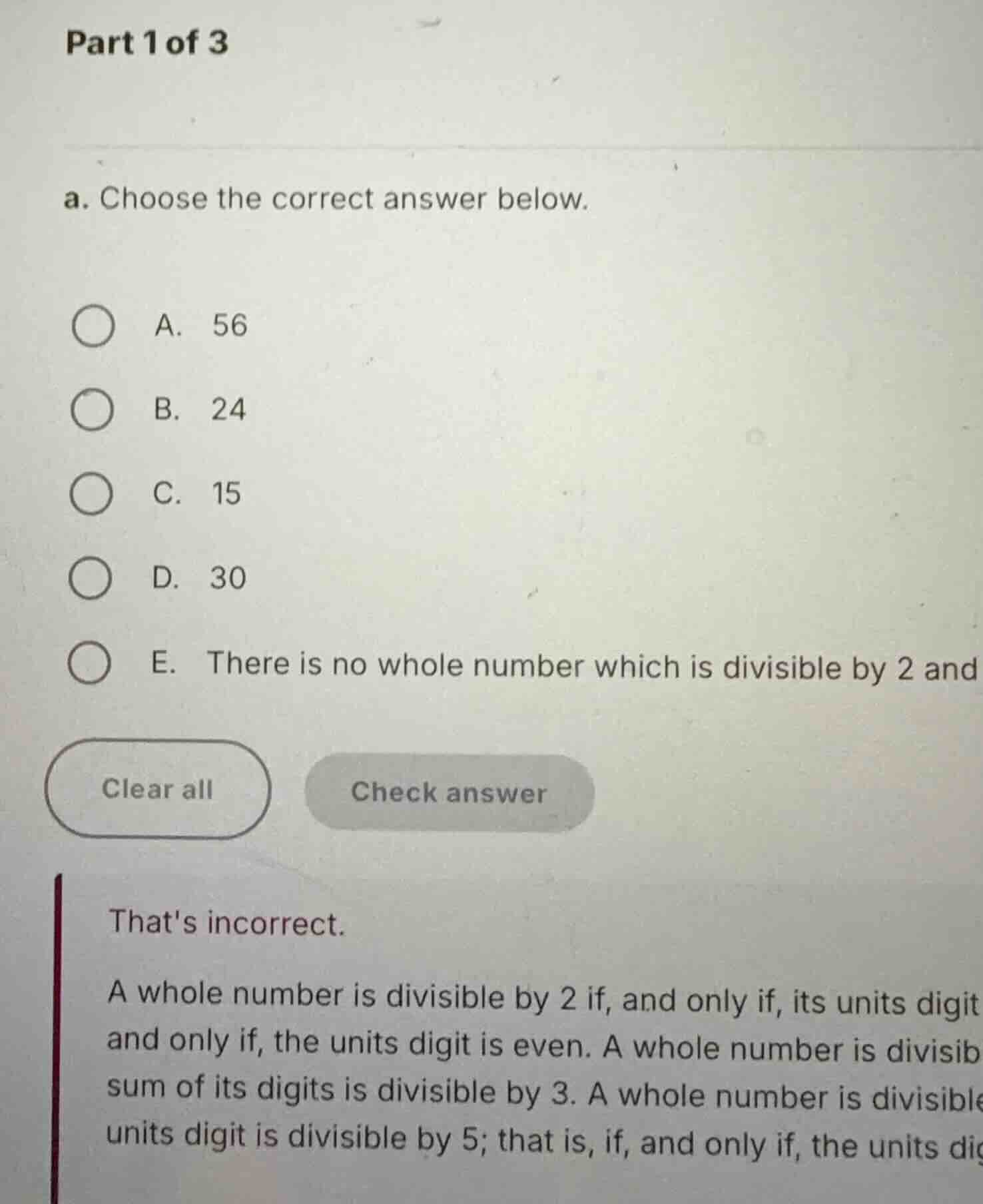
Identify the divisibility conditions
The feedback text at the bottom explains divisibility rules for \(2\), \(3\), and \(5\). It states:
- A whole number is divisible by \(2\) if its units digit is even.
- A whole number is divisible by \(3\) if the sum of its digits is divisible by \(3\).
- A whole number is divisible by \(5\) if its units digit is \(0\) or \(5\).
The cut-off text in option E mentions "divisible by 2 and [3 and 5]". We seek a number divisible by \(2\), \(3\), and \(5\).
Find the least common multiple
To be divisible by \(2\), \(3\), and \(5\), a number must be a multiple of their least common multiple (LCM).
Since \(2\), \(3\), and \(5\) are prime numbers:
$$
\text{LCM}(2, 3, 5) = 2 \times 3 \times 5 = 30
$$
Test the given options
We evaluate each option to see which is a multiple of \(30\):
- For A: \(56\) is not divisible by \(5\) or \(3\).
- For B: \(24\) is not divisible by \(5\).
- For C: \(15\) is not divisible by \(2\).
- For D: \(30\) is divisible by \(2\), \(3\), and \(5\).
Formulate the final selection
Option D (\(30\)) is the only number that satisfies all three divisibility criteria.

Snap & solve any problem in the app
Get step-by-step solutions on Sovi AI
Photo-based solutions with guided steps
Explore more problems and detailed explanations
- A. 56
- B. 24
- C. 15
- D. 30 (Correct answer)
- E. There is no whole number which is divisible by 2 and 3 and 5