QUESTION IMAGE
Question
Question was provided via image upload.
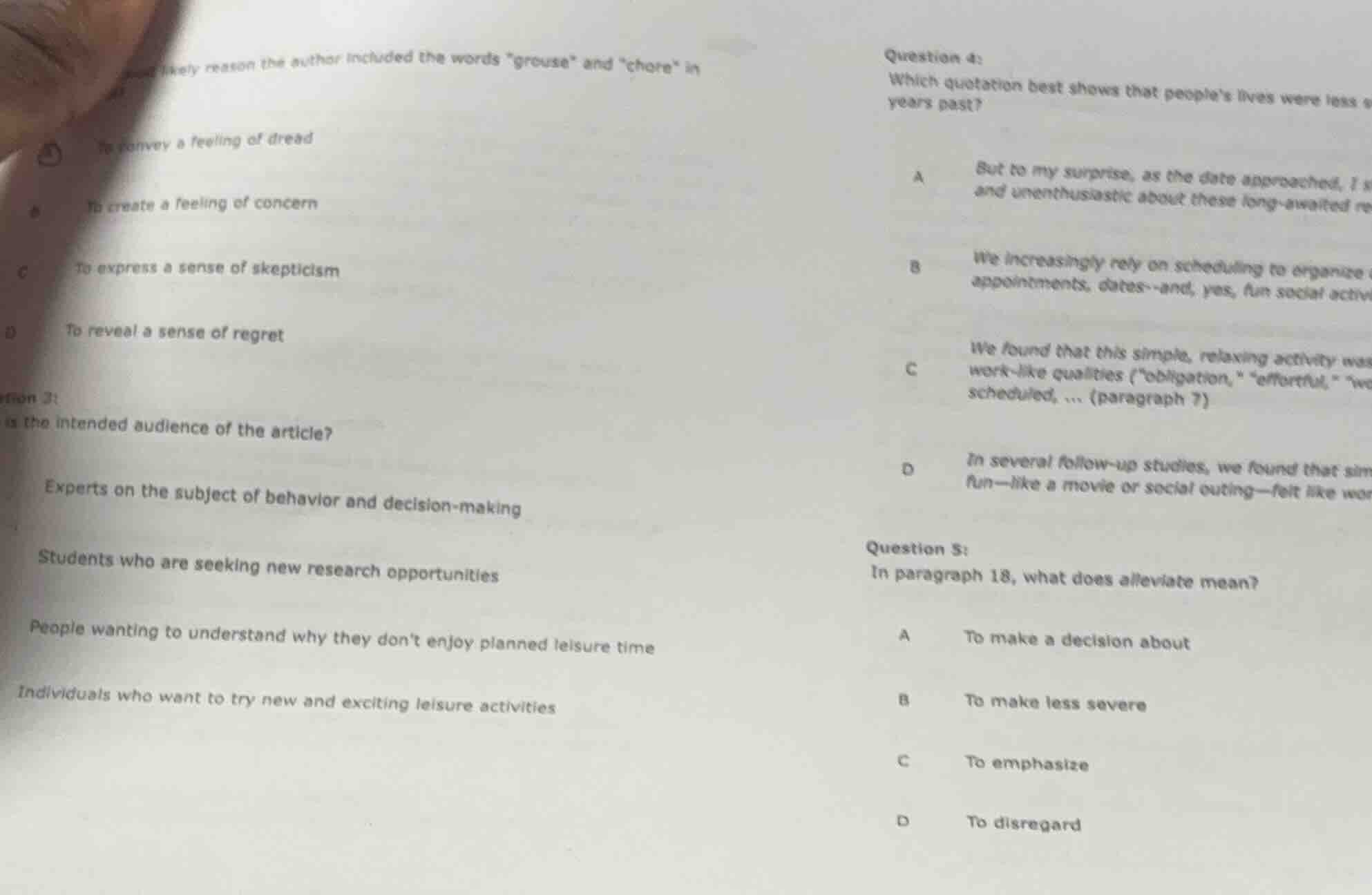
Analyze the vocabulary question on "grouse" and "chore"
The first visible question asks for the likely reason the author included the words "grouse" and "chore". These words carry negative connotations related to complaining and tedious tasks. Using Contextual Vocabulary and Main Purpose Analysis, we evaluate the options:
- (A) To convey a feeling of dread: "Dread" is too strong for daily complaints or routine tasks.
- (B) To create a feeling of concern: "Concern" suggests worry about a serious issue, which does not fit.
- (C) To express a sense of skepticism: "Skepticism" relates to doubt, not complaining.
- (D) To reveal a sense of regret: "Regret" is about wishing something had not happened.
Looking closely at the options, "dread" (A) or "concern" (B) are often used in standardized tests to describe negative reactions to scheduled tasks. Given the context of scheduled leisure feeling like a "chore" that people "grouse" (complain) about, it conveys a feeling of dread or reluctance toward these activities. Option A is the most fitting choice for expressing this negative anticipation.
Determine the intended audience of the article
The next question asks for the intended audience of the article. The options describe:
- Experts on behavior and decision-making.
- Students seeking research opportunities.
- People wanting to understand why they don't enjoy planned leisure time.
- Individuals who want to try new and exciting leisure activities.
The passage discusses how scheduling leisure activities makes them feel like work ("obligation," "effortful"). Therefore, the article is aimed at general readers, specifically People wanting to understand why they don't enjoy planned leisure time.
Identify the best quotation for past scheduling habits
Question 4 asks which quotation best shows that people's lives were less scheduled in years past. Let's evaluate the visible options:
- (A) "But to my surprise, as the date approached, I started to feel reluctant and unenthusiastic..." (Focuses on personal feelings about an upcoming event).
- (B) "We increasingly rely on scheduling to organize our lives—not just for appointments, dates—and, yes, fun social activities..." (The word "increasingly" directly contrasts current heavy scheduling with less scheduled past habits).
- (C) "We found that this simple, relaxing activity was perceived as having more work-like qualities..." (Focuses on the perception of scheduled activities).
- (D) "In several follow-up studies, we found that simply scheduling a fun—like a movie or social outing—felt like work..." (Focuses on study findings).
Using Textual Evidence, Option B is the only quote that indicates a change over time ("increasingly rely"), showing that lives were less scheduled in the past.
Define the word "alleviate" in context
Question 5 asks for the meaning of "alleviate" in paragraph 18.
Using Contextual Vocabulary, "alleviate" means to make a problem, pain, or severe situation less intense or more bearable.
- (A) To make a decision about
- (B) To make less severe
- (…

Snap & solve any problem in the app
Get step-by-step solutions on Sovi AI
Photo-based solutions with guided steps
Explore more problems and detailed explanations
Question 1
- (A) To convey a feeling of dread (Correct answer)
- (B) To create a feeling of concern
- (C) To express a sense of skepticism
- (D) To reveal a sense of regret
Question 2
- (A) Experts on the subject of behavior and decision-making
- (B) Students who are seeking new research opportunities
- (C) People wanting to understand why they don't enjoy planned leisure time (Correct answer)
- (D) Individuals who want to try new and exciting leisure activities
Question 4
- (A) "But to my surprise, as the date approached, I started to feel reluctant and unenthusiastic about these long-awaited..."
- (B) "We increasingly rely on scheduling to organize our lives—not just for appointments, dates—and, yes, fun social activities..." (Correct answer)
- (C) "We found that this simple, relaxing activity was perceived as having more work-like qualities ("obligation," "effortful," "work")..."
- (D) "In several follow-up studies, we found that simply scheduling a fun—like a movie or social outing—felt like work..."
Question 5
- (A) To make a decision about
- (B) To make less severe (Correct answer)
- (C) To emphasize
- (D) To disregard