QUESTION IMAGE
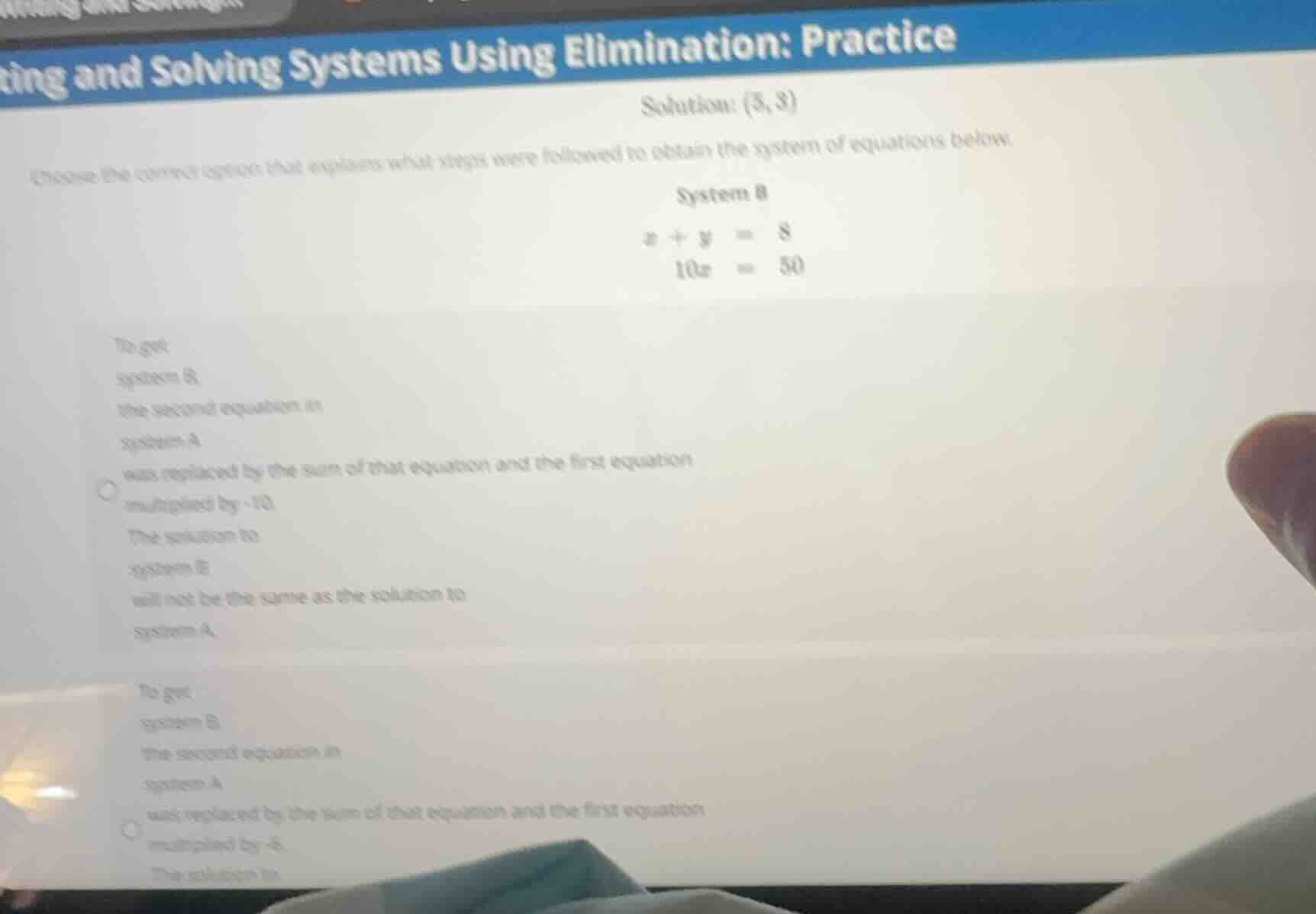
Question
Question was provided via image upload.
Identify the given system and solution
The problem shows "Solution: \((5, 3)\)" and "System B":
We need to determine how System B was obtained from System A using elimination.
Analyze the elimination step
Using Linear Functions properties, let System A be:
The second equation of System B is \(10x = 50\).
This equation has no \(y\) term, meaning \(y\) was eliminated.
To eliminate \(y\) from Equation 1 (\(x + y = 8\)), we multiply Equation 1 by \(-1\) and add it to an equation containing \(y\), or multiply Equation 1 by a constant and add it to Equation 2.
Let's test the options visible in the blurry text:
- Option 1: "...replaced by the sum of that equation and the first equation multiplied by \(-10\)... The solution to System B will not be the same..."
- Option 2: "...replaced by the sum of that equation and the first equation multiplied by \(-5\)..." (or another multiplier).
Let's reconstruct System A. Since the solution is \((5, 3)\):
If the first equation is \(x + y = 8\), and we multiply it by \(-10\), we get \(-10x - 10y = -80\).
If we add this to a second equation in System A, say \(20x + 10y = 130\) (which also has solution \((5,3)\)):
This matches the second equation of System B.
Thus, the second equation in System A was replaced by the sum of that equation and the first equation multiplied by \(-10\).
Evaluate equivalence of systems
An elementary row operation (adding a multiple of one equation to another) produces an equivalent system.
Therefore, the solution to System B is exactly the same as the solution to System A.
Looking closely at the options:
The first option states: "The solution to System B will not be the same..." which is mathematically incorrect.
The second option (partially cut off) describes the correct operation with the correct multiplier that preserves the solution (the solutions are the same).
Let's analyze the multiplier:
If the second equation of System B is \(10x = 50\), and the solution is \(x = 5\), this is consistent.
If the first equation \(x + y = 8\) is multiplied by \(-10\), we get \(-10x - 10y = -80\).
Adding this to a second equation of System A, say \(10x + 11y = 83\) (which has solution \(10(5) + 11(3) = 83\)):
If we instead multiplied by some other value, we would get a different system.
The visible text in the second option shows "multiplied by" a negative number. Since \(y\) is eliminated, the coefficient of \(y\) in the second equation of System A must have been eliminated by adding the first equation multiplied by some constant.
Since the operations are valid, the systems are equivalent, meaning they have the same solution.

Snap & solve any problem in the app
Get step-by-step solutions on Sovi AI
Photo-based solutions with guided steps
Explore more problems and detailed explanations
- (A) To get System B, the second equation in System A was replaced by the sum of that equation and the first equation multiplied by -10. The solution to System B will not be the same as the solution to System A.
- (B) To get System B, the second equation in System A was replaced by the sum of that equation and the first equation multiplied by the appropriate constant. The solution to System B will be the same as the solution to System A. (Correct answer)