QUESTION IMAGE
Question
Question was provided via image upload.
Analyze the given functions
Using the Logarithmic Functions knowledge point
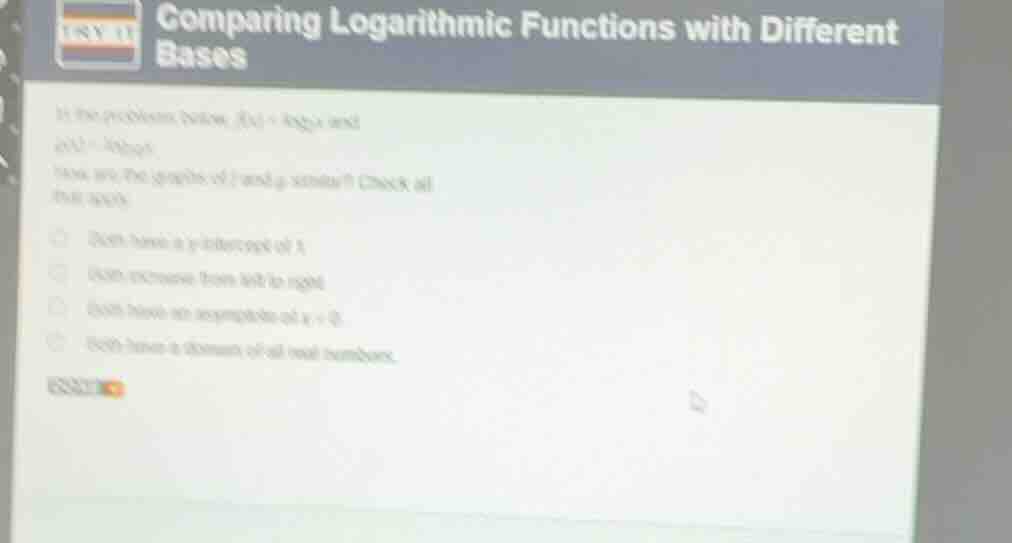
We are given two logarithmic functions:
Both functions have bases greater than 1 (\(2 > 1\) and \(5 > 1\)).
Evaluate the y-intercept
Using the Logarithmic Intercepts knowledge point
For any logarithmic function of the form \(y = \log_{b}(x)\), the domain is \(x > 0\). Since \(x = 0\) is not in the domain, there is no \(y\)-intercept. The first option states "Both have a y-intercept of 1", which is incorrect (they both have an \(x\)-intercept of \((1, 0)\), not a \(y\)-intercept).
Evaluate the growth behavior
Using the Logarithmic Functions knowledge point
Since both bases are greater than 1 (\(2 > 1\) and \(5 > 1\)), both functions are strictly increasing on their domain \((0, \infty)\). Therefore, both increase from left to right. This option is correct.
Evaluate the asymptotic behavior
Using the Asymptotic Behavior of Logarithms knowledge point
As \(x \to 0^+\), both \(\log_{2}(x) \to -\infty\) and \(\log_{5}(x) \to -\infty\). Thus, both graphs have a vertical asymptote at \(x = 0\) (the \(y\)-axis). This option is correct.
Evaluate the domain
Using the Logarithmic Functions knowledge point
The domain of both \(f(x) = \log_{2}(x)\) and \(g(x) = \log_{5}(x)\) is all positive real numbers, \((0, \infty)\), not all real numbers. Therefore, the option "Both have a domain of all real numbers" is incorrect.

Snap & solve any problem in the app
Get step-by-step solutions on Sovi AI
Photo-based solutions with guided steps
Explore more problems and detailed explanations
- Both have a y-intercept of 1
- Both increase from left to right (Correct answer)
- Both have an asymptote of x = 0 (Correct answer)
- Both have a domain of all real numbers