QUESTION IMAGE
Question
Question was provided via image upload.
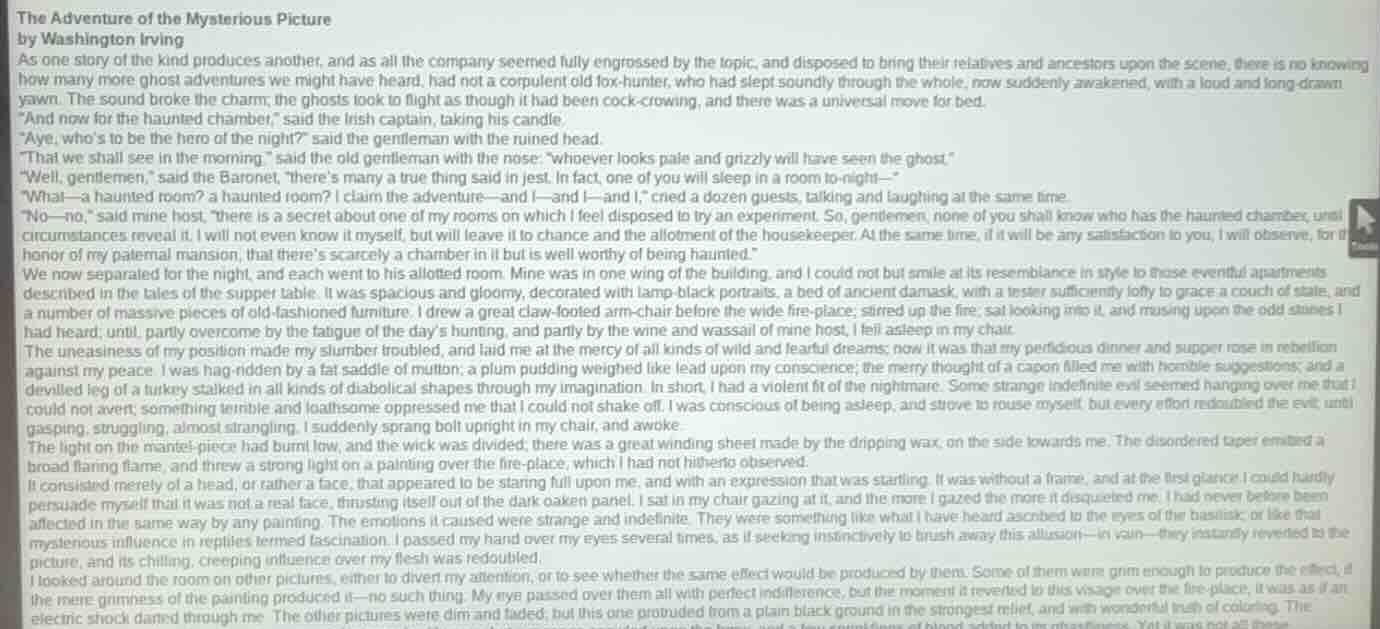
Analyze the narrative context
The text is an excerpt from "The Adventure of the Mysterious Picture" by Washington Irving. It describes a group of guests discussing ghost stories before retiring to bed. The host decides to conduct an experiment by keeping the identity of the "haunted chamber" a secret, leaving the room assignment to chance and the housekeeper.
Examine the narrator's experience
The narrator retires to his spacious, gloomy room, falls asleep in his chair, and experiences troubled, nightmare-filled sleep. Upon waking, he notices a painting over the fireplace that he had not previously observed.
Analyze the painting's effect
The painting consists of a startlingly realistic face staring at the narrator. The narrator describes its effect as deeply disquieting, comparing it to the gaze of a basilisk or the mysterious fascination of reptiles. Even when looking at other grim pictures in the room, they produce no such effect; only this specific painting causes a physical sensation like an "electric shock" and a "chilling, creeping influence."
Synthesize the central theme
The passage explores the psychological tension between reality and imagination, a classic element of Gothic literature. The mysterious painting serves as the focal point of the narrator's dread, illustrating how art and atmosphere can powerfully affect human perception and evoke fear.

Snap & solve any problem in the app
Get step-by-step solutions on Sovi AI
Photo-based solutions with guided steps
Explore more problems and detailed explanations
Based on the provided text from Washington Irving's "The Adventure of the Mysterious Picture," the passage establishes a classic Gothic atmosphere. After a evening of sharing ghost stories, the host decides to assign the guests to their rooms blindly to see who will experience the "haunted chamber."
The narrator is assigned a gloomy, antique room where he falls asleep and has vivid nightmares. Upon waking, he discovers a remarkably realistic and unsettling portrait of a face staring at him from above the fireplace. The painting exerts a powerful, hypnotic, and terrifying influence over him—which he compares to the gaze of a basilisk—distinguishing itself from all other ordinary, grim pictures in the room by provoking a physical sensation of dread and an "electric shock" of fear.