QUESTION IMAGE
Question
Question was provided via image upload.
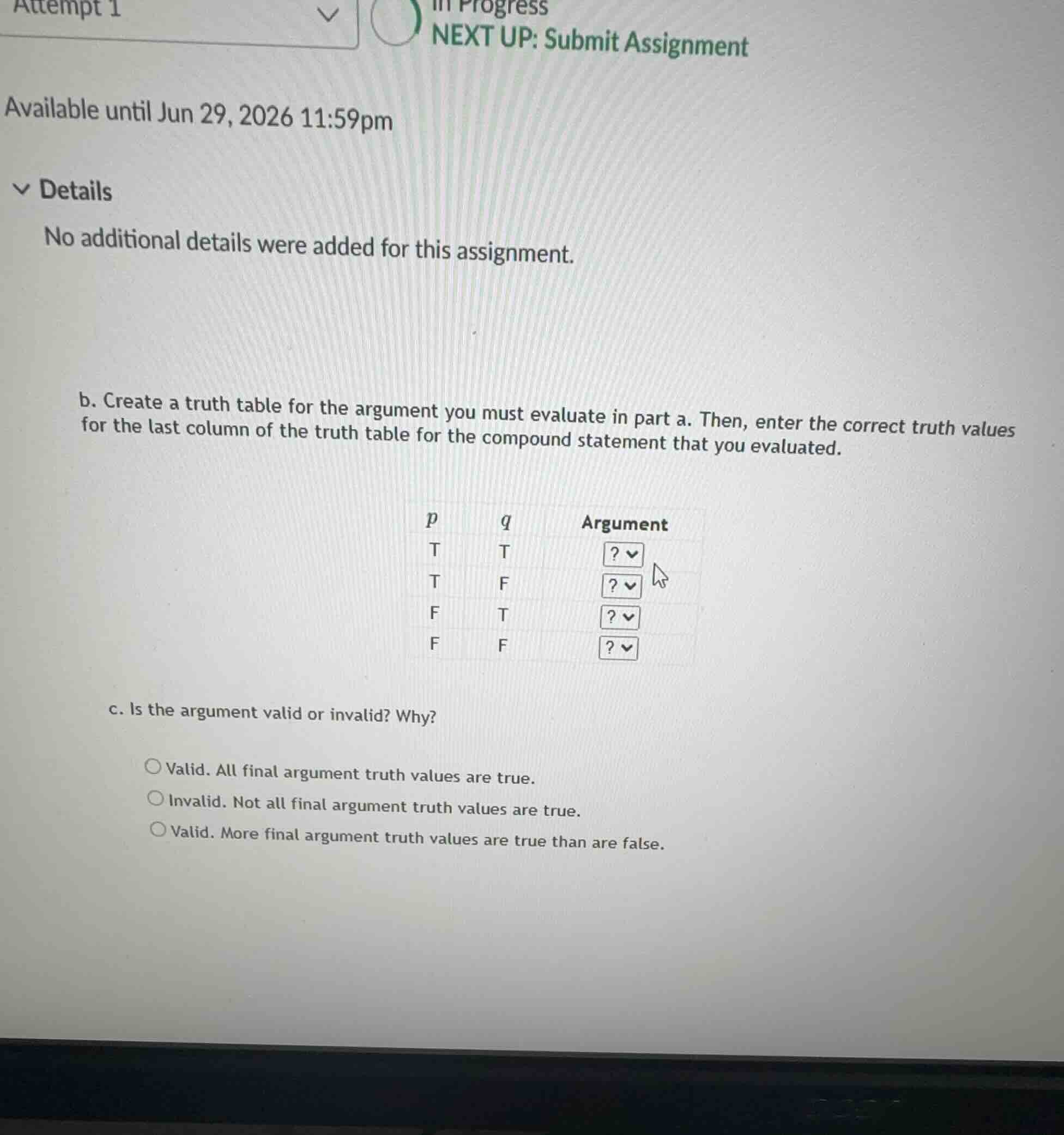
Analyze the relationship between part b and part c
The options in part c state:
- "Valid. All final argument truth values are true."
- "Invalid. Not all final argument truth values are true."
- "Valid. More final argument truth values are true than are false."
An argument is logically valid if and only if its corresponding conditional statement (the conjunction of the premises implying the conclusion) is a tautology (all truth values are True). If any truth value in the final column is False, the argument is invalid.
The second option in part c, "Invalid. Not all final argument truth values are true," is the correct definition for an invalid argument. This implies that the truth table in part b must contain at least one "F" (False) value, making the argument invalid.
Determine the truth values for part b and part c
Since part a is missing from the image, we cannot directly compute the truth values of the specific argument. However, the logical connection between the truth table's final column and the validity of the argument is universal:
- If the argument is valid, all final truth values must be T.
- If the argument is invalid, not all final truth values are T (at least one is F).
The standard multiple-choice option for an invalid argument is "Invalid. Not all final argument truth values are true." Therefore, the argument is invalid, and the final column of the truth table in part b contains at least one "F".
Without the specific symbolic argument from part a, we provide the general conditional relationship:
- If the argument from part a evaluates to all \(T\)'s:
- Part b: \(T, T, T, T\)
- Part c: "Valid. All final argument truth values are true."
- If the argument from part a evaluates to at least one \(F\):
- Part b: Contains at least one \(F\)
- Part c: "Invalid. Not all final argument truth values are true."

Snap & solve any problem in the app
Get step-by-step solutions on Sovi AI
Photo-based solutions with guided steps
Explore more problems and detailed explanations
Question b
Because part a of the problem is not visible in the image, the exact compound statement cannot be evaluated. The truth values for the "Argument" column depend on the specific symbolic argument from part a:
- If the argument is a tautology:
| \(p\) | \(q\) | Argument |
|---|---|---|
| T | F | T |
| F | T | T |
| F | F | T |
- If the argument is not a tautology (contains at least one False value):
The column will contain at least one F.
Question c
The correct choice depends on the final column of the truth table in part b:
- If all values in the "Argument" column are T:
- Valid. All final argument truth values are true. (Correct answer)
- If any value in the "Argument" column is F:
- Invalid. Not all final argument truth values are true. (Correct answer)