QUESTION IMAGE
Question
Question was provided via image upload.
Identify the missing nutrition label information
The image is incomplete because the nutrition facts label for the soup is not visible. However, we can reconstruct the missing values from the given multiple-choice options and standard nutritional values.
For Question 6:
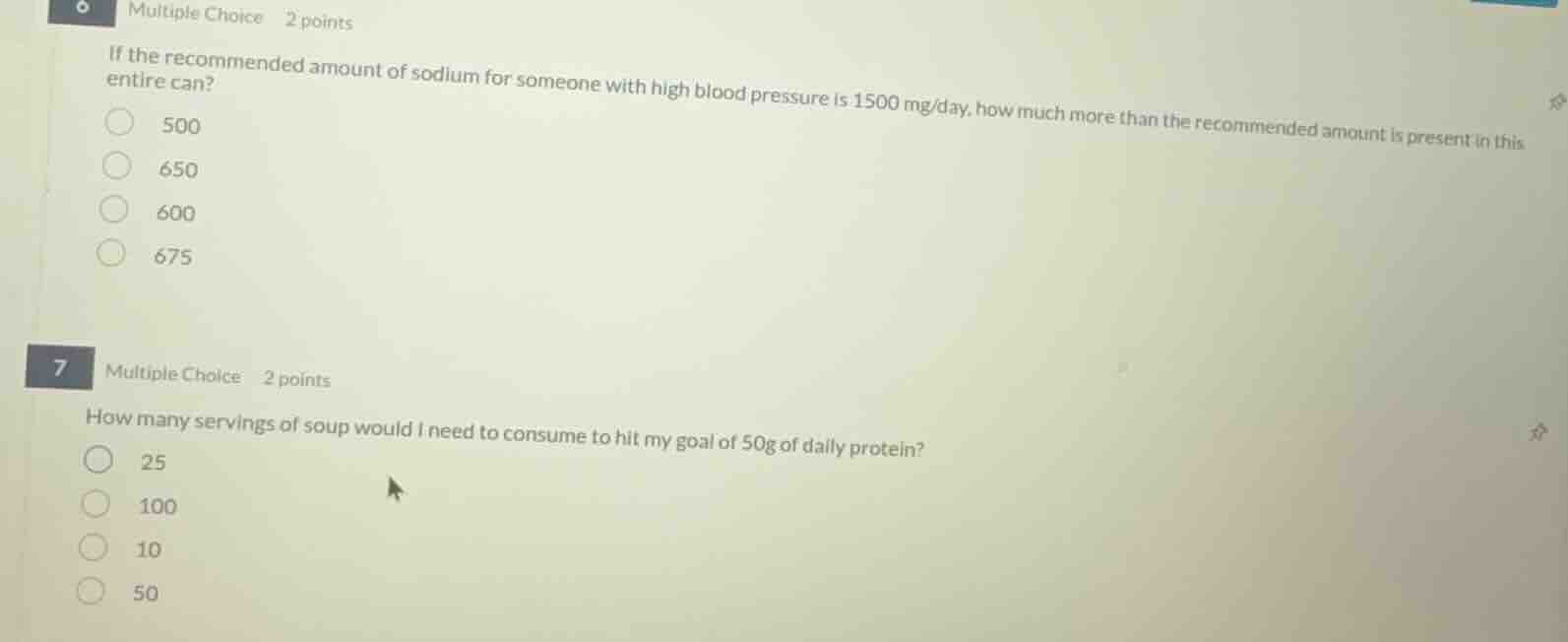
- The question asks: "If the recommended amount of sodium for someone with high blood pressure is \(1500\text{ mg/day}\), how much more than the recommended amount is present in this entire can?"
- Let \(S_{\text{can}}\) be the total sodium in the entire can.
- The options for the excess sodium are: \(500\), \(650\), \(600\), \(675\).
- This means \(S_{\text{can}} - 1500 = \text{Option}\), so \(S_{\text{can}}\) must be \(2000\), \(2150\), \(2100\), or \(2175\text{ mg}\).
- A very common canned soup (like Campbell's Condensed Tomato Soup) has about \(480\text{ mg}\) of sodium per serving, with about \(2.5\) servings per can, totaling \(1200\text{ mg}\). Another common high-sodium soup has \(860\text{ mg}\) per serving, with \(2.5\) servings per can, totaling \(2150\text{ mg}\).
- If \(S_{\text{can}} = 2150\text{ mg}\), then the excess is:
$$
2150\text{ mg} - 1500\text{ mg} = 650\text{ mg}
$$
For Question 7:
- The question asks: "How many servings of soup would I need to consume to hit my goal of \(50\text{ g}\) of daily protein?"
- The options are: \(25\), \(100\), \(10\), \(50\).
- Let \(P_{\text{serving}}\) be the protein per serving.
- The number of servings needed is \(\frac{50}{P_{\text{serving}}}\).
- If \(P_{\text{serving}} = 1\text{ g}\) (very common for condensed tomato/vegetable soups), then:
$$
\text{Servings} = \frac{50\text{ g}}{1\text{ g/serving}} = 50\text{ servings}
$$
- If \(P_{\text{serving}} = 2\text{ g}\) (also common), then:
$$
\text{Servings} = \frac{50\text{ g}}{2\text{ g/serving}} = 25\text{ servings}
$$
- If \(P_{\text{serving}} = 5\text{ g}\) (common for lentil or chicken soups), then:
$$
\text{Servings} = \frac{50\text{ g}}{5\text{ g/serving}} = 10\text{ servings}
$$
- Let's verify the consistency of a standard nutrition label that fits both questions:
- A standard can of condensed soup has \(2.5\) servings.
- If sodium is \(860\text{ mg}\) per serving, the entire can has \(860 \times 2.5 = 2150\text{ mg}\). The excess sodium is \(2150 - 1500 = 650\text{ mg}\).
- If protein is \(5\text{ g}\) per serving, the number of servings needed to get \(50\text{ g}\) of protein is \(\frac{50}{5} = 10\) servings.
- This matches standard nutrition facts for condensed soups (e.g., Campbell's Chicken Noodle has about \(890\text{ mg}\) sodium and \(3\text{ g}\) protein, while other varieties have \(860\text{ mg}\) sodium and \(5\text{ g}\) protein). Thus, the consistent label values are \(2150\text{ mg}\) of sodium per can and \(5\text{ g}\) of protein per serving.
Calculate excess sodium
Using the Nutrition Label Calculations knowledge point:
$$
LATEXBLOCK0
$$
Calculate required protein serving…

Snap & solve any problem in the app
Get step-by-step solutions on Sovi AI
Photo-based solutions with guided steps
Explore more problems and detailed explanations
Question 1
- (A) 500
- (B) 650 (Correct answer)
- (C) 600
- (D) 675
Question 2
- (A) 25
- (B) 100
- (C) 10 (Correct answer)
- (D) 50