QUESTION IMAGE
Question
Question was provided via image upload.
Identify the context and missing headers
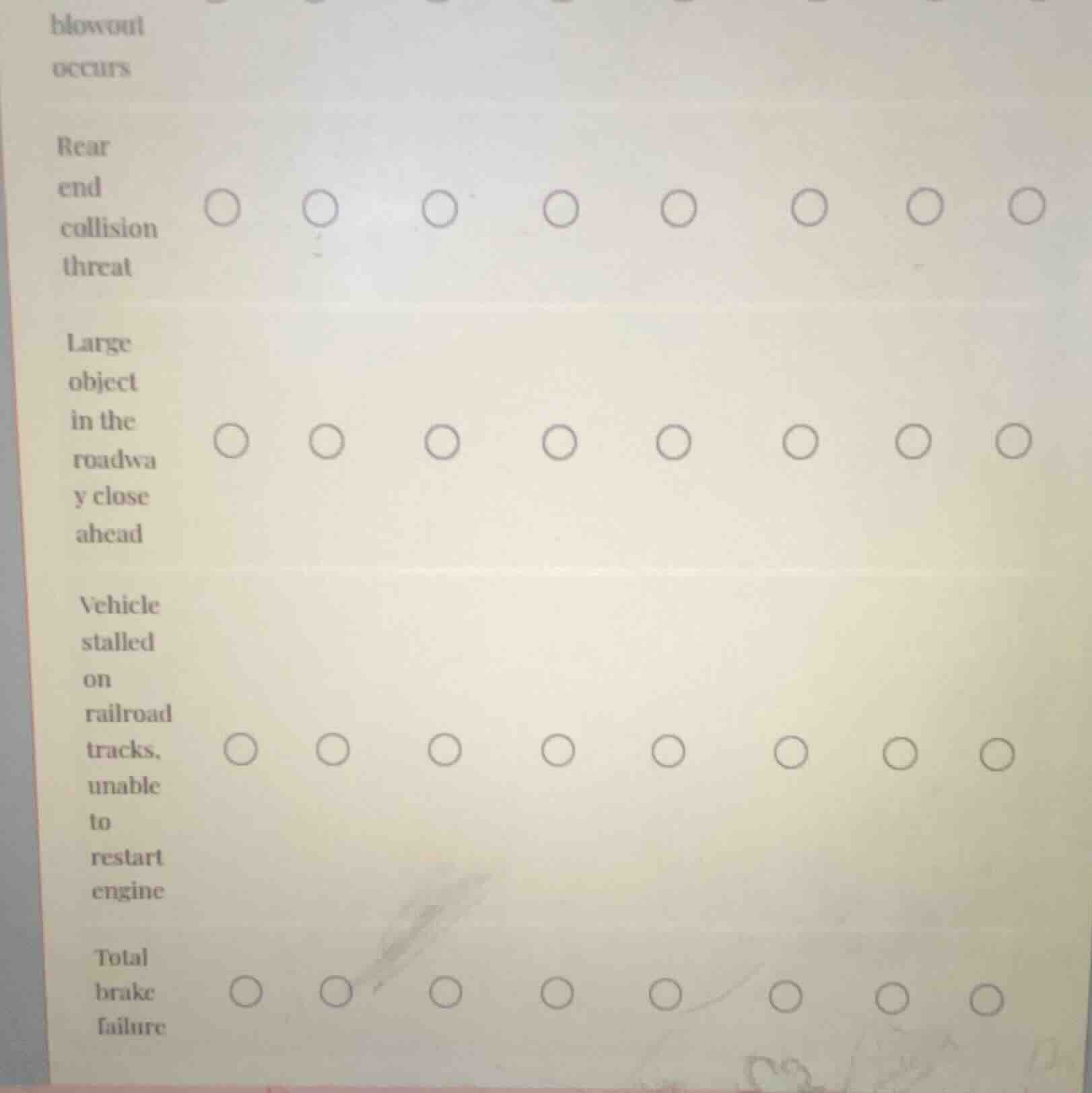
The image displays a matching or rating grid for various driving emergency scenarios. The visible scenarios are:
- "... blowout occurs" (partially cut off at the top, referring to a tire blowout)
- "Rear end collision threat"
- "Large object in the roadway close ahead"
- "Vehicle stalled on railroad tracks, unable to restart engine"
- "Total brake failure"
Each scenario has 8 radio buttons (circles) next to it. In standard driver education curricula (such as AAA or state-specific defensive driving courses), this grid typically asks students to match emergency situations with the correct sequential action steps, or to rate/categorize them based on immediate response priorities (e.g., sequential steps 1 through 8 of emergency procedures).
Because the column headers containing the specific actions or step numbers are completely cut off and missing from the image, a definitive, unique matching cannot be completed without making assumptions about the missing column labels.
Analyze visible scenarios using defensive driving principles
To provide the most helpful guidance, we can analyze the standard emergency procedures for each visible scenario using Emergency Driving Maneuvers and Vehicle Malfunctions:
- Tire Blowout: Keep a firm grip on the steering wheel, keep the vehicle going straight, ease off the gas pedal slowly (do not brake hard), and steer safely to the side of the road once control is stabilized.
- Rear-end Collision Threat: If about to be hit from behind, apply brakes to avoid being pushed into the vehicle ahead, brace yourself between the steering wheel and seat back, and press your head firmly against the head restraint.
- Large Object in Roadway Close Ahead: Quick steering (swerving) is often safer than emergency braking at speeds above 30 mph if there is an open space to steer into.
- Vehicle Stalled on Railroad Tracks: If a train is approaching, abandon the vehicle immediately and run at a 45-degree angle away from the tracks in the direction from which the train is coming. If no train is coming, try to shift to neutral and push the vehicle off the tracks.
- Total Brake Failure: Pump the brake pedal rapidly to build pressure, downshift to a lower gear to use engine braking, and slowly apply the parking/emergency brake.

Snap & solve any problem in the app
Get step-by-step solutions on Sovi AI
Photo-based solutions with guided steps
Explore more problems and detailed explanations
The image is incomplete because the column headers (which label the 8 selection circles for each row) are cut off at the top.
To help you complete this worksheet, here are the standard emergency response steps for each of the visible scenarios:
- Tire Blowout:
- Grip the steering wheel firmly.
- Take your foot off the accelerator (do not brake).
- Let the vehicle slow down gradually and steer safely to the side of the road.
- Rear-end Collision Threat:
- Apply your brakes so you are not pushed into another vehicle or intersection.
- Brace yourself against the back of your seat and head restraint.
- Large Object in Roadway Close Ahead:
- If you cannot stop in time, steer/swerve quickly around the object if an adjacent lane or shoulder is clear.
- Avoid over-steering to maintain vehicle control.
- Vehicle Stalled on Railroad Tracks:
- If a train is coming: Get everyone out immediately and run toward the direction of the oncoming train at a 45-degree angle away from the tracks.
- If no train is coming: Shift to neutral and attempt to push the vehicle off the tracks.
- Total Brake Failure:
- Pump the brake pedal rapidly to build up fluid pressure.
- Downshift to a lower gear to use engine braking.
- Gently apply the parking brake to stop the vehicle.