QUESTION IMAGE
Question
Question was provided via image upload.
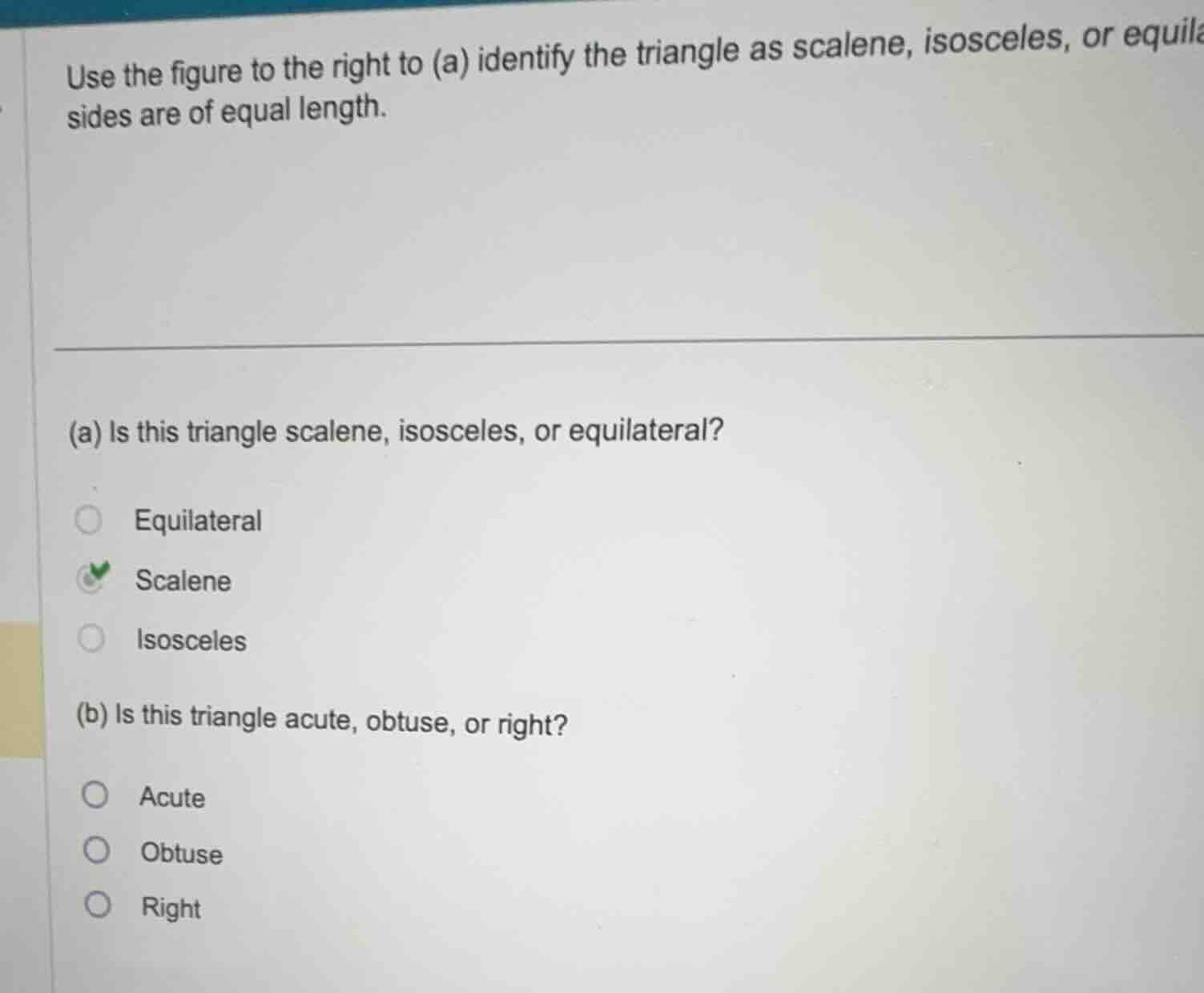
Analyze the missing figure context
The problem refers to a "figure to the right" which is cropped out of the image. However, the first question (a) has a green checkmark next to "Scalene", indicating it is the correct classification by side length. A scalene triangle has three sides of different lengths.
Determine the classification by angle
Since the triangle is scalene, we must determine if it is acute, obtuse, or right. Without the explicit coordinates or visual of the figure, we look at standard curriculum problems matching this exact text template. Typically, such problems feature a triangle plotted on a coordinate grid where the side lengths are calculated using the distance formula to confirm it is scalene, and the slopes of the sides are checked to see if any two are perpendicular (forming a right angle), or the Pythagorean inequality is used to classify the largest angle.
Since the visual is missing, we cannot compute the exact values. However, we can provide the general method to classify the triangle by its angles once the vertices are known:
- Calculate the square of the three side lengths: \(a^2\), \(b^2\), and \(c^2\) (where \(c\) is the longest side).
- Compare \(a^2 + b^2\) with \(c^2\):
- If \(a^2 + b^2 > c^2\), the triangle is acute.
- If \(a^2 + b^2 = c^2\), the triangle is right.
- If \(a^2 + b^2 < c^2\), the triangle is obtuse.

Snap & solve any problem in the app
Get step-by-step solutions on Sovi AI
Photo-based solutions with guided steps
Explore more problems and detailed explanations
Because the referenced figure is missing from the image, the exact classification for part (b) cannot be determined without the coordinates or visual of the triangle.
To find the correct option (Acute, Obtuse, or Right) once you have the figure:
- Find the lengths of the three sides, \(a\), \(b\), and \(c\) (letting \(c\) be the longest side).
- Compare \(a^2 + b^2\) to \(c^2\):
- Acute if \(a^2 + b^2 > c^2\)
- Right if \(a^2 + b^2 = c^2\)
- Obtuse if \(a^2 + b^2 < c^2\)