QUESTION IMAGE
Question
Question was provided via image upload.
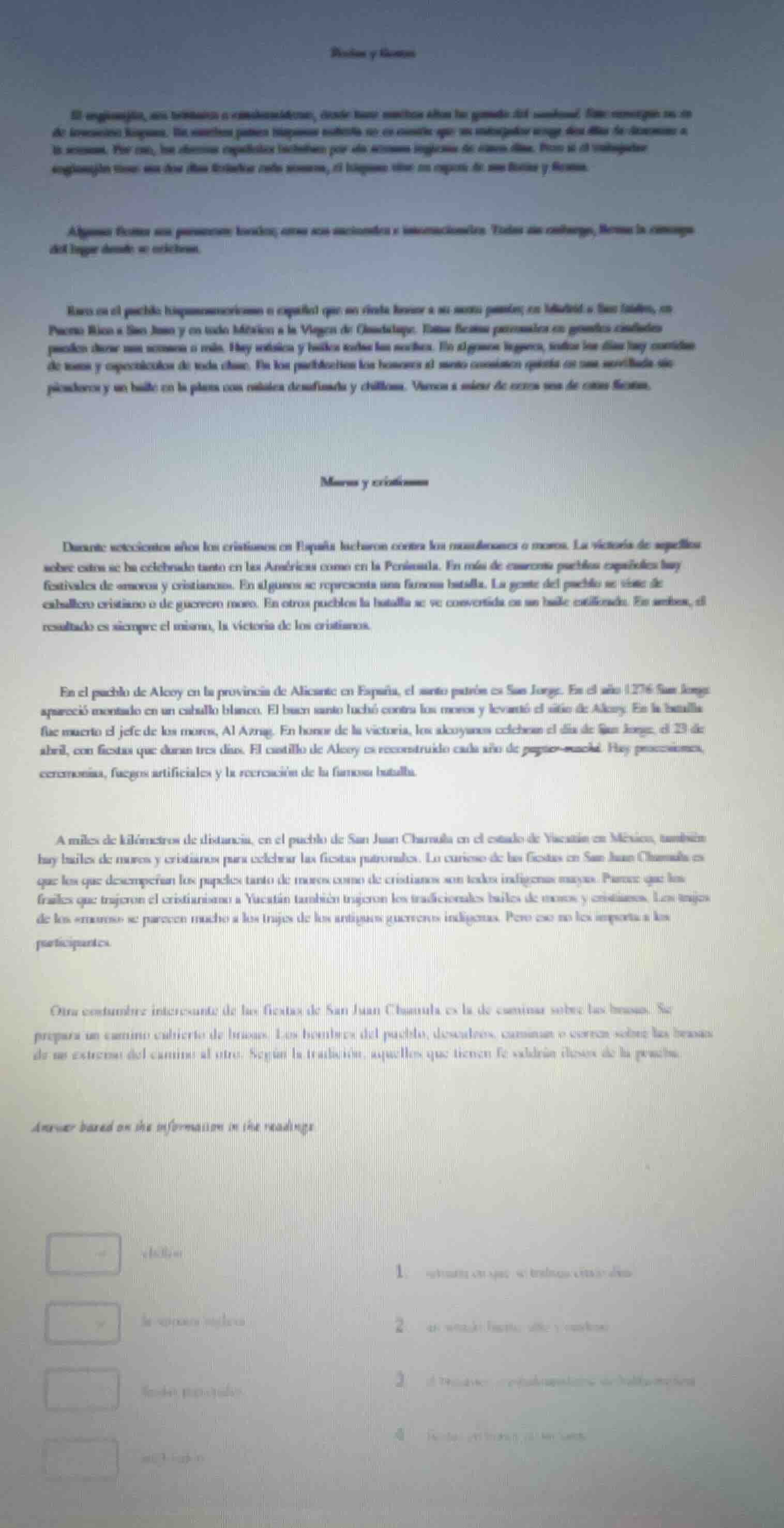
The image contains a Spanish reading passage titled "Fiestas y costumbres" (specifically focusing on "Moros y cristianos") followed by a matching exercise at the bottom.
Let's analyze the text to match the items on the left with the descriptions on the right.
Analyze the reading text
The text discusses several cultural aspects:
- El anglosajón, sea británico o estadounidense...: It mentions that Anglo-Saxons (British or American) have gained the weekend ("el weekend"). In Hispanic countries, workers traditionally had a five-day work week, but if they have two days off, they live in a state of "fiesta y siesta".
- Moros y cristianos: Discusses the historical battles between Christians and Moors in Spain, celebrated in both Spain and the Americas.
- Alcoy: In the town of Alcoy (Alicante, Spain), the patron saint is San Jorge. In 1276, San Jorge appeared on a white horse to fight the Moors. The Moorish leader, Al Azraq, was killed. The festival is celebrated on April 23rd with a papier-mâché castle, processions, and a reenactment of the battle.
- San Juan Chamula: In San Juan Chamula (Chiapas/Yucatán, Mexico), Mayan indigenous people play the roles of both Moors and Christians. They wear costumes resembling ancient indigenous warriors. Another custom here is walking on hot coals ("caminar sobre las brasas").
Match the terms on the left with the descriptions on the right
Let's identify the terms on the left (partially blurry but readable through context):
- First box/term: el "weekend" (or similar, referring to the weekend)
- Second box/term: la semana inglesa (the English week / five-day work week)
- Third box/term: fiestas patronales (patron saint festivals)
- Fourth box/term: el 23 de abril (April 23rd)
Let's identify the descriptions on the right:
- semana en que se trabaja cinco días (week in which one works five days)
- un feriado de dos días, sábado y domingo (a two-day holiday, Saturday and Sunday)
- el 23 de abril / el día en que se celebra la fiesta de San Jorge en Alcoy (the day on which the festival of San Jorge is celebrated in Alcoy)
- fiestas en honor del santo patrón (festivals in honor of the patron saint)
Using Spanish Reading Comprehension and Spanish Reading Analysis:
- el "weekend" matches description 2: un feriado de dos días, sábado y domingo (a two-day holiday, Saturday and Sunday).
- la semana inglesa matches description 1: semana en que se trabaja cinco días (week in which one works five days).
- fiestas patronales matches description 4: fiestas en honor del santo patrón (festivals in honor of the patron saint).
- el 23 de abril matches description 3: el día en que se celebra la fiesta de San Jorge en Alcoy (the day on which the festival of San Jorge is celebrated in Alcoy).
Formulate the final matches
Let's pair each term on the left with its corresponding numbered description on the right:
- el "weekend" $
ightarrow$ 2 (un feriado de dos días, sábado y domingo)
- la semana inglesa $
ightarrow$ 1 (semana en que se trabaja cinco días)
- fiestas patronales $
ightarrow$ 4 (…

Snap & solve any problem in the app
Get step-by-step solutions on Sovi AI
Photo-based solutions with guided steps
Explore more problems and detailed explanations
Based on the reading passage, here are the correct matches between the terms on the left and the descriptions on the right:
Question 1
- el "weekend" matches with 2: un feriado de dos días, sábado y domingo (a two-day holiday, Saturday and Sunday).
Question 2
- la semana inglesa matches with 1: semana en que se trabaja cinco días (a week in which one works five days).
Question 3
- fiestas patronales matches with 4: fiestas en honor del santo patrón (festivals in honor of the patron saint).
Question 4
- el 23 de abril matches with 3: el día en que se celebra la fiesta de San Jorge en Alcoy (the day on which the festival of San Jorge is celebrated in Alcoy).