QUESTION IMAGE
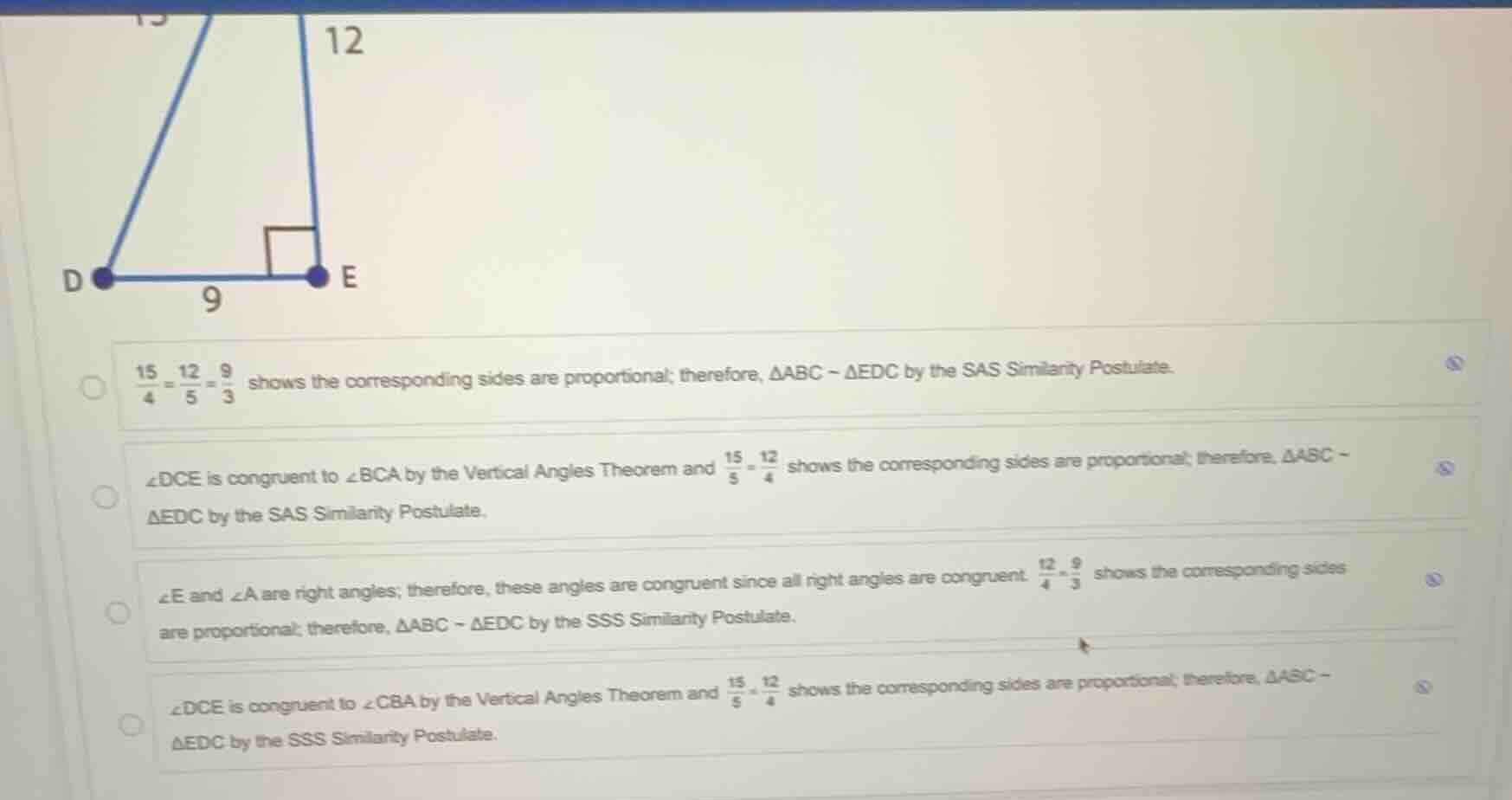
Question
Question was provided via image upload.
Identify given geometric information
We have two triangles sharing a vertex \(C\), forming vertical angles \(\angle DCE\) and \(\angle BCA\). The side lengths given for \(\triangle EDC\) are \(DE = 9\) and \(EC = 12\). By the Pythagorean theorem, the hypotenuse \(DC\) is:
For \(\triangle ABC\), the corresponding side lengths are \(BC = 5\) and \(AC = 4\).
Analyze vertical angles
Using the Geometric Proofs concept, the vertical angles \(\angle DCE\) and \(\angle BCA\) are congruent:
Check side proportionality
Using the Proportional Sides concept, we compare the ratios of the sides forming these congruent angles:
Since \(\frac{15}{5} = \frac{12}{4} = 3\), the corresponding sides are proportional.
Apply similarity postulate
Using the SAS Similarity postulate, since two pairs of corresponding sides are proportional and their included angles are congruent, the triangles are similar:
This matches the second option.

Snap & solve any problem in the app
Get step-by-step solutions on Sovi AI
Photo-based solutions with guided steps
Explore more problems and detailed explanations
- (A) \(\frac{15}{4} = \frac{12}{5} = \frac{9}{3}\) shows the corresponding sides are proportional; therefore, \(\triangle ABC \sim \triangle EDC\) by the SAS Similarity Postulate.
- (B) \(\angle DCE\) is congruent to \(\angle BCA\) by the Vertical Angles Theorem and \(\frac{15}{5} = \frac{12}{4}\) shows the corresponding sides are proportional; therefore, \(\triangle ABC \sim \triangle EDC\) by the SAS Similarity Postulate. (Correct answer)
- (C) \(\angle E\) and \(\angle A\) are right angles; therefore, these angles are congruent since all right angles are congruent. \(\frac{12}{4} = \frac{9}{3}\) shows the corresponding sides are proportional; therefore, \(\triangle ABC \sim \triangle EDC\) by the SSS Similarity Postulate.
- (D) \(\angle DCE\) is congruent to \(\angle CBA\) by the Vertical Angles Theorem and \(\frac{15}{5} = \frac{12}{4}\) shows the corresponding sides are proportional; therefore, \(\triangle ABC \sim \triangle EDC\) by the SSS Similarity Postulate.