QUESTION IMAGE
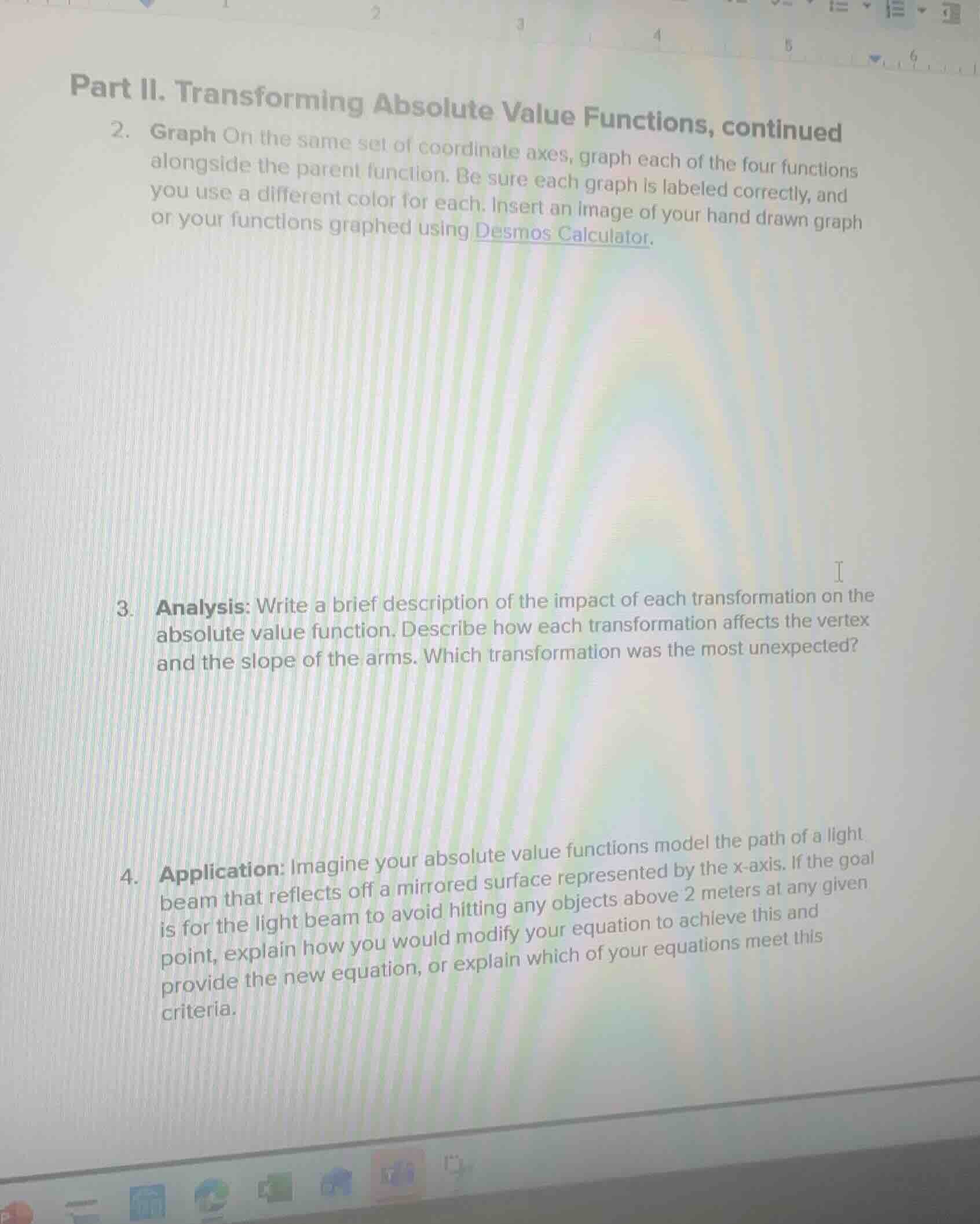
Question
Question was provided via image upload.
Identify the missing context and establish standard functions
Since the specific "four functions" from Part II are not visible in this cropped image, we define standard absolute value transformations to address the prompts:
- Parent function: \(f(x) = |x|\)
- Vertical shift: \(g(x) = |x| + 3\)
- Horizontal shift: \(h(x) = |x - 2|\)
- Reflection and vertical stretch: \(p(x) = -2|x|\)
- Combined transformation: \(q(x) = \frac{1}{2}|x + 1| - 2\)
Analyze the impact of transformations on vertex and slope
- Vertical shift \(|x| + k\): Vertex shifts to \((0, k)\); slope of arms remains \(\pm 1\).
- Horizontal shift \(|x - h|\): Vertex shifts to \((h, 0)\); slope of arms remains \(\pm 1\).
- Vertical stretch/compression \(a|x|\): Vertex remains \((0,0)\); slope of arms becomes \(\pm a\).
- Reflection \(-|x|\): Vertex remains \((0,0)\); graph opens downward (slopes invert).
Solve the application problem for light beam path
- Light beam reflecting off the x-axis: \(y = a|x - h| + k\) with \(k \ge 0\) and \(a > 0\).
- To avoid hitting any objects above \(2\) meters at any given point, the beam must stay entirely below \(2\) meters, or we must restrict the height.
- If the goal is to keep the entire path below \(2\) meters, we can reflect the function downward and shift it vertically: \(y = -|x| + 1.5\). This ensures the maximum height (the vertex) is \(1.5\) meters, which is strictly less than \(2\) meters.

Snap & solve any problem in the app
Get step-by-step solutions on Sovi AI
Photo-based solutions with guided steps
Explore more problems and detailed explanations
Question 2
The visual representation of the parent absolute value function \(f(x) = |x|\) and its transformations is plotted below.
Question 3
- Vertical Shift (\(f(x) + k\)): Shifts the vertex vertically to \((0, k)\). The slope of the arms remains \(\pm 1\).
- Horizontal Shift (\(f(x - h)\)): Shifts the vertex horizontally to \((h, 0)\). The slope of the arms remains \(\pm 1\).
- Vertical Stretch/Compression (\(a \cdot f(x)\)): Keeps the vertex at \((0, 0)\) while changing the slope of the arms to \(\pm a\).
- Reflection (\(-f(x)\)): Flips the graph across the x-axis. The vertex remains \((0, 0)\) and the arms open downward with slopes \(\mp 1\).
Question 4
To ensure the light beam avoids hitting any objects above \(2\) meters at any point, the maximum value of the absolute value function must be strictly less than \(2\).
By reflecting the parent function downward and shifting it vertically upward by less than \(2\) units, we obtain:
The vertex (maximum point) of this path is \((0, 1.5)\), ensuring the entire beam path stays below \(2\) meters.