QUESTION IMAGE
Question
Question was provided via image upload.
Identify the reference material
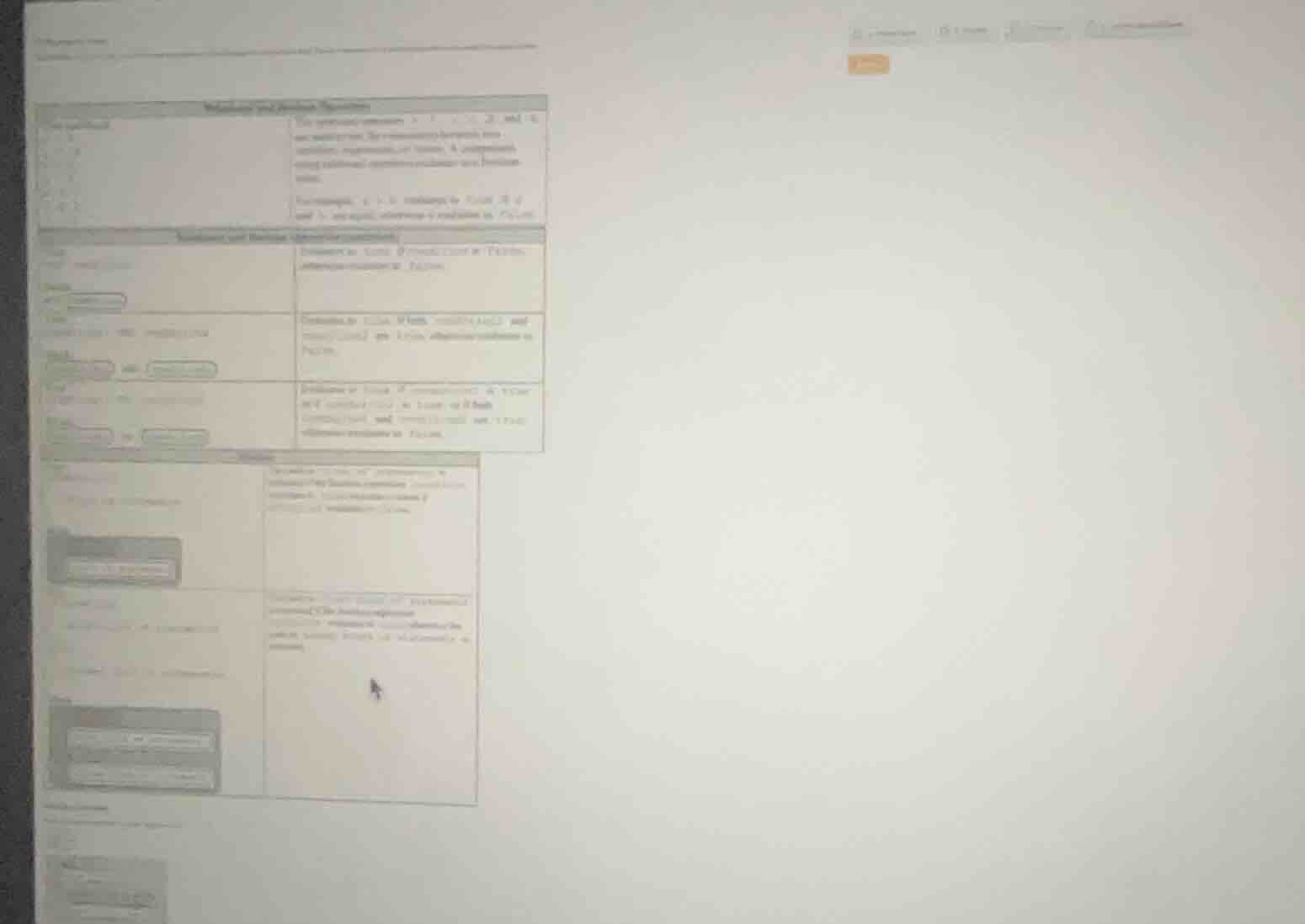
The provided image displays a reference guide for programming concepts, specifically focusing on Relational Operators, Logical Operators, and Conditional Statements (such as if and if-else blocks).
Analyze the Relational Operators section
The top table defines relational operators:
- Operators include \(=\), \(
eq\), \(>\), \(<\), \(\ge\), and \(\le\).
- These operators compare two values, expressions, or variables.
- A comparison using relational operators evaluates to a Boolean Expression (either
trueorfalse). - For example, \(x > y\) evaluates to
trueif \(x\) is greater than \(y\), andfalseotherwise.
Analyze the Logical Operators section
The middle table defines boolean logical operators:
- Logical NOT Operator (
not): Evaluates totrueif the condition isfalse, and vice versa. - Logical Operator
and: Evaluates totrueif both conditions aretrue. If either isfalse, the result isfalse. - Logical Operator
or: Evaluates totrueif at least one condition istrue. It only evaluates tofalseif both conditions arefalse.
Analyze the Conditional Statements section
The bottom section explains control flow using Conditional Statements:
- An
ifstatement executes a block of code only if its boolean condition evaluates totrue. - An
if-elsestatement provides an alternative block of code to execute when the condition evaluates tofalse.

Snap & solve any problem in the app
Get step-by-step solutions on Sovi AI
Photo-based solutions with guided steps
Explore more problems and detailed explanations
This reference sheet outlines the fundamental rules of Boolean logic and control flow in programming:
- Relational Operators: Used to compare values (e.g., equal, not equal, greater than, less than), resulting in a
trueorfalsevalue. - Logical Operators:
NOT: Reverses the Boolean value.AND: Onlytrueif both conditions are met.OR:trueif at least one condition is met.
- Conditional Statements: Use these Boolean results to decide which blocks of code to run (
ifandif-elsestructures).