QUESTION IMAGE
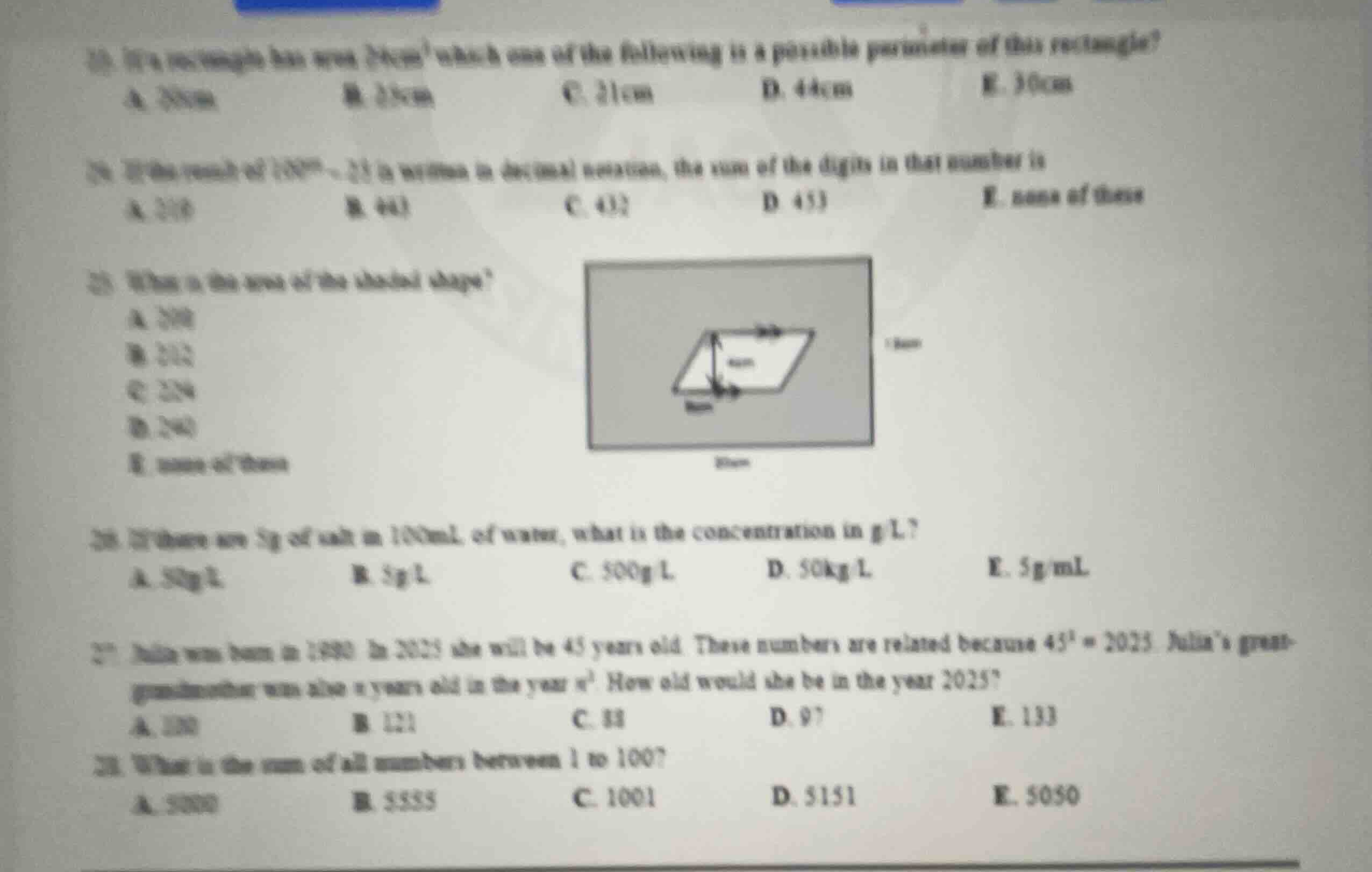
Question
Question was provided via image upload.
Solve Question 23
We need to find a possible perimeter of a rectangle with an area of \(24\text{ cm}^2\).
Let the side lengths of the rectangle be \(a\) and \(b\), where \(a \times b = 24\).
The perimeter is given by \(P = 2(a + b)\).
If \(a\) and \(b\) are integers, the possible factor pairs of \(24\) are:
- \(1 \times 24 \implies P = 2(1 + 24) = 50\text{ cm}\)
- \(2 \times 12 \implies P = 2(2 + 12) = 28\text{ cm}\)
- \(3 \times 8 \implies P = 2(3 + 8) = 22\text{ cm}\)
- \(4 \times 6 \implies P = 2(4 + 6) = 20\text{ cm}\)
Looking at the options:
A. \(20\text{ cm}\)
B. \(23\text{ cm}\)
C. \(21\text{ cm}\)
D. \(44\text{ cm}\)
E. \(30\text{ cm}\)
The value \(20\text{ cm}\) is a possible perimeter.
Solve Question 24
We need to find the sum of the digits of the number \(10^{50} - 23\) when written in decimal notation.
The number \(10^{50}\) is \(1\) followed by \(50\) zeros.
When we subtract \(23\) from \(10^{50}\):
The number of digits is \(50\). The first \(48\) digits are \(9\), and the last two digits are \(7\) and \(7\).
The sum of the digits is:
Let's check the options:
A. \(210\)
B. \(443\)
C. \(432\)
D. \(453\)
E. none of these
Since \(446\) is not listed, the correct option is E.
Solve Question 25
We need to find the area of the shaded shape.
The outer shape is a rectangle with dimensions \(20\text{ cm}\) by \(12\text{ cm}\).
The area of the outer rectangle is:
The inner unshaded shape is a parallelogram with a base of \(8\text{ cm}\) and a height of \(4\text{ cm}\).
The area of the parallelogram is:
The area of the shaded region is:
Looking at the options:
A. \(208\)
B. \(212\)
C. \(224\)
D. \(240\)
E. none of these
The correct option is A.
Solve Question 26
We need to find the concentration in \(\text{g/L}\) if there are \(5\text{ g}\) of salt in \(100\text{ mL}\) of water.
First, convert the volume from milliliters to liters:
Now, calculate the concentration:
Looking at the options:
A. \(50\text{ g/L}\)
B. \(5\text{ g/L}\)
C. \(500\text{ g/L}\)
D. \(50\text{ kg/L}\)
E. \(5\text{ g/mL}\)
The correct option is A.
Solve Question 27
Julia was born in \(1980\). In \(2025\) she will be \(45\) years old because \(45^2 = 2025\).
Julia's great-grandmother was \(x\) years old in the year \(x^2\).
For a person to be alive in a reasonable historical timeframe relative to \(1980\), we look for a perfect square \(x^2\) representing a year in the 19th or 20th century.
Let's test values for \(x\):
- If \(x = 43\), \(x^2 = 1849\). Born in \(1849 - 43 = 1806\).
- If \(x = 44\), \(x^2 = 1936\). Born in \(1936 - 44 = 1892\).
If she was born in \(1892\), her age in \(2025\) would be:
This is…

Snap & solve any problem in the app
Get step-by-step solutions on Sovi AI
Photo-based solutions with guided steps
Explore more problems and detailed explanations
Question 23
- (A) 20cm (Correct answer)
- (B) 23cm
- (C) 21cm
- (D) 44cm
- (E) 30cm
Question 24
- (A) 210
- (B) 443
- (C) 432
- (D) 453
- (E) none of these (Correct answer)
Question 25
- (A) 208 (Correct answer)
- (B) 212
- (C) 224
- (D) 240
- (E) none of these
Question 26
- (A) 50g/L (Correct answer)
- (B) 5g/L
- (C) 500g/L
- (D) 50kg/L
- (E) 5g/mL
Question 27
- (A) 100
- (B) 121
- (C) 88
- (D) 97
- (E) 133 (Correct answer)
Question 28
- (A) 5000
- (B) 5555
- (C) 1001
- (D) 5151
- (E) 5050 (Correct answer)