QUESTION IMAGE
Question
how would you explain the relationship between the real zero(s) of the function and x-intercept(s) of the graph?
since the graph crosses the x-axis at \\(x = -2\\), the function has a real zero of \\(x = -2\\).
since the graph never crosses the x-axis, the function has no real zeros.
since the graph eventually crosses the x-axis, the function has a real zero.
since the graph crosses the y-axis at \\(\frac{1}{9}\\), the function results in a real zero of \\(x = \frac{1}{9}\\)?
Analyze the graph and function
Using the Exponential Function Graphs knowledge point
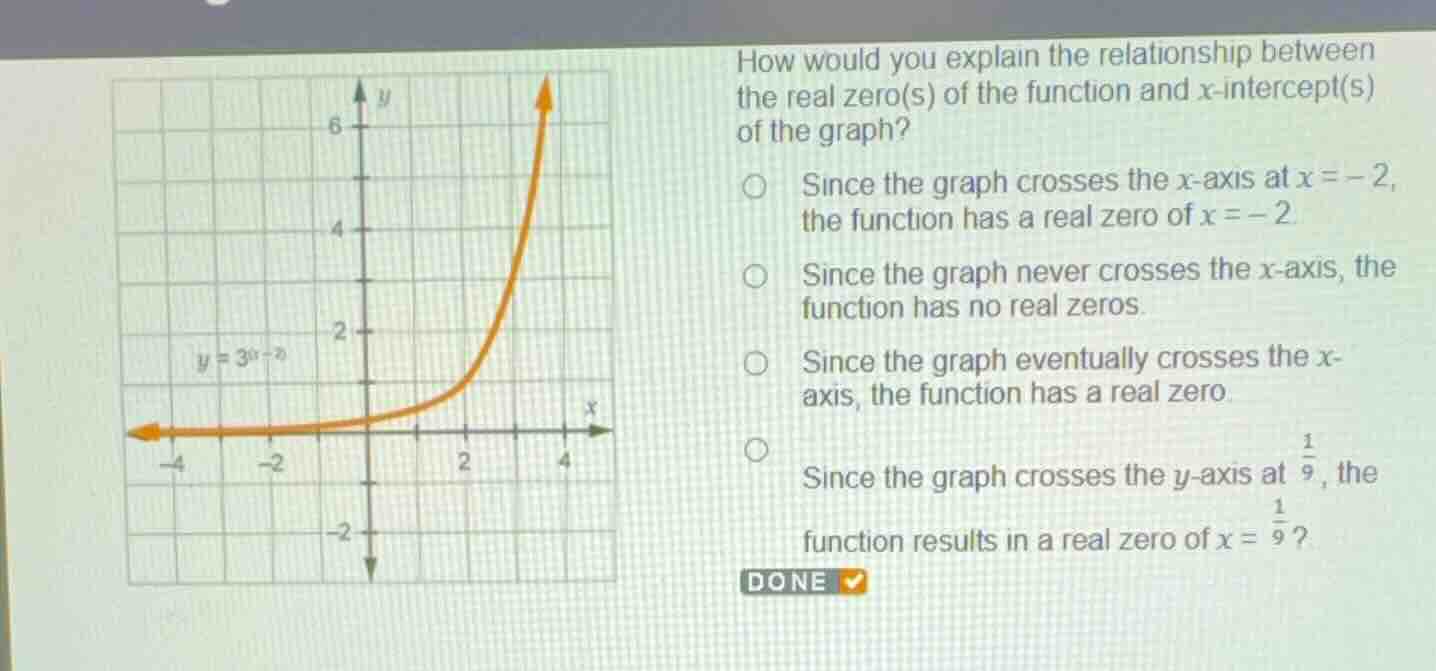
The graph represents the exponential function \(y = 3^{x-2}\). As \(x \to -\infty\), the graph approaches the horizontal asymptote \(y = 0\) (the \(x\)-axis) but never touches or crosses it.
Determine the existence of x-intercepts
Using the Asymptotic Behavior of Logarithms knowledge point
Because \(3^{x-2} > 0\) for all real numbers \(x\), there is no value of \(x\) that satisfies \(3^{x-2} = 0\). Thus, the graph has no \(x\)-intercepts.
Connect x-intercepts to real zeros
The real zeros of a function correspond to the \(x\)-intercepts of its graph. Since the graph never crosses or touches the \(x\)-axis, the function has no real zeros.

Snap & solve any problem in the app
Get step-by-step solutions on Sovi AI
Photo-based solutions with guided steps
Explore more problems and detailed explanations
- Since the graph crosses the \(x\)-axis at \(x = -2\), the function has a real zero of \(x = -2\).
- Since the graph never crosses the \(x\)-axis, the function has no real zeros. (Correct answer)
- Since the graph eventually crosses the \(x\)-axis, the function has a real zero.
- Since the graph crosses the \(y\)-axis at \(\frac{1}{9}\), the function results in a real zero of \(x = \frac{1}{9}\)?