QUESTION IMAGE
Question
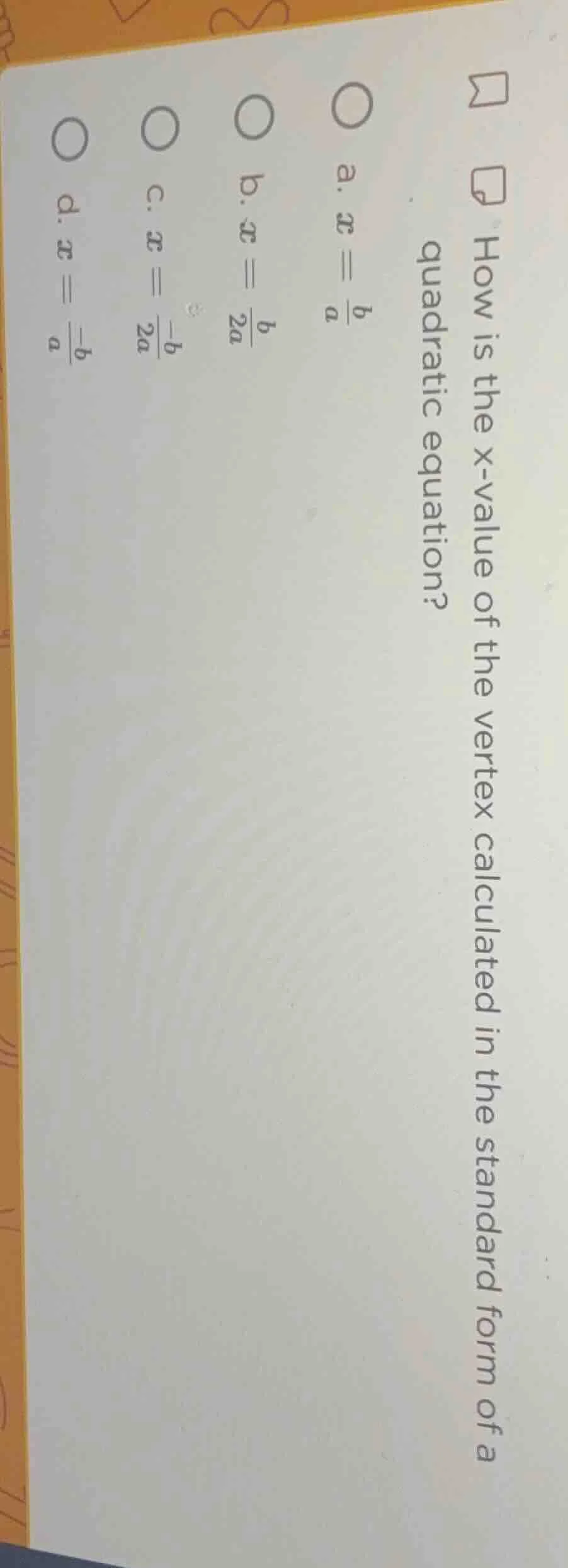
how is the x - value of the vertex calculated in the standard form of a quadratic equation?
a. $x = \frac{b}{a}$
b. $x = \frac{b}{2a}$
c. $x = \frac{-b}{2a}$
d. $x = \frac{-b}{a}$
Step1: Recall vertex formula
The standard form of a quadratic equation is \( y = ax^2 + bx + c \) (where \( a
eq 0 \)). The formula for the x - coordinate of the vertex of a quadratic function in this form is derived from the process of completing the square or from the axis of symmetry formula. The x - coordinate of the vertex (and also the axis of symmetry) is given by \( x=\frac{-b}{2a} \).
Step2: Match with options
Looking at the options:
- Option a: \( x = \frac{b}{a} \) is incorrect.
- Option b: \( x=\frac{b}{2a} \) is incorrect.
- Option c: \( x=\frac{-b}{2a} \) matches the formula for the x - coordinate of the vertex.
- Option d: \( x=\frac{-b}{a} \) is incorrect.

Snap & solve any problem in the app
Get step-by-step solutions on Sovi AI
Photo-based solutions with guided steps
Explore more problems and detailed explanations
c. \( x = \frac{-b}{2a} \)