QUESTION IMAGE
Question
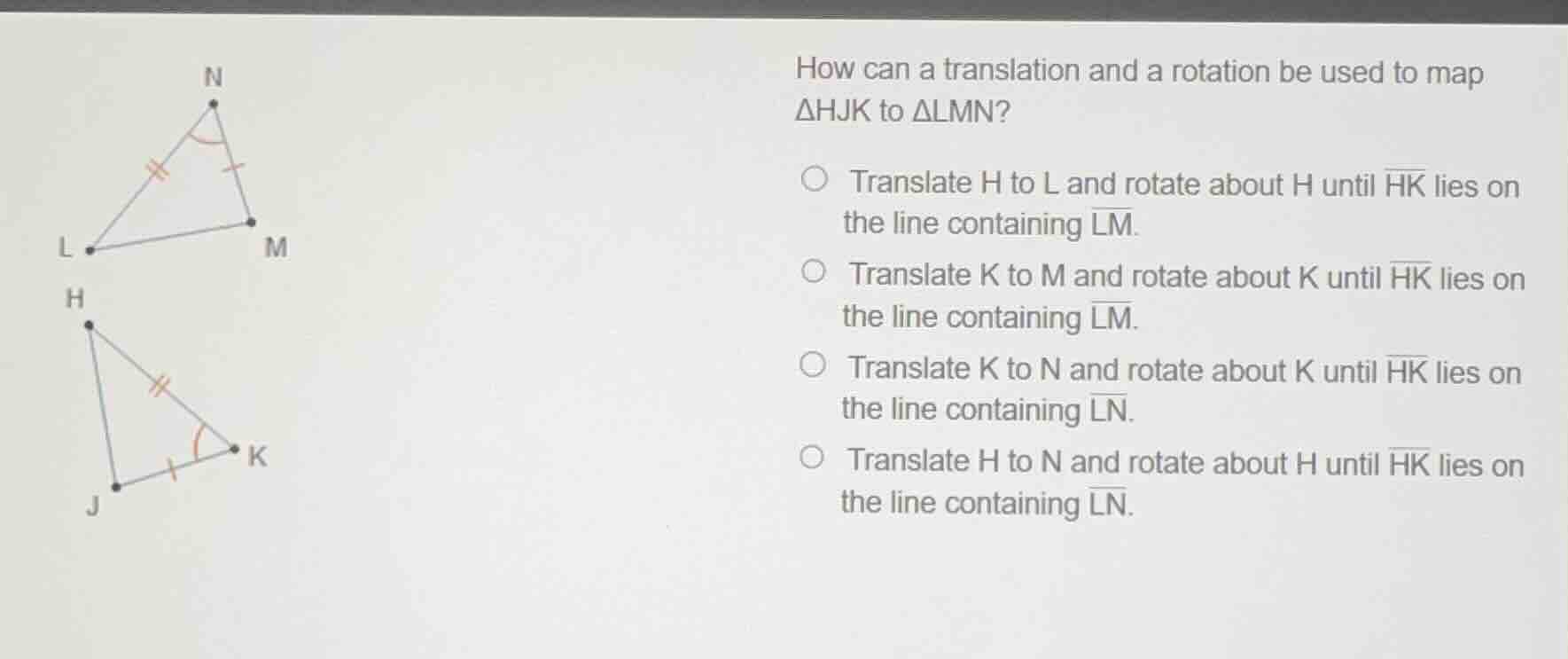
how can a translation and a rotation be used to map \\(\delta hjk\\) to \\(\delta lmn\\)?
\\(\bigcirc\\) translate h to l and rotate about h until \\(\overline{hk}\\) lies on the line containing \\(\overline{lm}\\).
\\(\bigcirc\\) translate k to m and rotate about k until \\(\overline{hk}\\) lies on the line containing \\(\overline{lm}\\).
\\(\bigcirc\\) translate k to n and rotate about k until \\(\overline{hk}\\) lies on the line containing \\(\overline{ln}\\).
\\(\bigcirc\\) translate h to n and rotate about h until \\(\overline{hk}\\) lies on the line containing \\(\overline{ln}\\).
Identify corresponding parts
Using the Congruence Mapping concept, we map \(\Delta HJK\) to \(\Delta LMN\).
The order of vertices in the similarity/congruence statement dictates the correspondence:
- Vertex \(H\) corresponds to vertex \(L\).
- Vertex \(J\) corresponds to vertex \(M\).
- Vertex \(K\) corresponds to vertex \(N\).
Therefore, the segment \(\overline{HK}\) corresponds to the segment \(\overline{LN}\).
Analyze the transformation steps
Using the Rigid Transformations concept, we map the first triangle to the second:
- Translation: To align the first corresponding vertices, we translate vertex \(H\) to vertex \(L\).
- Rotation: After translating \(H\) to \(L\), we rotate the figure about the image of \(H\) (which is now at \(L\)) until the segment \(\overline{HK}\) lies on the line containing its corresponding segment, \(\overline{LN}\).
Evaluate the given options
- Option 1: "Translate \(H\) to \(L\) and rotate about \(H\) until \(\overline{HK}\) lies on the line containing \(\overline{LM}\)."
- Incorrect because \(\overline{HK}\) corresponds to \(\overline{LN}\), not \(\overline{LM}\).
- Option 2: "Translate \(K\) to \(M\) and rotate..."
- Incorrect because \(K\) corresponds to \(N\), not \(M\).
- Option 3: "Translate \(K\) to \(N\) and rotate about \(K\) until \(\overline{HK}\) lies on the line containing \(\overline{LN}\)."
- This is a valid alternative mapping, but let's check the rotation center. If we translate \(K\) to \(N\), the center of rotation must be \(K\) (now at \(N\)) until \(\overline{HK}\) lies on the line containing \(\overline{LN}\). This is geometrically correct and matches the third option.
- Option 4: "Translate \(H\) to \(N\) and rotate..."
- Incorrect because \(H\) corresponds to \(L\), not \(N\).
Thus, Option 3 is the correct transformation sequence.

Snap & solve any problem in the app
Get step-by-step solutions on Sovi AI
Photo-based solutions with guided steps
Explore more problems and detailed explanations
- Translate H to L and rotate about H until \(\overline{HK}\) lies on the line containing \(\overline{LM}\).
- Translate K to M and rotate about K until \(\overline{HK}\) lies on the line containing \(\overline{LM}\).
- Translate K to N and rotate about K until \(\overline{HK}\) lies on the line containing \(\overline{LN}\). (Correct answer)
- Translate H to N and rotate about H until \(\overline{HK}\) lies on the line containing \(\overline{LN}\).