QUESTION IMAGE
Question
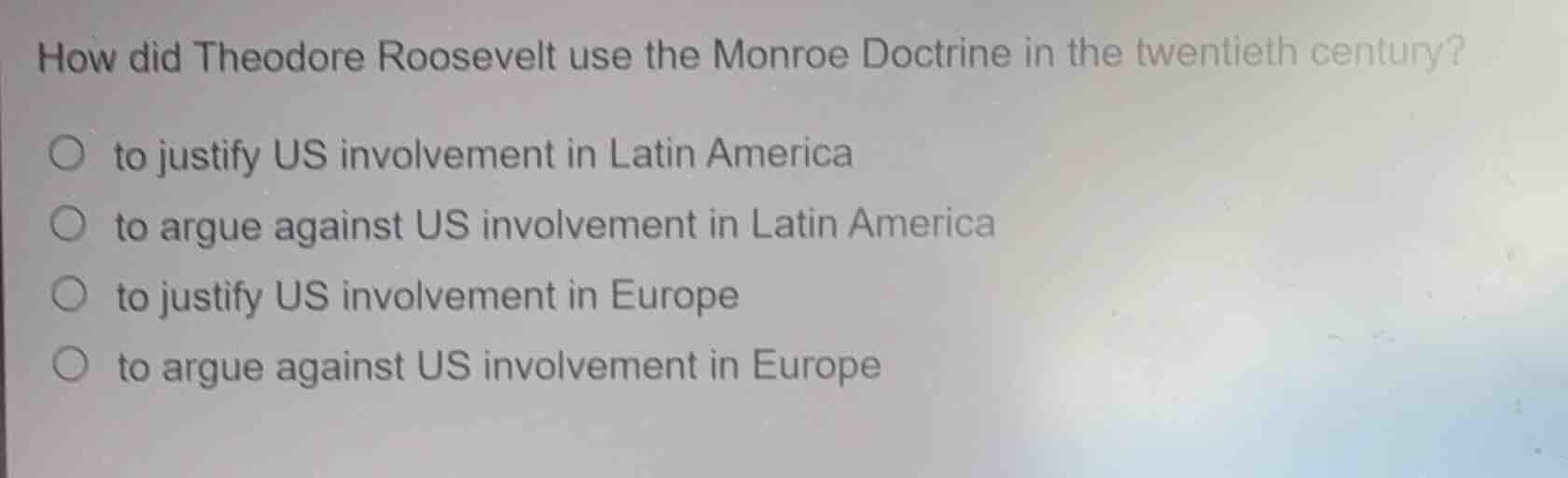
how did theodore roosevelt use the monroe doctrine in the twentieth century?
to justify us involvement in latin america
to argue against us involvement in latin america
to justify us involvement in europe
to argue against us involvement in europe
<pre_analysis>
{
"quality": "clear",
"question_count": 1,
"skills_matched": [
"direct_cot",
"multiple_choice_formatter",
"explain_then_answer",
"tutor",
"mastery_adaptive_brevity"
],
"needs_drawing": false,
"concepts_used": [
"Monroe Doctrine",
"US Foreign Policy"
],
"new_concepts": [
"Roosevelt Corollary",
"Big Stick Diplomacy"
],
"current_concepts": [
"Monroe Doctrine",
"US Foreign Policy",
"Roosevelt Corollary",
"Big Stick Diplomacy"
]
}
</pre_analysis>
<reasoning>
Analyze the core question
The question asks how President Theodore Roosevelt utilized the 19th-century Monroe Doctrine during his presidency in the early 20th century.
Connect to Roosevelt's foreign policy
Using the US Foreign Policy and Monroe Doctrine knowledge points
- Theodore Roosevelt established the "Roosevelt Corollary" to the Monroe Doctrine in 1904.
- The original Monroe Doctrine (1823) warned European powers to stay out of the Western Hemisphere.
- Roosevelt's Corollary asserted that the United States had the right to intervene actively in the domestic affairs of Latin American nations to maintain economic and political stability.
Evaluate the given options
- to justify US involvement in Latin America: This aligns directly with the Roosevelt Corollary, which used the Monroe Doctrine as a shield to justify military and financial interventions in nations like the Dominican Republic, Panama, and Cuba.
- to argue against US involvement in Latin America: Incorrect, as Roosevelt actively promoted intervention.
- to justify US involvement in Europe: Incorrect, the Monroe Doctrine focused on the Western Hemisphere and warned against European intervention, not justifying US intervention in Europe.
- to argue against US involvement in Europe: Incorrect, while the US remained largely isolationist toward European conflicts at this time, this was not the primary active application of the doctrine by Roosevelt in the 20th century.
Formulate the final conclusion
The correct option is the first choice: "to justify US involvement in Latin America".
</reasoning>
<answer>
<mcq-correct>(A) to justify US involvement in Latin America</mcq-correct>
<mcq-option>(B) to argue against US involvement in Latin America</mcq-option>
<mcq-option>(C) to justify US involvement in Europe</mcq-option>
<mcq-option>(D) to argue against US involvement in Europe</mcq-option>
</answer>
<post_analysis>
{
"subject": "Social Science",
"question_type": "Multiple Choice",
"knowledge_point": [
"Social Science",
"U.S. History",
"Roosevelt Corollary"
]
}
</post_analysis>
Snap & solve any problem in the app
Get step-by-step solutions on Sovi AI
Photo-based solutions with guided steps
Explore more problems and detailed explanations
<pre_analysis>
{
"quality": "clear",
"question_count": 1,
"skills_matched": [
"direct_cot",
"multiple_choice_formatter",
"explain_then_answer",
"tutor",
"mastery_adaptive_brevity"
],
"needs_drawing": false,
"concepts_used": [
"Monroe Doctrine",
"US Foreign Policy"
],
"new_concepts": [
"Roosevelt Corollary",
"Big Stick Diplomacy"
],
"current_concepts": [
"Monroe Doctrine",
"US Foreign Policy",
"Roosevelt Corollary",
"Big Stick Diplomacy"
]
}
</pre_analysis>
<reasoning>
Analyze the core question
The question asks how President Theodore Roosevelt utilized the 19th-century Monroe Doctrine during his presidency in the early 20th century.
Connect to Roosevelt's foreign policy
Using the US Foreign Policy and Monroe Doctrine knowledge points
- Theodore Roosevelt established the "Roosevelt Corollary" to the Monroe Doctrine in 1904.
- The original Monroe Doctrine (1823) warned European powers to stay out of the Western Hemisphere.
- Roosevelt's Corollary asserted that the United States had the right to intervene actively in the domestic affairs of Latin American nations to maintain economic and political stability.
Evaluate the given options
- to justify US involvement in Latin America: This aligns directly with the Roosevelt Corollary, which used the Monroe Doctrine as a shield to justify military and financial interventions in nations like the Dominican Republic, Panama, and Cuba.
- to argue against US involvement in Latin America: Incorrect, as Roosevelt actively promoted intervention.
- to justify US involvement in Europe: Incorrect, the Monroe Doctrine focused on the Western Hemisphere and warned against European intervention, not justifying US intervention in Europe.
- to argue against US involvement in Europe: Incorrect, while the US remained largely isolationist toward European conflicts at this time, this was not the primary active application of the doctrine by Roosevelt in the 20th century.
Formulate the final conclusion
The correct option is the first choice: "to justify US involvement in Latin America".
</reasoning>
<answer>
<mcq-correct>(A) to justify US involvement in Latin America</mcq-correct>
<mcq-option>(B) to argue against US involvement in Latin America</mcq-option>
<mcq-option>(C) to justify US involvement in Europe</mcq-option>
<mcq-option>(D) to argue against US involvement in Europe</mcq-option>
</answer>
<post_analysis>
{
"subject": "Social Science",
"question_type": "Multiple Choice",
"knowledge_point": [
"Social Science",
"U.S. History",
"Roosevelt Corollary"
]
}
</post_analysis>