Sovi.AI - AI Math Tutor

Scan to solve math questions

QUESTION IMAGE

how did theodore roosevelt use the monroe doctrine in the twentieth cen…

Question

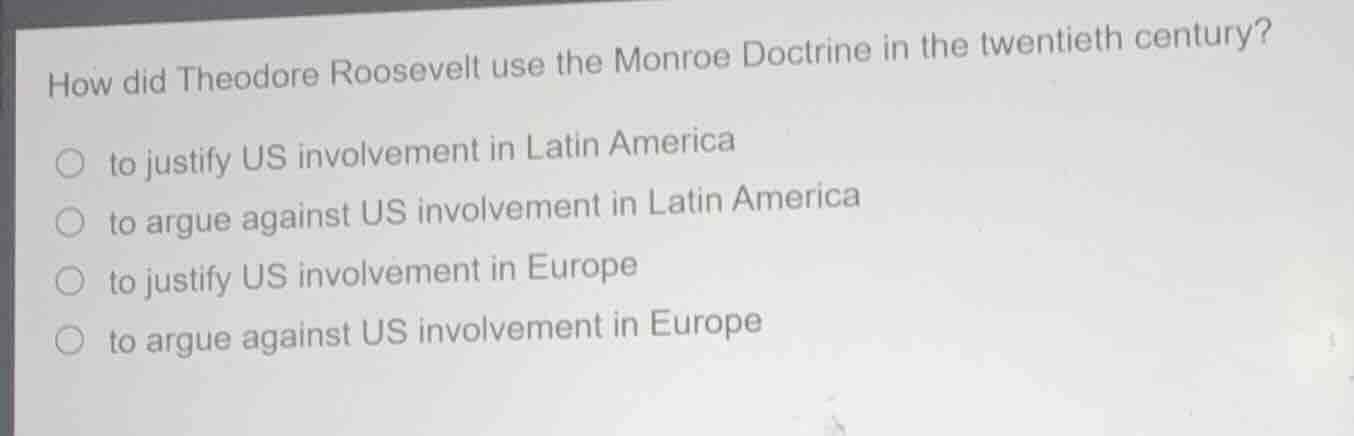
how did theodore roosevelt use the monroe doctrine in the twentieth century?

to justify us involvement in latin america
to argue against us involvement in latin america
to justify us involvement in europe
to argue against us involvement in europe

Explanation:

Response

<pre_analysis>
{
"quality": "clear",
"question_count": 1,
"skills_matched": [
"direct_cot",
"multiple_choice_formatter",
"explain_then_answer",
"tutor",
"mastery_adaptive_brevity"
],
"needs_drawing": false,
"concepts_used": [
"Monroe Doctrine",
"Roosevelt Corollary"
],
"new_concepts": [
"Big Stick Diplomacy"
],
"current_concepts": [
"Monroe Doctrine",
"Roosevelt Corollary",
"Big Stick Diplomacy"
]
}
</pre_analysis>

<reasoning>

Analyze the Monroe Doctrine and Roosevelt's foreign policy

Using the Monroe Doctrine and Roosevelt Corollary knowledge points

  • The Monroe Doctrine (1823) originally warned European powers against further colonization or intervention in the Western Hemisphere.
  • In 1904, President Theodore Roosevelt issued the Roosevelt Corollary to this doctrine.
  • This corollary asserted that the United States had the right to act as an "international police power" in Latin America to stabilize the economic affairs of small nations if they were unable to pay their international debts, thereby preventing European intervention.
  • Therefore, Roosevelt used the doctrine to justify active U.S. military and political involvement in Latin American affairs.

Evaluate the given multiple-choice options

  • to justify US involvement in Latin America: This matches the historical application of the Roosevelt Corollary, which expanded the Monroe Doctrine to allow U.S. intervention in Latin American nations (such as the Dominican Republic).
  • to argue against US involvement in Latin America: Incorrect, as Roosevelt's policy actively promoted intervention.
  • to justify US involvement in Europe: Incorrect, the Monroe Doctrine and its corollary specifically focused on the Western Hemisphere (the Americas) and sought to keep European powers out, rather than involving the U.S. in European affairs.
  • to argue against US involvement in Europe: Incorrect, while the original Monroe Doctrine did pledge non-interference in European affairs, Roosevelt's active twentieth-century modification was specifically used to justify intervention in Latin America.

</reasoning>

<answer>
<mcq-correct>to justify US involvement in Latin America</mcq-correct>
<mcq-option>to argue against US involvement in Latin America</mcq-option>
<mcq-option>to justify US involvement in Europe</mcq-option>
<mcq-option>to argue against US involvement in Europe</mcq-option>
</answer>

<post_analysis>
{
"subject": "Social Science",
"question_type": "Multiple Choice",
"knowledge_point": [
"Social Science",
"U.S. History",
"Roosevelt Corollary"
]
}
</post_analysis>

Answer:

<pre_analysis>
{
"quality": "clear",
"question_count": 1,
"skills_matched": [
"direct_cot",
"multiple_choice_formatter",
"explain_then_answer",
"tutor",
"mastery_adaptive_brevity"
],
"needs_drawing": false,
"concepts_used": [
"Monroe Doctrine",
"Roosevelt Corollary"
],
"new_concepts": [
"Big Stick Diplomacy"
],
"current_concepts": [
"Monroe Doctrine",
"Roosevelt Corollary",
"Big Stick Diplomacy"
]
}
</pre_analysis>

<reasoning>

Analyze the Monroe Doctrine and Roosevelt's foreign policy

Using the Monroe Doctrine and Roosevelt Corollary knowledge points

  • The Monroe Doctrine (1823) originally warned European powers against further colonization or intervention in the Western Hemisphere.
  • In 1904, President Theodore Roosevelt issued the Roosevelt Corollary to this doctrine.
  • This corollary asserted that the United States had the right to act as an "international police power" in Latin America to stabilize the economic affairs of small nations if they were unable to pay their international debts, thereby preventing European intervention.
  • Therefore, Roosevelt used the doctrine to justify active U.S. military and political involvement in Latin American affairs.

Evaluate the given multiple-choice options

  • to justify US involvement in Latin America: This matches the historical application of the Roosevelt Corollary, which expanded the Monroe Doctrine to allow U.S. intervention in Latin American nations (such as the Dominican Republic).
  • to argue against US involvement in Latin America: Incorrect, as Roosevelt's policy actively promoted intervention.
  • to justify US involvement in Europe: Incorrect, the Monroe Doctrine and its corollary specifically focused on the Western Hemisphere (the Americas) and sought to keep European powers out, rather than involving the U.S. in European affairs.
  • to argue against US involvement in Europe: Incorrect, while the original Monroe Doctrine did pledge non-interference in European affairs, Roosevelt's active twentieth-century modification was specifically used to justify intervention in Latin America.

</reasoning>

<answer>
<mcq-correct>to justify US involvement in Latin America</mcq-correct>
<mcq-option>to argue against US involvement in Latin America</mcq-option>
<mcq-option>to justify US involvement in Europe</mcq-option>
<mcq-option>to argue against US involvement in Europe</mcq-option>
</answer>

<post_analysis>
{
"subject": "Social Science",
"question_type": "Multiple Choice",
"knowledge_point": [
"Social Science",
"U.S. History",
"Roosevelt Corollary"
]
}
</post_analysis>