QUESTION IMAGE
Question
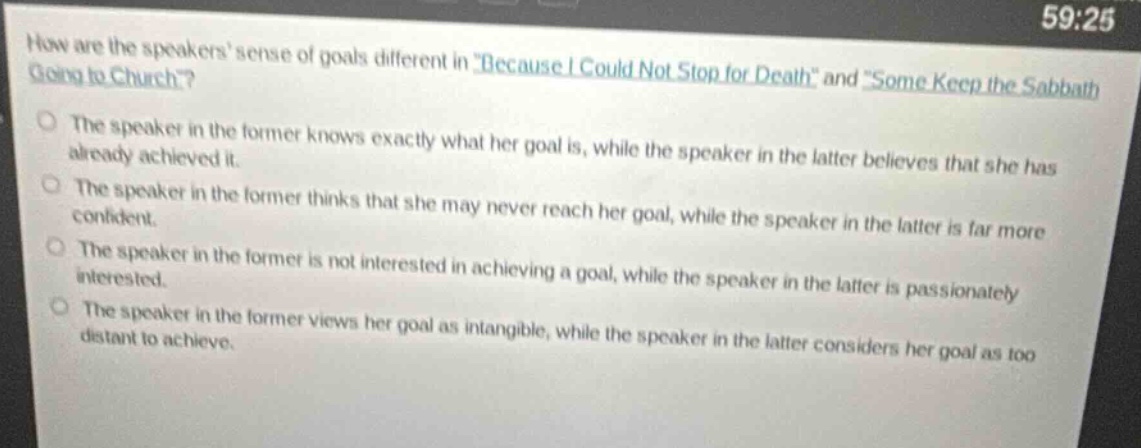
how are the speakers sense of goals different in \because i could not stop for death\ and \some keep the sabbath going to church\?
- the speaker in the former knows exactly what her goal is, while the speaker in the latter believes that she has already achieved it.
- the speaker in the former thinks that she may never reach her goal, while the speaker in the latter is far more confident.
- the speaker in the former is not interested in achieving a goal, while the speaker in the latter is passionately interested.
- the speaker in the former views her goal as intangible, while the speaker in the latter considers her goal as too distant to achieve.
⚡ Using what you learned: thematic comparison across multiple works
Step 1: Analyze the speaker's goal in "Because I Could Not Stop for Death"
In Emily Dickinson's "Because I Could Not Stop for Death", the speaker is on a carriage ride with Death toward eternity. The journey is passive, and the speaker does not have a clear, self-determined destination or active goal in mind during the journey. Instead, she is being led toward an afterlife ("Eternity") that remains mysterious, intangible, and beyond her active control or complete understanding.
Step 2: Analyze the speaker's goal in "Some Keep the Sabbath Going to Church"
In "Some Keep the Sabbath Going to Church", the speaker rejects traditional churchgoing in favor of experiencing heaven on Earth through nature. In the final lines, she states:
"So instead of getting to Heaven, at last – / I’m going, all along."
This speaker is highly confident and believes she does not have to wait for a distant, future afterlife to reach her spiritual goal (Heaven); she is actively experiencing and achieving it right now in her daily life.
Step 3: Compare the options
- Option 1: "The speaker in the former knows exactly what her goal is, while the speaker in the latter believes that she has already achieved it."
- This is incorrect because the speaker in "Because I Could Not Stop for Death" does not have a clear, active grasp of her destination; it is an unfolding, mysterious journey.
- Option 2: "The speaker in the former thinks that she may never reach her goal, while the speaker in the latter is far more confident."
- This is incorrect because the speaker in the former does not express doubt about never reaching it, but rather a passive acceptance of the journey.
- Option 3: "The speaker in the former is not interested in achieving a goal, while the speaker in the latter is passionately interested."
- This is incorrect because it mischaracterizes the spiritual engagement of both speakers.
- Option 4: "The speaker in the former views her goal as intangible, while the speaker in the latter considers her goal as too distant to achieve."
- This is incorrect because the speaker in the latter does not view her goal as too distant; she views it as immediately present.
Let's re-evaluate the exact wording of Option 1:
The speaker in "Because I Could Not Stop for Death" is being taken toward "Eternity," which is a defined destination (knowing what the ultimate destination/goal is), whereas the speaker in "Some Keep the Sabbath Going to Church" is "going [to Heaven], all along," meaning she is already actively living in and achieving her spiritual goal. This makes the first option the most accurate comparison.

Snap & solve any problem in the app
Get step-by-step solutions on Sovi AI
Photo-based solutions with guided steps
Explore more problems and detailed explanations
The speaker in the former knows exactly what her goal is, while the speaker in the latter believes that she has already achieved it.