Sovi.AI - AI Math Tutor

Scan to solve math questions

QUESTION IMAGE

(b) how do psychologists distinguish between reinforcement and punishme…

Question

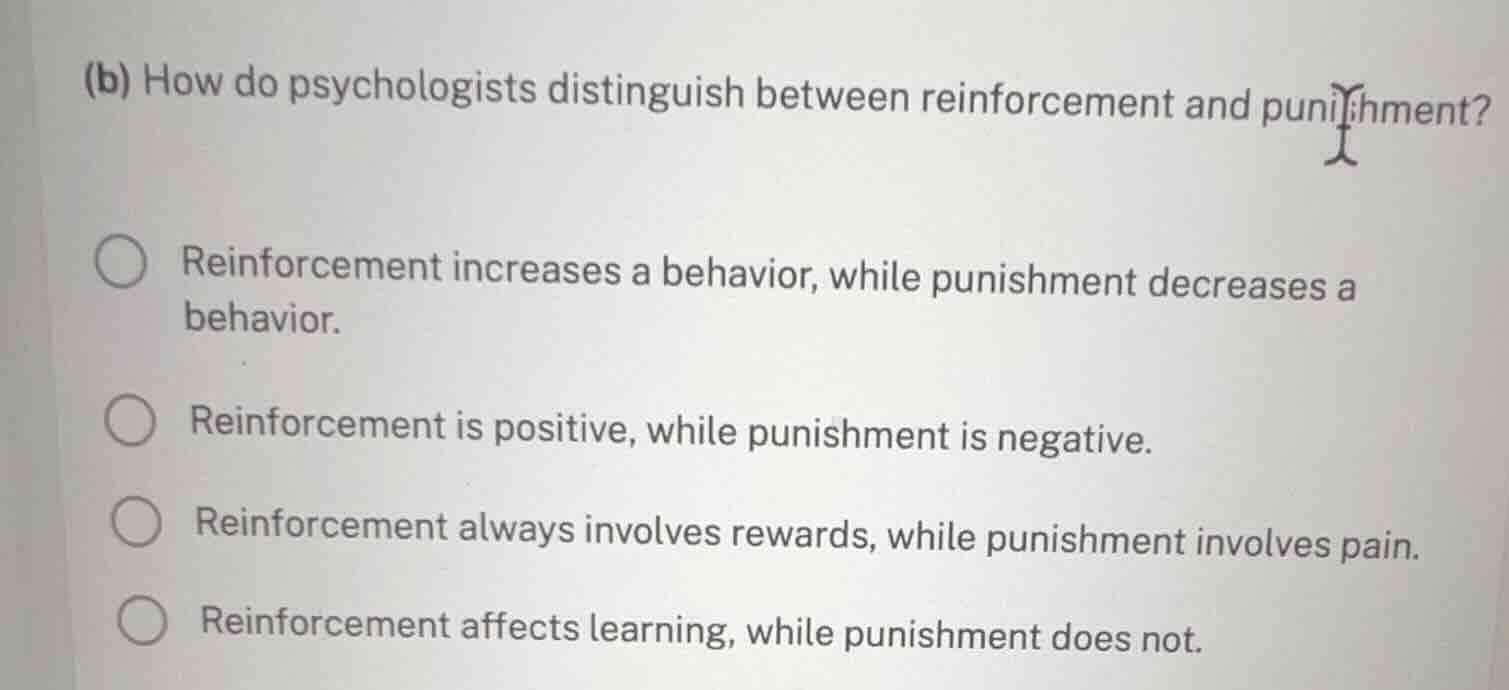
(b) how do psychologists distinguish between reinforcement and punishment?

reinforcement increases a behavior, while punishment decreases a behavior.
reinforcement is positive, while punishment is negative.
reinforcement always involves rewards, while punishment involves pain.
reinforcement affects learning, while punishment does not.

Explanation:

Response

<pre_analysis>
{
"quality": "clear",
"question_count": 1,
"skills_matched": [
"direct_cot",
"multiple_choice_formatter",
"explain_then_answer",
"tutor",
"mastery_adaptive_brevity"
],
"needs_drawing": false,
"concepts_used": [
"Operant Conditioning"
],
"new_concepts": [],
"current_concepts": [
"Operant Conditioning",
"Reinforcement vs Punishment"
]
}
</pre_analysis>

<reasoning>

Define the core concepts of operant conditioning

Using the Operant Conditioning knowledge point

In operant conditioning, consequences are classified based on their effect on the likelihood of a behavior reoccurring:

  • Reinforcement is any consequence that strengthens or increases the frequency of a behavior.
  • Punishment is any consequence that weakens or decreases the frequency of a behavior.

Evaluate the given options

Using the Operant Conditioning knowledge point

  • Option 1: "Reinforcement increases a behavior, while punishment decreases a behavior." This aligns exactly with the psychological definitions of reinforcement and punishment.
  • Option 2: "Reinforcement is positive, while punishment is negative." This is incorrect because both reinforcement and punishment can be positive (adding a stimulus) or negative (removing a stimulus).
  • Option 3: "Reinforcement always involves rewards, while punishment involves pain." This is incorrect because reinforcement does not have to be a traditional "reward" (e.g., negative reinforcement involves removing an unpleasant stimulus), and punishment does not have to involve physical pain (e.g., losing privileges).
  • Option 4: "Reinforcement affects learning, while punishment does not." This is incorrect because both processes are fundamental mechanisms of learning and behavior modification.

</reasoning>

<answer>
<mcq-correct>(A) Reinforcement increases a behavior, while punishment decreases a behavior.</mcq-correct>
<mcq-option>(B) Reinforcement is positive, while punishment is negative.</mcq-option>
<mcq-option>(C) Reinforcement always involves rewards, while punishment involves pain.</mcq-option>
<mcq-option>(D) Reinforcement affects learning, while punishment does not.</mcq-option>
</answer>

<post_analysis>
{
"subject": "Social Science",
"question_type": "Multiple Choice",
"knowledge_point": [
"Social Science",
"Psychology",
"Operant Conditioning"
]
}
</post_analysis>

Answer:

<pre_analysis>
{
"quality": "clear",
"question_count": 1,
"skills_matched": [
"direct_cot",
"multiple_choice_formatter",
"explain_then_answer",
"tutor",
"mastery_adaptive_brevity"
],
"needs_drawing": false,
"concepts_used": [
"Operant Conditioning"
],
"new_concepts": [],
"current_concepts": [
"Operant Conditioning",
"Reinforcement vs Punishment"
]
}
</pre_analysis>

<reasoning>

Define the core concepts of operant conditioning

Using the Operant Conditioning knowledge point

In operant conditioning, consequences are classified based on their effect on the likelihood of a behavior reoccurring:

  • Reinforcement is any consequence that strengthens or increases the frequency of a behavior.
  • Punishment is any consequence that weakens or decreases the frequency of a behavior.

Evaluate the given options

Using the Operant Conditioning knowledge point

  • Option 1: "Reinforcement increases a behavior, while punishment decreases a behavior." This aligns exactly with the psychological definitions of reinforcement and punishment.
  • Option 2: "Reinforcement is positive, while punishment is negative." This is incorrect because both reinforcement and punishment can be positive (adding a stimulus) or negative (removing a stimulus).
  • Option 3: "Reinforcement always involves rewards, while punishment involves pain." This is incorrect because reinforcement does not have to be a traditional "reward" (e.g., negative reinforcement involves removing an unpleasant stimulus), and punishment does not have to involve physical pain (e.g., losing privileges).
  • Option 4: "Reinforcement affects learning, while punishment does not." This is incorrect because both processes are fundamental mechanisms of learning and behavior modification.

</reasoning>

<answer>
<mcq-correct>(A) Reinforcement increases a behavior, while punishment decreases a behavior.</mcq-correct>
<mcq-option>(B) Reinforcement is positive, while punishment is negative.</mcq-option>
<mcq-option>(C) Reinforcement always involves rewards, while punishment involves pain.</mcq-option>
<mcq-option>(D) Reinforcement affects learning, while punishment does not.</mcq-option>
</answer>

<post_analysis>
{
"subject": "Social Science",
"question_type": "Multiple Choice",
"knowledge_point": [
"Social Science",
"Psychology",
"Operant Conditioning"
]
}
</post_analysis>