Sovi.AI - AI Math Tutor

Scan to solve math questions

QUESTION IMAGE

(c) how can prolonged stress affect the immune system? - it can weaken …

Question

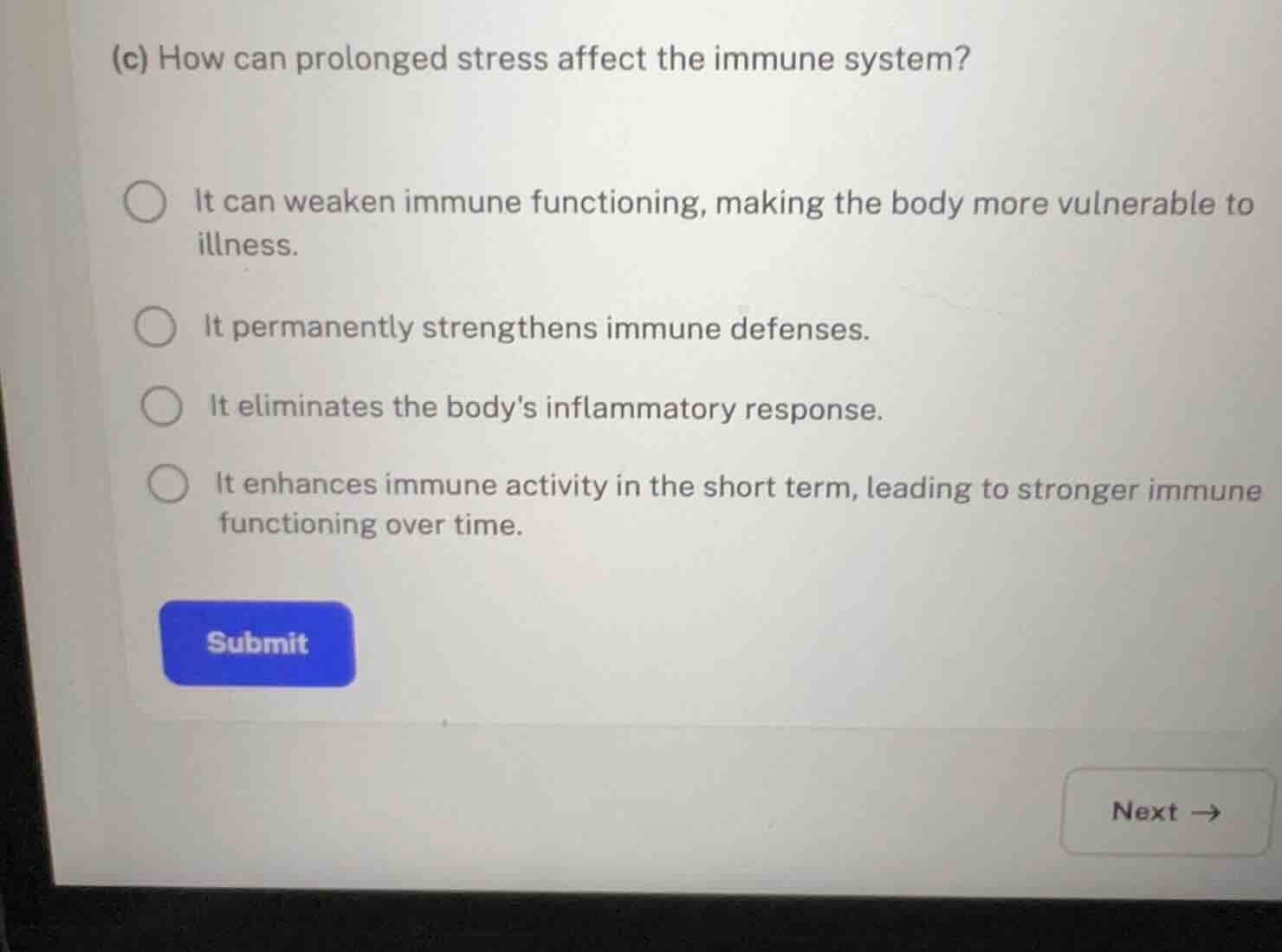
(c) how can prolonged stress affect the immune system?

  • it can weaken immune functioning, making the body more vulnerable to illness.
  • it permanently strengthens immune defenses.
  • it eliminates the bodys inflammatory response.
  • it enhances immune activity in the short term, leading to stronger immune functioning over time.

Explanation:

Response

<pre_analysis>
{
"quality": "clear",
"question_count": 1,
"skills_matched": [
"direct_cot",
"multiple_choice_formatter",
"explain_then_answer",
"tutor",
"mastery_adaptive_brevity"
],
"needs_drawing": false,
"concepts_used": [
"Cortisol Effects",
"Psychophysiological Disorders"
],
"new_concepts": [
"Stress and Immune Functioning"
],
"current_concepts": [
"Cortisol Effects",
"Psychophysiological Disorders",
"Stress and Immune Functioning"
]
}
</pre_analysis>

<reasoning>

Analyze the physiological effects of chronic stress

Using the Cortisol Effects and Psychophysiological Disorders knowledge points

  • Chronic stress triggers the sustained release of stress hormones like cortisol.
  • High cortisol levels suppress the production and activity of lymphocytes (white blood cells).
  • This suppression directly impairs the body's ability to fight off antigens.

Evaluate the given multiple-choice options

  • Option 1: Correctly states that prolonged stress weakens immune functioning, increasing vulnerability to illness.
  • Option 2: Incorrect, as chronic stress suppresses rather than permanently strengthens immune defenses.
  • Option 3: Incorrect, as stress does not eliminate inflammation; in fact, chronic stress can lead to persistent, low-grade systemic inflammation.
  • Option 4: Incorrect, as prolonged stress leads to weaker, not stronger, immune functioning over time.

</reasoning>

<answer>
<mcq-correct>(A) It can weaken immune functioning, making the body more vulnerable to illness.</mcq-correct>
<mcq-option>(B) It permanently strengthens immune defenses.</mcq-option>
<mcq-option>(C) It eliminates the body's inflammatory response.</mcq-option>
<mcq-option>(D) It enhances immune activity in the short term, leading to stronger immune functioning over time.</mcq-option>
</answer>

<post_analysis>
{
"subject": "Natural Science",
"question_type": "Multiple Choice",
"knowledge_point": [
"Natural Science",
"Biology",
"Stress and Immune Functioning"
]
}
</post_analysis>

Answer:

<pre_analysis>
{
"quality": "clear",
"question_count": 1,
"skills_matched": [
"direct_cot",
"multiple_choice_formatter",
"explain_then_answer",
"tutor",
"mastery_adaptive_brevity"
],
"needs_drawing": false,
"concepts_used": [
"Cortisol Effects",
"Psychophysiological Disorders"
],
"new_concepts": [
"Stress and Immune Functioning"
],
"current_concepts": [
"Cortisol Effects",
"Psychophysiological Disorders",
"Stress and Immune Functioning"
]
}
</pre_analysis>

<reasoning>

Analyze the physiological effects of chronic stress

Using the Cortisol Effects and Psychophysiological Disorders knowledge points

  • Chronic stress triggers the sustained release of stress hormones like cortisol.
  • High cortisol levels suppress the production and activity of lymphocytes (white blood cells).
  • This suppression directly impairs the body's ability to fight off antigens.

Evaluate the given multiple-choice options

  • Option 1: Correctly states that prolonged stress weakens immune functioning, increasing vulnerability to illness.
  • Option 2: Incorrect, as chronic stress suppresses rather than permanently strengthens immune defenses.
  • Option 3: Incorrect, as stress does not eliminate inflammation; in fact, chronic stress can lead to persistent, low-grade systemic inflammation.
  • Option 4: Incorrect, as prolonged stress leads to weaker, not stronger, immune functioning over time.

</reasoning>

<answer>
<mcq-correct>(A) It can weaken immune functioning, making the body more vulnerable to illness.</mcq-correct>
<mcq-option>(B) It permanently strengthens immune defenses.</mcq-option>
<mcq-option>(C) It eliminates the body's inflammatory response.</mcq-option>
<mcq-option>(D) It enhances immune activity in the short term, leading to stronger immune functioning over time.</mcq-option>
</answer>

<post_analysis>
{
"subject": "Natural Science",
"question_type": "Multiple Choice",
"knowledge_point": [
"Natural Science",
"Biology",
"Stress and Immune Functioning"
]
}
</post_analysis>