Sovi.AI - AI Math Tutor

Scan to solve math questions

QUESTION IMAGE

(c) how can prolonged stress affect the immune system? - it enhances im…

Question

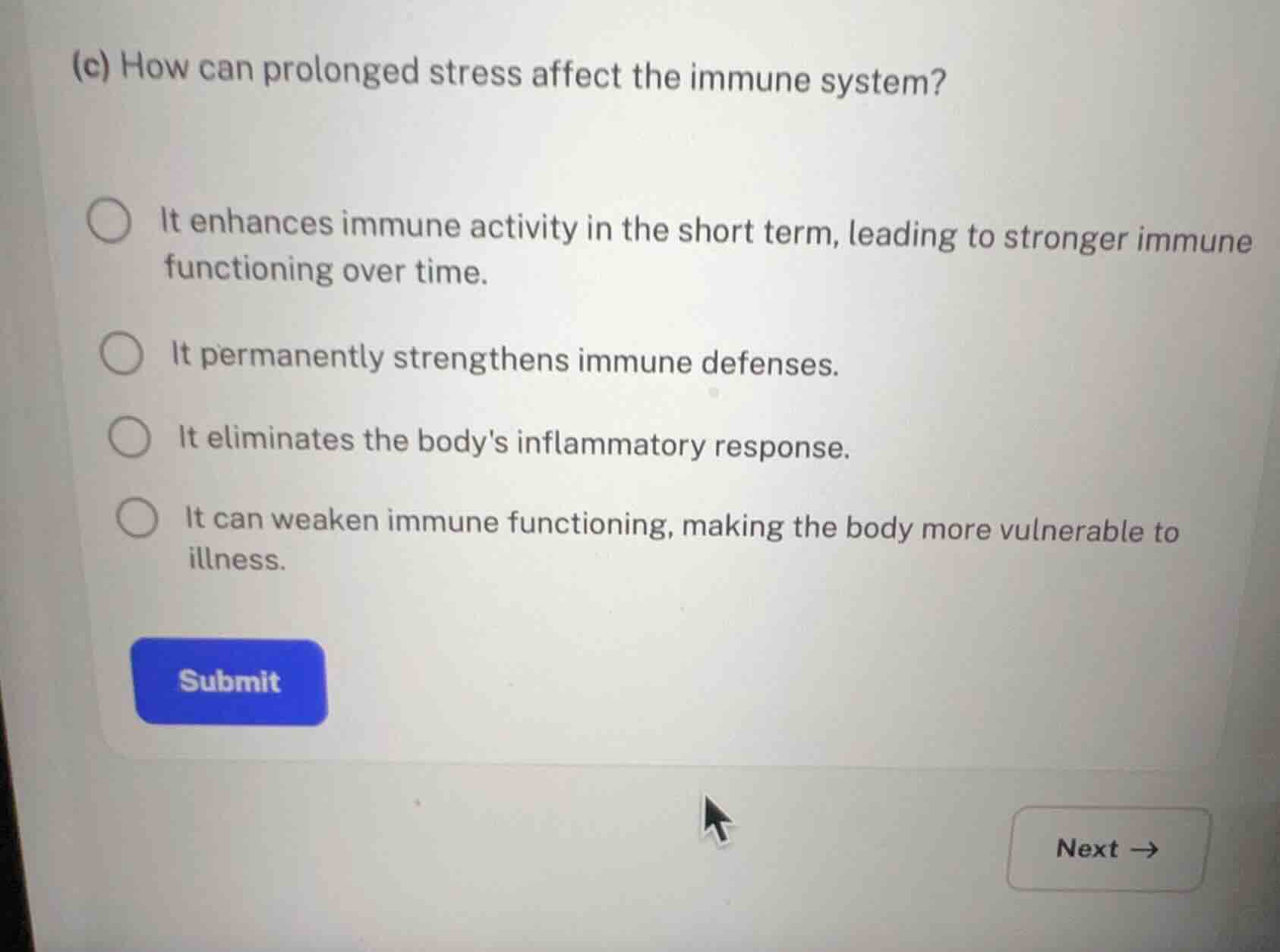
(c) how can prolonged stress affect the immune system?

  • it enhances immune activity in the short term, leading to stronger immune functioning over time.
  • it permanently strengthens immune defenses.
  • it eliminates the bodys inflammatory response.
  • it can weaken immune functioning, making the body more vulnerable to illness.

Explanation:

Response

<pre_analysis>
{
"quality": "clear",
"question_count": 1,
"skills_matched": [
"direct_cot",
"multiple_choice_formatter",
"explain_then_answer",
"tutor",
"mastery_adaptive_brevity"
],
"needs_drawing": false,
"concepts_used": [
"Stress and Immune Functioning"
],
"new_concepts": [],
"current_concepts": [
"Stress and Immune Functioning"
]
}
</pre_analysis>

<reasoning>

Analyze the effects of chronic stress

Using the Stress and Immune Functioning knowledge point

Prolonged or chronic stress leads to the continuous release of stress hormones like cortisol. Over time, elevated cortisol levels suppress the production and effectiveness of lymphocytes (white blood cells), which are crucial for fighting off infections. Consequently, this downregulates the body's immune response, leaving an individual more susceptible to viral and bacterial illnesses.

Evaluate the given options

  • Option 1: "It enhances immune activity in the short term, leading to stronger immune functioning over time." This is incorrect because prolonged stress weakens, rather than strengthens, immune functioning over time.
  • Option 2: "It permanently strengthens immune defenses." This is incorrect because chronic stress has a suppressive and damaging effect on the immune system.
  • Option 3: "It eliminates the body's inflammatory response." This is incorrect; chronic stress often leads to persistent, low-grade systemic inflammation due to glucocorticoid receptor resistance.
  • Option 4: "It can weaken immune functioning, making the body more vulnerable to illness." This accurately describes the immunosuppressive effects of long-term stress.

</reasoning>

<answer>
<mcq-option>It enhances immune activity in the short term, leading to stronger immune functioning over time.</mcq-option>
<mcq-option>It permanently strengthens immune defenses.</mcq-option>
<mcq-option>It eliminates the body's inflammatory response.</mcq-option>
<mcq-correct>It can weaken immune functioning, making the body more vulnerable to illness.</mcq-correct>
</answer>

<post_analysis>
{
"subject": "Natural Science",
"question_type": "Multiple Choice",
"knowledge_point": [
"Natural Science",
"Biology",
"Stress and Immune Functioning"
]
}
</post_analysis>

Answer:

<pre_analysis>
{
"quality": "clear",
"question_count": 1,
"skills_matched": [
"direct_cot",
"multiple_choice_formatter",
"explain_then_answer",
"tutor",
"mastery_adaptive_brevity"
],
"needs_drawing": false,
"concepts_used": [
"Stress and Immune Functioning"
],
"new_concepts": [],
"current_concepts": [
"Stress and Immune Functioning"
]
}
</pre_analysis>

<reasoning>

Analyze the effects of chronic stress

Using the Stress and Immune Functioning knowledge point

Prolonged or chronic stress leads to the continuous release of stress hormones like cortisol. Over time, elevated cortisol levels suppress the production and effectiveness of lymphocytes (white blood cells), which are crucial for fighting off infections. Consequently, this downregulates the body's immune response, leaving an individual more susceptible to viral and bacterial illnesses.

Evaluate the given options

  • Option 1: "It enhances immune activity in the short term, leading to stronger immune functioning over time." This is incorrect because prolonged stress weakens, rather than strengthens, immune functioning over time.
  • Option 2: "It permanently strengthens immune defenses." This is incorrect because chronic stress has a suppressive and damaging effect on the immune system.
  • Option 3: "It eliminates the body's inflammatory response." This is incorrect; chronic stress often leads to persistent, low-grade systemic inflammation due to glucocorticoid receptor resistance.
  • Option 4: "It can weaken immune functioning, making the body more vulnerable to illness." This accurately describes the immunosuppressive effects of long-term stress.

</reasoning>

<answer>
<mcq-option>It enhances immune activity in the short term, leading to stronger immune functioning over time.</mcq-option>
<mcq-option>It permanently strengthens immune defenses.</mcq-option>
<mcq-option>It eliminates the body's inflammatory response.</mcq-option>
<mcq-correct>It can weaken immune functioning, making the body more vulnerable to illness.</mcq-correct>
</answer>

<post_analysis>
{
"subject": "Natural Science",
"question_type": "Multiple Choice",
"knowledge_point": [
"Natural Science",
"Biology",
"Stress and Immune Functioning"
]
}
</post_analysis>