QUESTION IMAGE
Question
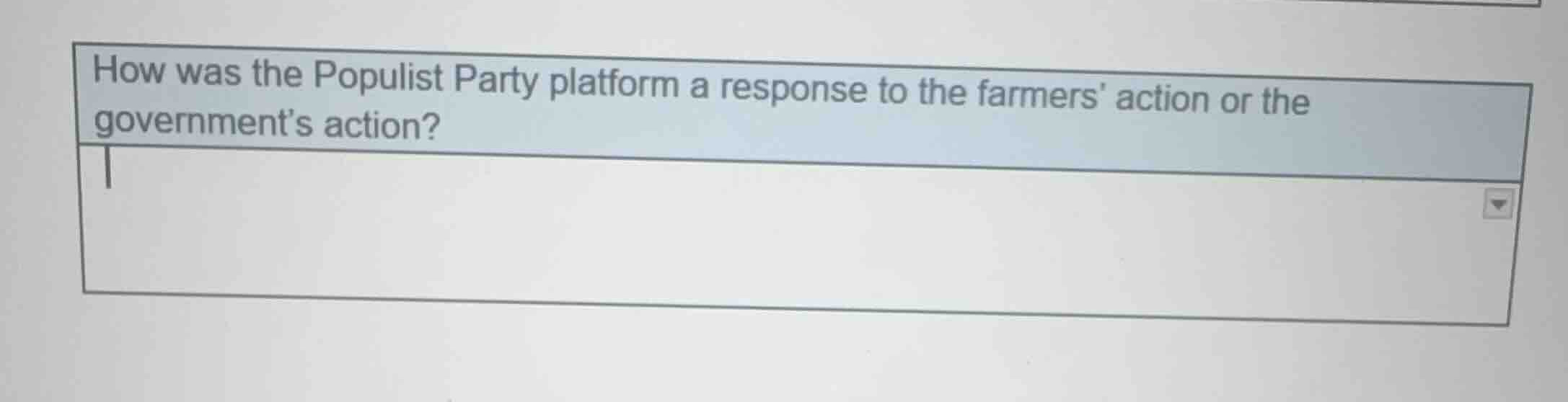
how was the populist party platform a response to the farmers action or the governments action?
The Populist Party (or People's Party) emerged in the early 1890s as a culmination of farmers' efforts to organize against economic hardships.
- Response to Farmers' Action: Farmers had previously formed cooperative organizations like the Patrons of Husbandry (the Grange) and the Farmers' Alliances to pool resources and demand economic reforms. The Populist Party took these localized agrarian demands and unified them into a national political platform (the Omaha Platform of 1892), advocating for reforms such as the free coinage of silver, a graduated income tax, and government ownership of railroads.
- Response to Government's Action: The platform directly challenged federal policies that farmers believed favored Eastern financial elites and corporations over working-class citizens. Specifically, it reacted against:
- The government's adherence to the tight-money gold standard (which caused deflation and increased farmers' debt burdens).
- The lack of federal regulation over monopolistic railroad companies that charged exorbitant shipping rates.
- The government's protective tariffs that raised the cost of manufactured goods while agricultural prices fell.

Snap & solve any problem in the app
Get step-by-step solutions on Sovi AI
Photo-based solutions with guided steps
Explore more problems and detailed explanations
The Populist Party platform was a direct response to both the collective actions of farmers and the perceived inaction or unfavorable policies of the federal government. It synthesized the demands of agrarian movements (like the Grange and Farmers' Alliances) into a political agenda to counter government policies that favored industrial monopolies, railroads, and the gold standard.