QUESTION IMAGE
Question
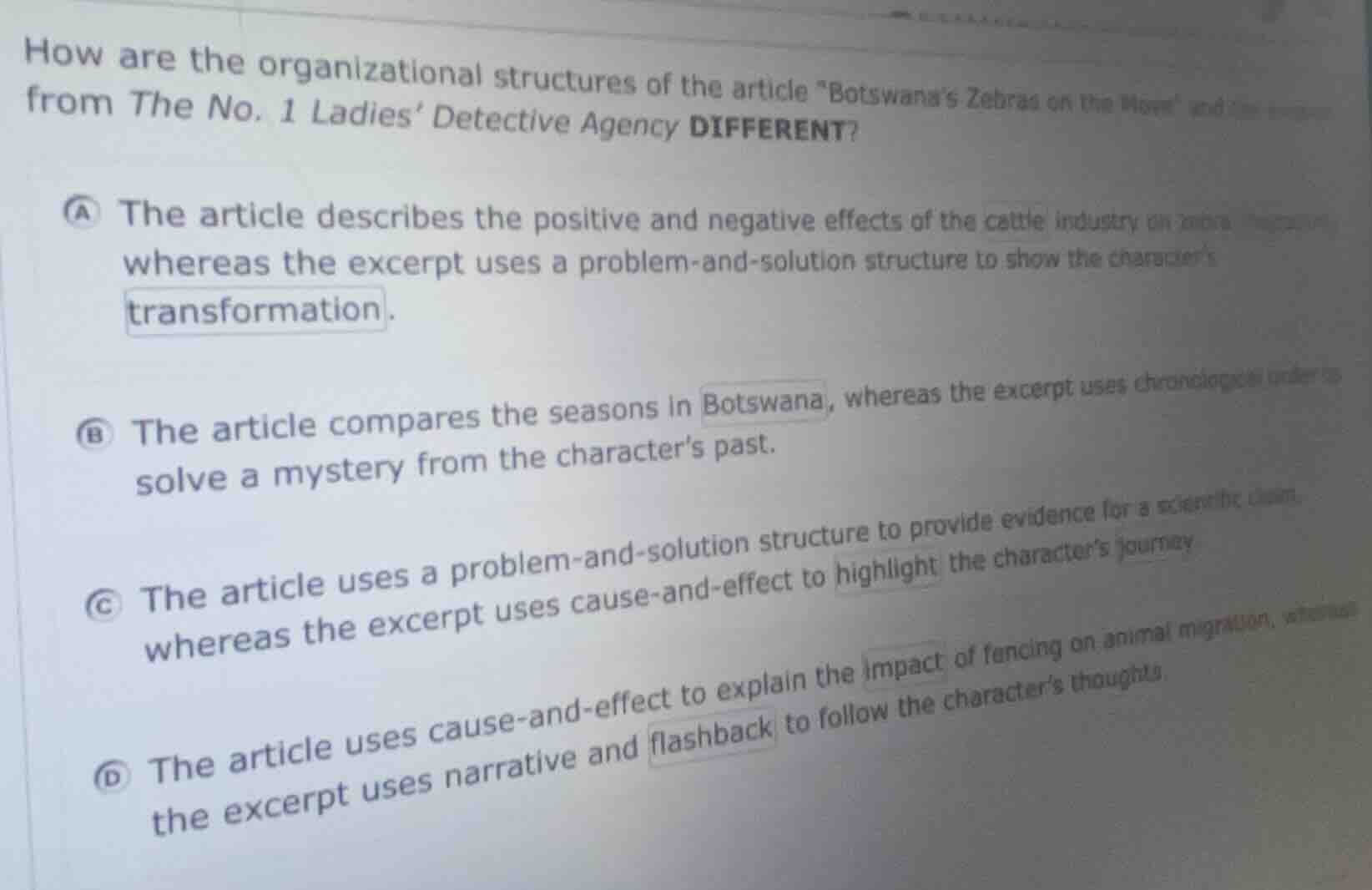
how are the organizational structures of the article \botswanas zebras on the move\ and the excerpt from the no. 1 ladies detective agency different?
a the article describes the positive and negative effects of the cattle industry on zebra migration, whereas the excerpt uses a problem-and-solution structure to show the characters transformation.
b the article compares the seasons in botswana, whereas the excerpt uses chronological order to solve a mystery from the characters past.
c the article uses a problem-and-solution structure to provide evidence for a scientific claim, whereas the excerpt uses cause-and-effect to highlight the characters journey.
d the article uses cause-and-effect to explain the impact of fencing on animal migration, whereas the excerpt uses narrative and flashback to follow the characters thoughts.
<pre_analysis>
{
"quality": "clear",
"question_count": 1,
"skills_matched": [
"direct_cot",
"multiple_choice_formatter",
"explain_then_answer",
"tutor"
],
"needs_drawing": false,
"concepts_used": [
"Textual Structure Analysis",
"Comparative Text Analysis"
],
"new_concepts": [],
"current_concepts": [
"Textual Structure Analysis",
"Comparative Text Analysis"
]
}
</pre_analysis>
<reasoning>
Analyze the question prompt
The question asks us to compare the organizational structures of two texts: the informational article "Botswana's Zebras on the Move" and a literary excerpt from The No. 1 Ladies' Detective Agency. We need to identify how their structures are DIFFERENT.
Evaluate the nature of the two texts
The first text, "Botswana's Zebras on the Move," is a scientific/informational article about zebra migration patterns in Botswana and how human interventions (like veterinary fences built for the cattle industry) have disrupted these migrations. This topic naturally lends itself to a cause-and-effect structure (e.g., how fences cause changes in migration routes and animal mortality).
The second text is an excerpt from the novel The No. 1 Ladies' Detective Agency, which is a work of fiction. Literary fiction typically uses narrative structure, often incorporating literary devices like flashbacks to reveal a character's inner thoughts, memories, and personal history.
Assess the given options
Let's analyze the options based on Textual Structure Analysis and Comparative Text Analysis:
- Option A: Suggests the article describes positive/negative effects of the cattle industry, while the excerpt uses problem-and-solution to show character transformation. This mischaracterizes the narrative structure of the novel excerpt.
- Option B: Suggests the article compares seasons, and the excerpt uses chronological order to solve a mystery from the past. This does not accurately capture the primary structural difference.
- Option C: Suggests the article uses problem-and-solution for a scientific claim, while the excerpt uses cause-and-effect. This reverses the logical flow of the informational text and misidentifies the literary structure.
- Option D: States that the article uses cause-and-effect to explain the impact of fencing on animal migration, whereas the excerpt uses narrative and flashback to follow the character's thoughts. This perfectly aligns with the informational focus on the ecological impact of fencing (cause-and-effect) and the literary focus on character reflection (narrative and flashback).
</reasoning>
<answer>
<mcq-option>(A) The article describes the positive and negative effects of the cattle industry on zebra migration, whereas the excerpt uses a problem-and-solution structure to show the character's transformation.</mcq-option>
<mcq-option>(B) The article compares the seasons in Botswana, whereas the excerpt uses chronological order to solve a mystery from the character's past.</mcq-option>
<mcq-option>(C) The article uses a problem-and-solution structure to provide evidence for a scientific claim, whereas the excerpt uses cause-and-effect to highlight the character's journey.</mcq-option>
<mcq-correct>(D) The article uses cause-and-effect to explain the impact of fencing on animal migration, whereas the excerpt uses narrative and flashback to follow the character's thoughts.</mcq-correct>
</answer>
<post_analysis>
{
"subject": "Others",
"question_type": "Multiple Choice",
"knowledge_point": [
"Others",
"English Language…
Snap & solve any problem in the app
Get step-by-step solutions on Sovi AI
Photo-based solutions with guided steps
Explore more problems and detailed explanations
<pre_analysis>
{
"quality": "clear",
"question_count": 1,
"skills_matched": [
"direct_cot",
"multiple_choice_formatter",
"explain_then_answer",
"tutor"
],
"needs_drawing": false,
"concepts_used": [
"Textual Structure Analysis",
"Comparative Text Analysis"
],
"new_concepts": [],
"current_concepts": [
"Textual Structure Analysis",
"Comparative Text Analysis"
]
}
</pre_analysis>
<reasoning>
Analyze the question prompt
The question asks us to compare the organizational structures of two texts: the informational article "Botswana's Zebras on the Move" and a literary excerpt from The No. 1 Ladies' Detective Agency. We need to identify how their structures are DIFFERENT.
Evaluate the nature of the two texts
The first text, "Botswana's Zebras on the Move," is a scientific/informational article about zebra migration patterns in Botswana and how human interventions (like veterinary fences built for the cattle industry) have disrupted these migrations. This topic naturally lends itself to a cause-and-effect structure (e.g., how fences cause changes in migration routes and animal mortality).
The second text is an excerpt from the novel The No. 1 Ladies' Detective Agency, which is a work of fiction. Literary fiction typically uses narrative structure, often incorporating literary devices like flashbacks to reveal a character's inner thoughts, memories, and personal history.
Assess the given options
Let's analyze the options based on Textual Structure Analysis and Comparative Text Analysis:
- Option A: Suggests the article describes positive/negative effects of the cattle industry, while the excerpt uses problem-and-solution to show character transformation. This mischaracterizes the narrative structure of the novel excerpt.
- Option B: Suggests the article compares seasons, and the excerpt uses chronological order to solve a mystery from the past. This does not accurately capture the primary structural difference.
- Option C: Suggests the article uses problem-and-solution for a scientific claim, while the excerpt uses cause-and-effect. This reverses the logical flow of the informational text and misidentifies the literary structure.
- Option D: States that the article uses cause-and-effect to explain the impact of fencing on animal migration, whereas the excerpt uses narrative and flashback to follow the character's thoughts. This perfectly aligns with the informational focus on the ecological impact of fencing (cause-and-effect) and the literary focus on character reflection (narrative and flashback).
</reasoning>
<answer>
<mcq-option>(A) The article describes the positive and negative effects of the cattle industry on zebra migration, whereas the excerpt uses a problem-and-solution structure to show the character's transformation.</mcq-option>
<mcq-option>(B) The article compares the seasons in Botswana, whereas the excerpt uses chronological order to solve a mystery from the character's past.</mcq-option>
<mcq-option>(C) The article uses a problem-and-solution structure to provide evidence for a scientific claim, whereas the excerpt uses cause-and-effect to highlight the character's journey.</mcq-option>
<mcq-correct>(D) The article uses cause-and-effect to explain the impact of fencing on animal migration, whereas the excerpt uses narrative and flashback to follow the character's thoughts.</mcq-correct>
</answer>
<post_analysis>
{
"subject": "Others",
"question_type": "Multiple Choice",
"knowledge_point": [
"Others",
"English Language Arts",
"Comparative Text Analysis"
]
}
</post_analysis>