QUESTION IMAGE
Question
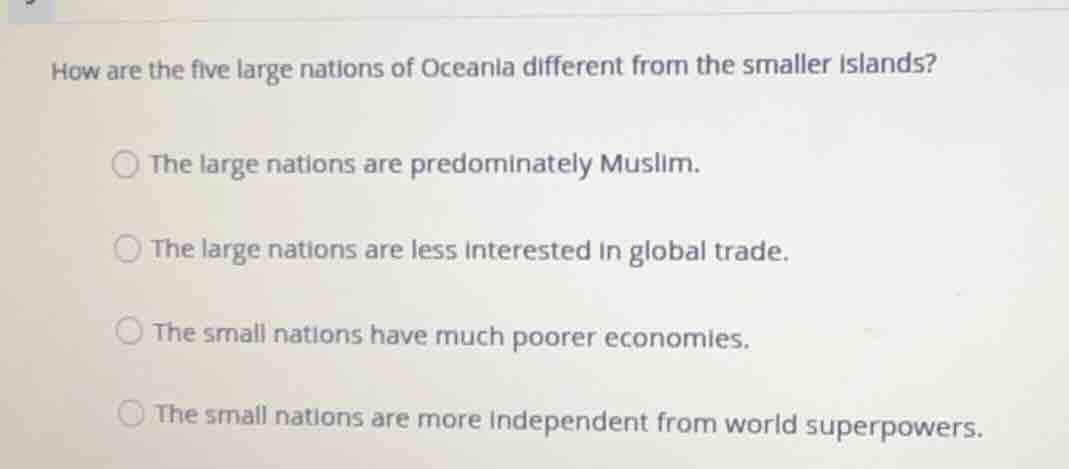
how are the five large nations of oceania different from the smaller islands?
the large nations are predominately muslim.
the large nations are less interested in global trade.
the small nations have much poorer economies.
the small nations are more independent from world superpowers.
<pre_analysis>
{
"quality": "clear",
"question_count": 1,
"skills_matched": [
"direct_cot",
"multiple_choice_formatter",
"explain_then_answer",
"quick"
],
"needs_drawing": false,
"concepts_used": [
"Oceania Regionalization"
],
"new_concepts": [
"Oceanian Geopolitics",
"Economic Disparity in Oceania"
],
"current_concepts": [
"Oceania Regionalization",
"Oceanian Geopolitics",
"Economic Disparity in Oceania"
]
}
</pre_analysis>
<reasoning>
Analyze the characteristics of large versus small Oceanian nations
The five large nations of Oceania (Australia, New Zealand, Papua New Guinea, Solomon Islands, and Fiji) possess significantly larger landmasses, more abundant natural resources, and more diversified economic bases compared to the thousands of tiny, isolated islands and atolls.
Evaluate the given options
- The large nations are predominately Muslim: Incorrect. Christianity is the predominant religion in most of Oceania, including the large nations.
- The large nations are less interested in global trade: Incorrect. Large nations like Australia and New Zealand are highly integrated into global trade networks.
- The small nations have much poorer economies: Correct. Due to extreme geographic isolation, limited land area, lack of natural resources, and susceptibility to environmental hazards, the smaller island nations face severe economic constraints and have much poorer, aid-dependent economies compared to the larger nations.
- The small nations are more independent from world superpowers: Incorrect. Many small island nations rely heavily on foreign aid, defense agreements, and diplomatic partnerships with superpowers.
</reasoning>
<answer>
<mcq-option>(A) The large nations are predominately Muslim.</mcq-option>
<mcq-option>(B) The large nations are less interested in global trade.</mcq-option>
<mcq-correct>(C) The small nations have much poorer economies.</mcq-correct>
<mcq-option>(D) The small nations are more independent from world superpowers.</mcq-option>
</answer>
<post_analysis>
{
"subject": "Social Science",
"question_type": "Multiple Choice",
"knowledge_point": [
"Social Science",
"Geography",
"Oceania Regionalization"
]
}
</post_analysis>
Snap & solve any problem in the app
Get step-by-step solutions on Sovi AI
Photo-based solutions with guided steps
Explore more problems and detailed explanations
<pre_analysis>
{
"quality": "clear",
"question_count": 1,
"skills_matched": [
"direct_cot",
"multiple_choice_formatter",
"explain_then_answer",
"quick"
],
"needs_drawing": false,
"concepts_used": [
"Oceania Regionalization"
],
"new_concepts": [
"Oceanian Geopolitics",
"Economic Disparity in Oceania"
],
"current_concepts": [
"Oceania Regionalization",
"Oceanian Geopolitics",
"Economic Disparity in Oceania"
]
}
</pre_analysis>
<reasoning>
Analyze the characteristics of large versus small Oceanian nations
The five large nations of Oceania (Australia, New Zealand, Papua New Guinea, Solomon Islands, and Fiji) possess significantly larger landmasses, more abundant natural resources, and more diversified economic bases compared to the thousands of tiny, isolated islands and atolls.
Evaluate the given options
- The large nations are predominately Muslim: Incorrect. Christianity is the predominant religion in most of Oceania, including the large nations.
- The large nations are less interested in global trade: Incorrect. Large nations like Australia and New Zealand are highly integrated into global trade networks.
- The small nations have much poorer economies: Correct. Due to extreme geographic isolation, limited land area, lack of natural resources, and susceptibility to environmental hazards, the smaller island nations face severe economic constraints and have much poorer, aid-dependent economies compared to the larger nations.
- The small nations are more independent from world superpowers: Incorrect. Many small island nations rely heavily on foreign aid, defense agreements, and diplomatic partnerships with superpowers.
</reasoning>
<answer>
<mcq-option>(A) The large nations are predominately Muslim.</mcq-option>
<mcq-option>(B) The large nations are less interested in global trade.</mcq-option>
<mcq-correct>(C) The small nations have much poorer economies.</mcq-correct>
<mcq-option>(D) The small nations are more independent from world superpowers.</mcq-option>
</answer>
<post_analysis>
{
"subject": "Social Science",
"question_type": "Multiple Choice",
"knowledge_point": [
"Social Science",
"Geography",
"Oceania Regionalization"
]
}
</post_analysis>