QUESTION IMAGE
Question
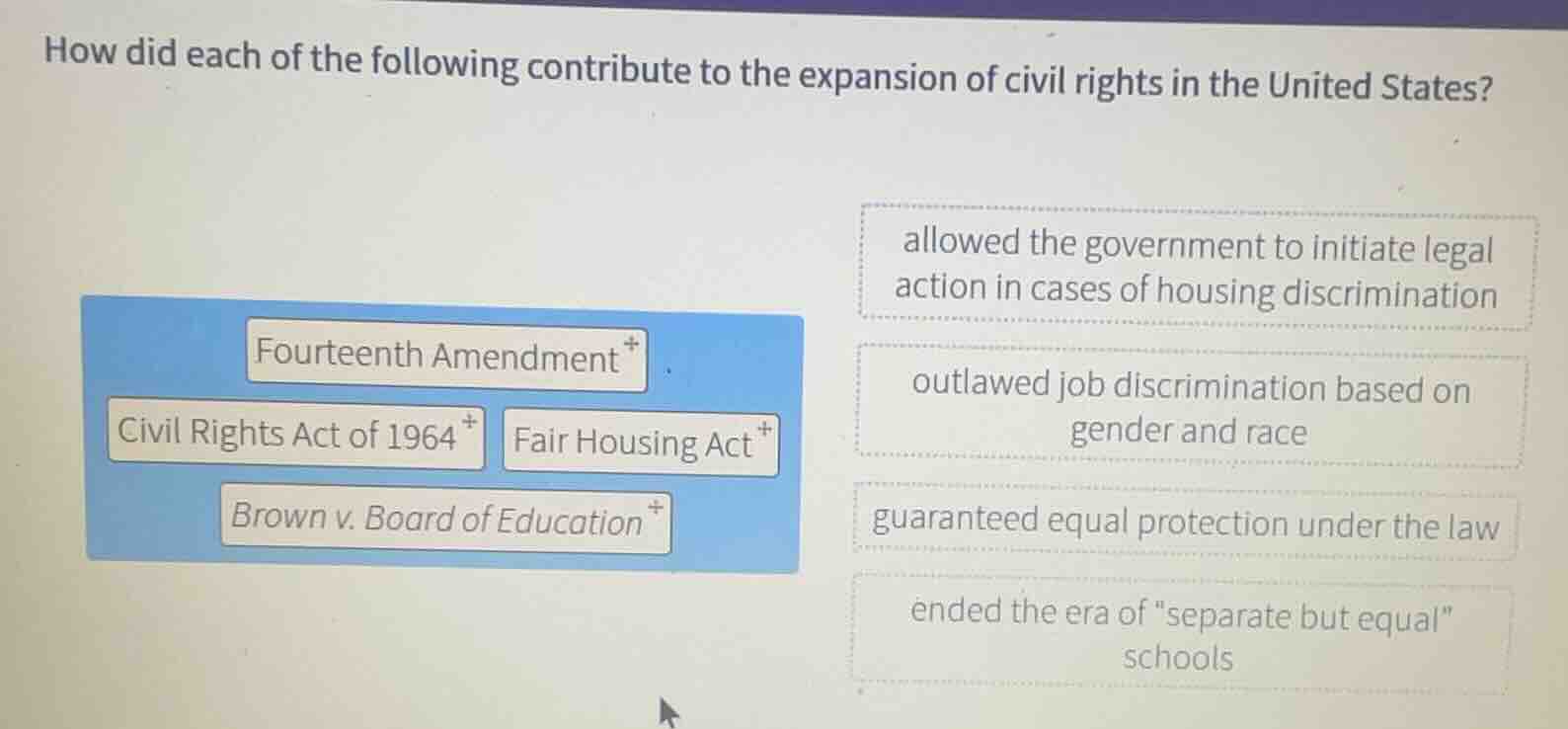
how did each of the following contribute to the expansion of civil rights in the united states?
fourteenth amendment
civil rights act of 1964
fair housing act
brown v. board of education
allowed the government to initiate legal action in cases of housing discrimination
outlawed job discrimination based on gender and race
guaranteed equal protection under the law
ended the era of \separate but equal\ schools
Match legal provisions to their civil rights contributions
- Fourteenth Amendment: Ratified in 1868, its Equal Protection Clause explicitly guaranteed equal protection under the law to all citizens.
- Civil Rights Act of 1964: Outlawed discrimination based on race, color, religion, sex, or national origin in employment (job discrimination) and public accommodations.
- Fair Housing Act (Civil Rights Act of 1968): Prohibited discrimination concerning the sale, rental, and financing of housing, allowing the federal government to initiate legal action in cases of housing discrimination.
- Brown v. Board of Education (1954): Landmark Supreme Court decision that ruled racial segregation in public schools unconstitutional, ending the era of "separate but equal" schools.

Snap & solve any problem in the app
Get step-by-step solutions on Sovi AI
Photo-based solutions with guided steps
Explore more problems and detailed explanations
| Legal Provision / Event | Contribution to Civil Rights |
|---|---|
| Civil Rights Act of 1964 | outlawed job discrimination based on gender and race |
| Fair Housing Act | allowed the government to initiate legal action in cases of housing discrimination |
| Brown v. Board of Education | ended the era of "separate but equal" schools |