QUESTION IMAGE
Question
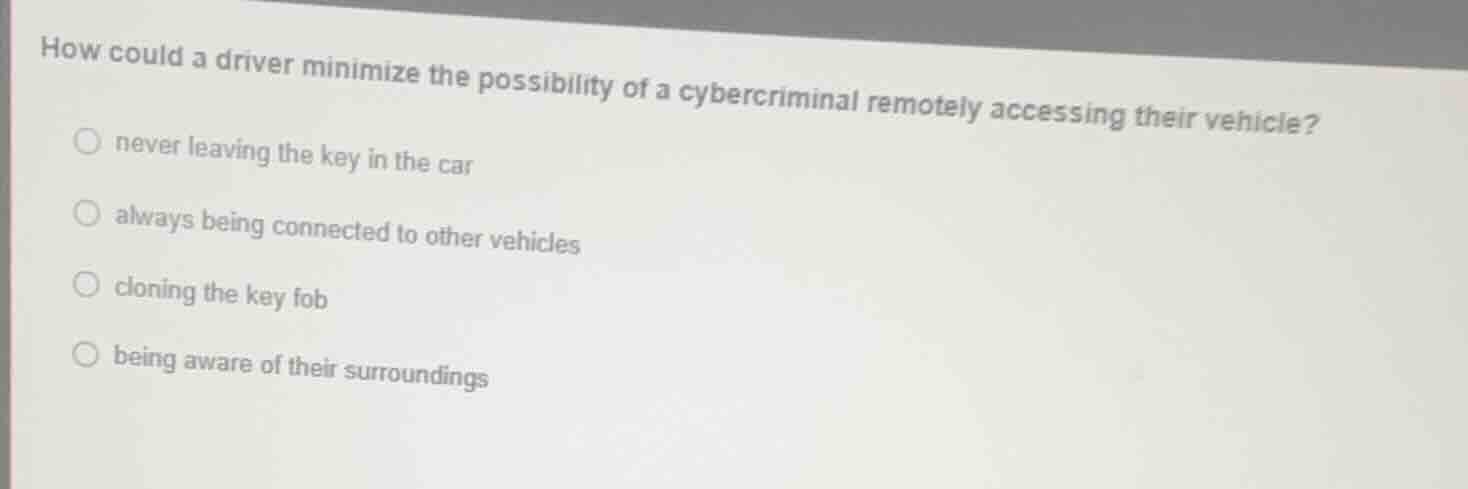
how could a driver minimize the possibility of a cybercriminal remotely accessing their vehicle?
never leaving the key in the car
always being connected to other vehicles
cloning the key fob
being aware of their surroundings
Analyze the security threat
The question asks how a driver can minimize the risk of a cybercriminal remotely accessing their vehicle. Remote access typically exploits wireless entry systems, such as keyless entry signals or connected vehicle networks.
Evaluate the options
- never leaving the key in the car: Leaving a smart key inside the car allows anyone physically present to start it, but more importantly, keeping the key inside maintains an active wireless connection/handshake with the vehicle's receivers. Removing the key breaks this active link, reducing the window for remote signal interception or relay attacks.
- always being connected to other vehicles: This increases the attack surface via vehicle-to-vehicle (V2V) networks, making remote hacking more likely, not less.
- cloning the key fob: This is a method used by criminals to steal cars, not a defensive measure.
- being aware of their surroundings: While good for physical safety, situational awareness does not prevent remote digital exploits or wireless signal interception.
Apply vehicle security principles
Using Vehicle Security Systems knowledge, leaving a smart key or key fob inside a modern vehicle keeps its transponder active. This allows attackers to perform relay attacks or exploit the vehicle's wireless systems remotely. Therefore, never leaving the key in the car is the most effective action among the choices to minimize remote access vulnerabilities.

Snap & solve any problem in the app
Get step-by-step solutions on Sovi AI
Photo-based solutions with guided steps
Explore more problems and detailed explanations
- (A) never leaving the key in the car (Correct answer)
- (B) always being connected to other vehicles
- (C) cloning the key fob
- (D) being aware of their surroundings