QUESTION IMAGE
Question
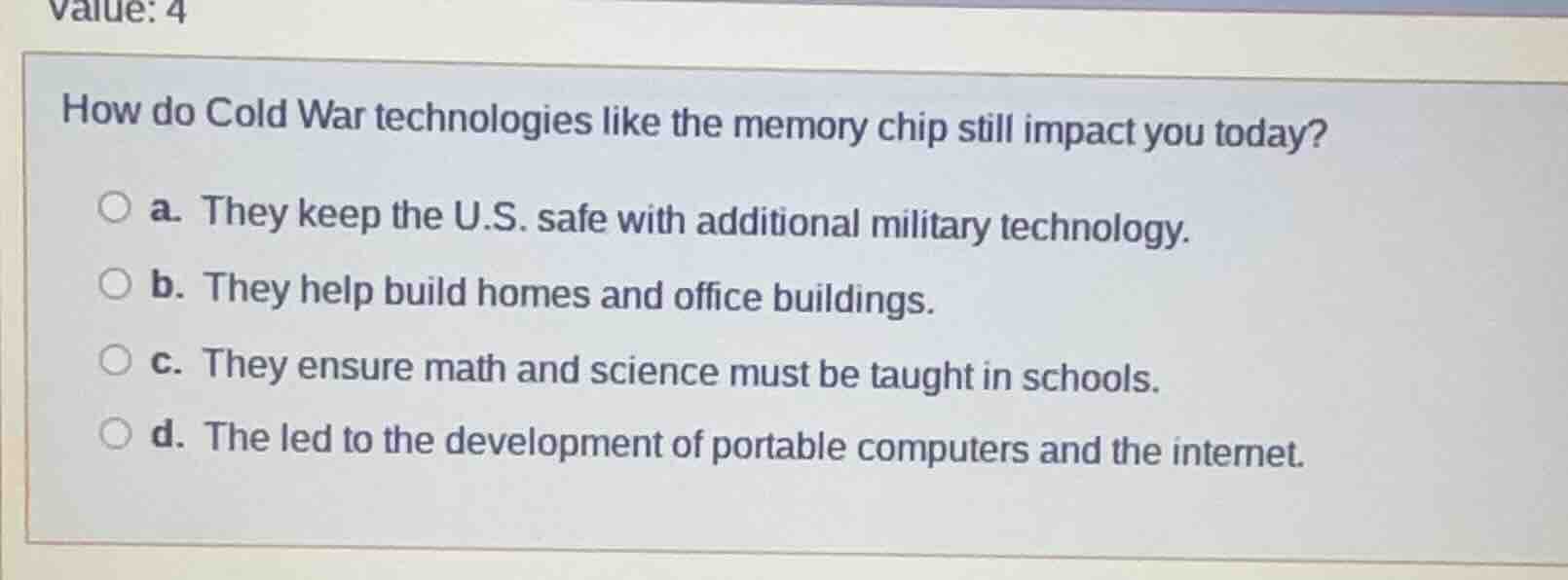
how do cold war technologies like the memory chip still impact you today?
a. they keep the u.s. safe with additional military technology.
b. they help build homes and office buildings.
c. they ensure math and science must be taught in schools.
d. the led to the development of portable computers and the internet.
Analyze the question prompt
The question asks how Cold War technologies, specifically mentioning the memory chip, still impact individuals today. This requires connecting historical military/space race innovations to modern daily life.
Evaluate the options
- Option a: While military technology remains active, "keeping the U.S. safe" is a national defense function rather than a direct personal impact of consumer-facing technologies like memory chips for most individuals.
- Option b: Memory chips and related digital technologies are not primary materials or tools used to physically build homes and office buildings.
- Option c: The National Defense Education Act promoted math and science education, but memory chips themselves do not "ensure" school curricula.
- Option d: Memory chips, microprocessors, and early network developments during the Cold War directly paved the way for modern consumer electronics, including portable computers, smartphones, and the internet.
Connect to mastered concepts
Using the Cold War Technology knowledge point, we know that government-funded research during the mid-to-late 20th century aimed at miniaturizing circuits for guidance systems and satellite communications. This research directly accelerated the development of silicon microchips and early packet-switching networks (like ARPANET), which ultimately evolved into modern personal computers and the global internet.
Formulate the final selection
Option d is the most accurate and direct description of how these specific technological advancements impact everyday life today.

Snap & solve any problem in the app
Get step-by-step solutions on Sovi AI
Photo-based solutions with guided steps
Explore more problems and detailed explanations
- a. They keep the U.S. safe with additional military technology.
- b. They help build homes and office buildings.
- c. They ensure math and science must be taught in schools.
- d. The led to the development of portable computers and the internet. (Correct answer)