QUESTION IMAGE
Question
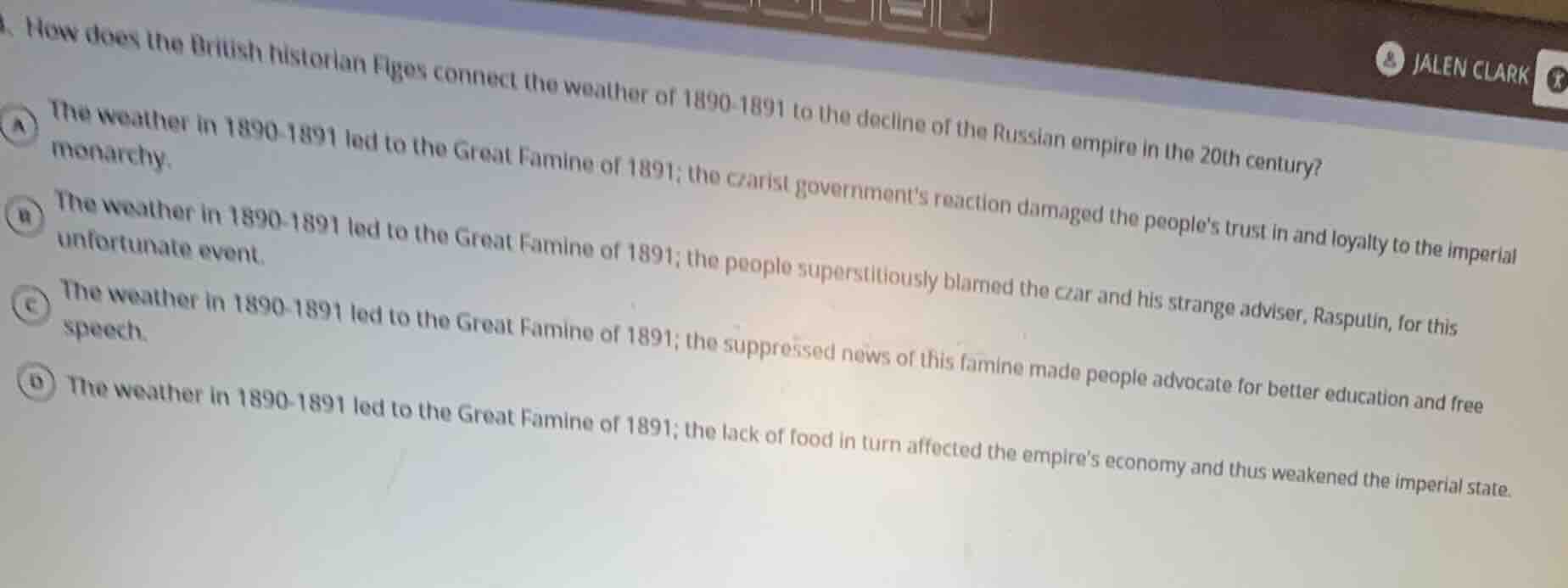
- how does the british historian figes connect the weather of 1890 - 1891 to the decline of the russian empire in the 20th century?
a) the weather in 1890 - 1891 led to the great famine of 1891; the czarist government’s reaction damaged the people’s trust in and loyalty to the imperial monarchy.
b) the weather in 1890 - 1891 led to the great famine of 1891; the people superstitiously blamed the czar and his strange adviser, rasputin, for this unfortunate event.
c) the weather in 1890 - 1891 led to the great famine of 1891; the suppressed news of this famine made people advocate for better education and free speech.
d) the weather in 1890 - 1891 led to the great famine of 1891; the lack of food in turn affected the empire’s economy and thus weakened the imperial state.
Orlando Figes argues that the 1890-1891 extreme weather triggered the 1891 Great Famine. The tsarist government's slow, inadequate response eroded public trust and loyalty to the monarchy, which was a key step in the empire's 20th-century decline. Option C is incorrect because Rasputin rose to influence later, not during 1891. Option D misrepresents Figes' focus, which was on political legitimacy rather than direct economic impact alone. Option A is too vague without linking to the government's failure.

Snap & solve any problem in the app
Get step-by-step solutions on Sovi AI
Photo-based solutions with guided steps
Explore more problems and detailed explanations
B. The weather in 1890-1891 led to the Great Famine of 1891; the people superstitiously blamed the czar and his strange adviser, Rasputin, for this unfortunate event.