Sovi.AI - AI Math Tutor

Scan to solve math questions

QUESTION IMAGE

how do the areas of the parallelograms compare? - the area of parallelo…

Question

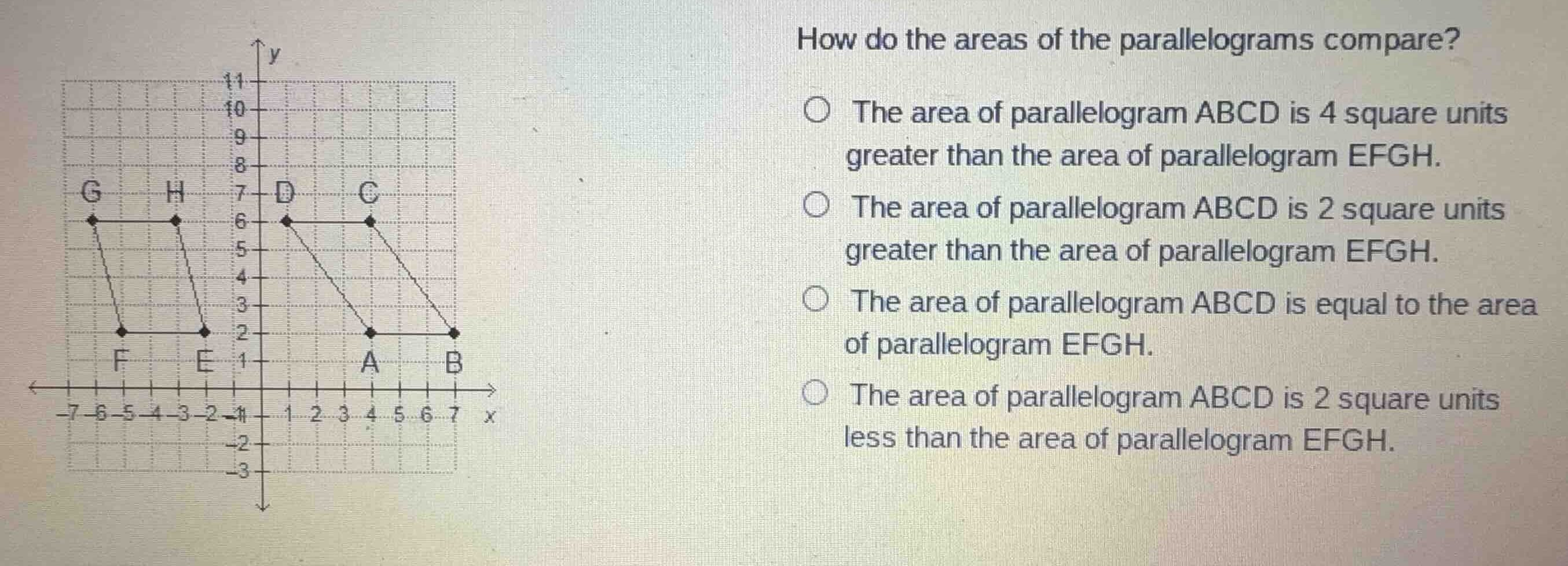
how do the areas of the parallelograms compare?

  • the area of parallelogram abcd is 4 square units greater than the area of parallelogram efgh.
  • the area of parallelogram abcd is 2 square units greater than the area of parallelogram efgh.
  • the area of parallelogram abcd is equal to the area of parallelogram efgh.
  • the area of parallelogram abcd is 2 square units less than the area of parallelogram efgh.

Explanation:

Response

<pre_analysis>
{
"quality": "clear",
"question_count": 1,
"skills_matched": [
"step_cot",
"multiple_choice_formatter",
"explain_then_answer",
"tutor"
],
"needs_drawing": false,
"concepts_used": [
"Area of Polygons"
],
"new_concepts": [
"Parallelogram Area in Coordinate Plane"
],
"current_concepts": [
"Area of Polygons",
"Parallelogram Area in Coordinate Plane"
]
}
</pre_analysis>

<reasoning>

Identify coordinates and dimensions of ABCD

We find the coordinates of the vertices of parallelogram \(ABCD\) from the grid:

  • \(A = (4, 2)\)
  • \(B = (7, 2)\)
  • \(C = (4, 6)\)
  • \(D = (1, 6)\)

Using the Area of Polygons concept, we find the base and height:

  • The base \(AB\) lies on the horizontal line \(y = 2\).
  • Length of base \(b_1 = 7 - 4 = 3\) units.
  • The height \(h_1\) is the vertical distance between the parallel lines \(y = 2\) and \(y = 6\).
  • Height \(h_1 = 6 - 2 = 4\) units.

Calculate the area of ABCD

Using the formula for the area of a parallelogram:
\[
\text{Area}(ABCD) = b_1 \times h_1
\]
\[
\text{Area}(ABCD) = 3 \times 4 = 12\text{ square units}
\]

Identify coordinates and dimensions of EFGH

We find the coordinates of the vertices of parallelogram \(EFGH\) from the grid:

  • \(E = (-2, 2)\)
  • \(F = (-5, 2)\)
  • \(G = (-6, 6)\)
  • \(H = (-3, 6)\)

Using the Area of Polygons concept, we find the base and height:

  • The base \(FE\) lies on the horizontal line \(y = 2\).
  • Length of base \(b_2 = -2 - (-5) = 3\) units.
  • The height \(h_2\) is the vertical distance between the parallel lines \(y = 2\) and \(y = 6\).
  • Height \(h_2 = 6 - 2 = 4\) units.

Calculate the area of EFGH

Using the formula for the area of a parallelogram:
\[
\text{Area}(EFGH) = b_2 \times h_2
\]
\[
\text{Area}(EFGH) = 3 \times 4 = 12\text{ square units}
\]

Compare the areas

We compare the calculated areas:

  • \(\text{Area}(ABCD) = 12\text{ square units}\)
  • \(\text{Area}(EFGH) = 12\text{ square units}\)

Since both areas are equal, the areas of the two parallelograms are equal.
</reasoning>

<answer>
<mcq-option>The area of parallelogram ABCD is 4 square units greater than the area of parallelogram EFGH.</mcq-option>
<mcq-option>The area of parallelogram ABCD is 2 square units greater than the area of parallelogram EFGH.</mcq-option>
<mcq-correct>The area of parallelogram ABCD is equal to the area of parallelogram EFGH.</mcq-correct>
<mcq-option>The area of parallelogram ABCD is 2 square units less than the area of parallelogram EFGH.</mcq-option>
</answer>

<post_analysis>
{
"subject": "Mathematics",
"question_type": "Multiple Choice",
"knowledge_point": [
"Mathematics",
"Geometry",
"Parallelogram Area in Coordinate Plane"
]
}
</post_analysis>

Answer:

<pre_analysis>
{
"quality": "clear",
"question_count": 1,
"skills_matched": [
"step_cot",
"multiple_choice_formatter",
"explain_then_answer",
"tutor"
],
"needs_drawing": false,
"concepts_used": [
"Area of Polygons"
],
"new_concepts": [
"Parallelogram Area in Coordinate Plane"
],
"current_concepts": [
"Area of Polygons",
"Parallelogram Area in Coordinate Plane"
]
}
</pre_analysis>

<reasoning>

Identify coordinates and dimensions of ABCD

We find the coordinates of the vertices of parallelogram \(ABCD\) from the grid:

  • \(A = (4, 2)\)
  • \(B = (7, 2)\)
  • \(C = (4, 6)\)
  • \(D = (1, 6)\)

Using the Area of Polygons concept, we find the base and height:

  • The base \(AB\) lies on the horizontal line \(y = 2\).
  • Length of base \(b_1 = 7 - 4 = 3\) units.
  • The height \(h_1\) is the vertical distance between the parallel lines \(y = 2\) and \(y = 6\).
  • Height \(h_1 = 6 - 2 = 4\) units.

Calculate the area of ABCD

Using the formula for the area of a parallelogram:
\[
\text{Area}(ABCD) = b_1 \times h_1
\]
\[
\text{Area}(ABCD) = 3 \times 4 = 12\text{ square units}
\]

Identify coordinates and dimensions of EFGH

We find the coordinates of the vertices of parallelogram \(EFGH\) from the grid:

  • \(E = (-2, 2)\)
  • \(F = (-5, 2)\)
  • \(G = (-6, 6)\)
  • \(H = (-3, 6)\)

Using the Area of Polygons concept, we find the base and height:

  • The base \(FE\) lies on the horizontal line \(y = 2\).
  • Length of base \(b_2 = -2 - (-5) = 3\) units.
  • The height \(h_2\) is the vertical distance between the parallel lines \(y = 2\) and \(y = 6\).
  • Height \(h_2 = 6 - 2 = 4\) units.

Calculate the area of EFGH

Using the formula for the area of a parallelogram:
\[
\text{Area}(EFGH) = b_2 \times h_2
\]
\[
\text{Area}(EFGH) = 3 \times 4 = 12\text{ square units}
\]

Compare the areas

We compare the calculated areas:

  • \(\text{Area}(ABCD) = 12\text{ square units}\)
  • \(\text{Area}(EFGH) = 12\text{ square units}\)

Since both areas are equal, the areas of the two parallelograms are equal.
</reasoning>

<answer>
<mcq-option>The area of parallelogram ABCD is 4 square units greater than the area of parallelogram EFGH.</mcq-option>
<mcq-option>The area of parallelogram ABCD is 2 square units greater than the area of parallelogram EFGH.</mcq-option>
<mcq-correct>The area of parallelogram ABCD is equal to the area of parallelogram EFGH.</mcq-correct>
<mcq-option>The area of parallelogram ABCD is 2 square units less than the area of parallelogram EFGH.</mcq-option>
</answer>

<post_analysis>
{
"subject": "Mathematics",
"question_type": "Multiple Choice",
"knowledge_point": [
"Mathematics",
"Geometry",
"Parallelogram Area in Coordinate Plane"
]
}
</post_analysis>