QUESTION IMAGE
Question
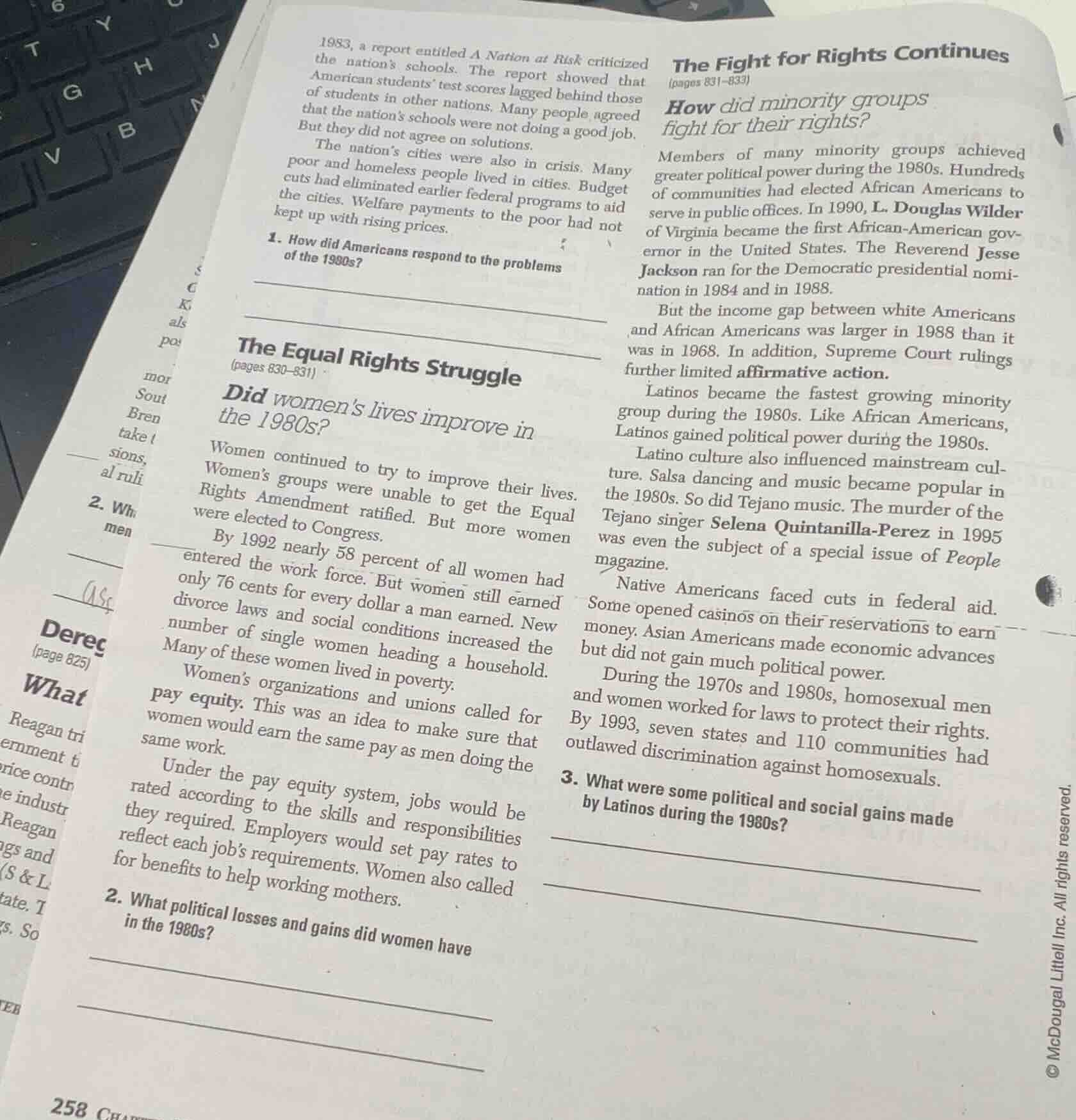
- how did americans respond to the problems of the 1980s?
- what political losses and gains did women have in the 1980s?
- what were some political and social gains made by latinos during the 1980s?
Analyze responses to 1980s problems
The text describes two major problems in the 1980s: a decline in public education quality (highlighted by the 1983 report A Nation at Risk) and an urban crisis marked by poverty, homelessness, and budget cuts. Americans responded by agreeing that schools were underperforming, though they disagreed on solutions. In cities, rising prices and cuts to federal aid and welfare payments left many struggling, with no unified national response described other than recognizing the crises.
Analyze women's political gains and losses
According to the section "The Equal Rights Struggle," women experienced both advancements and setbacks in the 1980s:
- Losses/Setbacks: They failed to get the Equal Rights Amendment (ERA) ratified. Economically, women still faced a significant wage gap, earning only 76 cents for every dollar earned by men by 1992, and many single-mother households lived in poverty.
- Gains: More women were elected to Congress, and their workforce participation increased to nearly 58 percent by 1992. Organizations also successfully advocated for pay equity systems and benefits for working mothers.
Analyze political and social gains of Latinos
According to the section "The Fight for Rights Continues," Latinos made several notable advancements:
- Political Gains: Latinos became the fastest-growing minority group and successfully gained increased political power during the decade.
- Social/Cultural Gains: Latino culture significantly influenced mainstream American culture, with growing popularity in salsa dancing, Latino music, and Tejano music.

Snap & solve any problem in the app
Get step-by-step solutions on Sovi AI
Photo-based solutions with guided steps
Explore more problems and detailed explanations
Question 1
Americans responded to the educational crisis by widely agreeing that public schools were not performing well, though they remained divided on the proper solutions. In response to the urban crisis of poverty and homelessness, which was worsened by federal budget cuts and inadequate welfare adjustments, local communities faced severe social strain without a unified national consensus on how to resolve these issues.
Question 2
- Political and Economic Losses: Women failed to secure the ratification of the Equal Rights Amendment (ERA). Economically, they continued to earn significantly less than men (76 cents on the dollar by 1992), and an increase in divorce rates left many single-mother households in poverty.
- Political and Economic Gains: More women were elected to Congress, and female labor force participation rose to nearly 58 percent by 1992. Additionally, women's organizations successfully pushed for pay equity policies and support benefits for working mothers.
Question 3
- Political Gains: Latinos became the fastest-growing minority group in the United States and successfully expanded their political representation and influence.
- Social and Cultural Gains: Latino culture entered the mainstream, marked by the widespread popularity of salsa dancing, Latino music, and Tejano music.