QUESTION IMAGE
Question
homework 3 - due on monday, feb 26 at 5 pm.
instructions: write your answers in the space provided. it is ok to complete the homework digitally using a tablet; simply download the pdf template from blackboard. upload a legible scanned pdf of your answers to gradescope when finished.
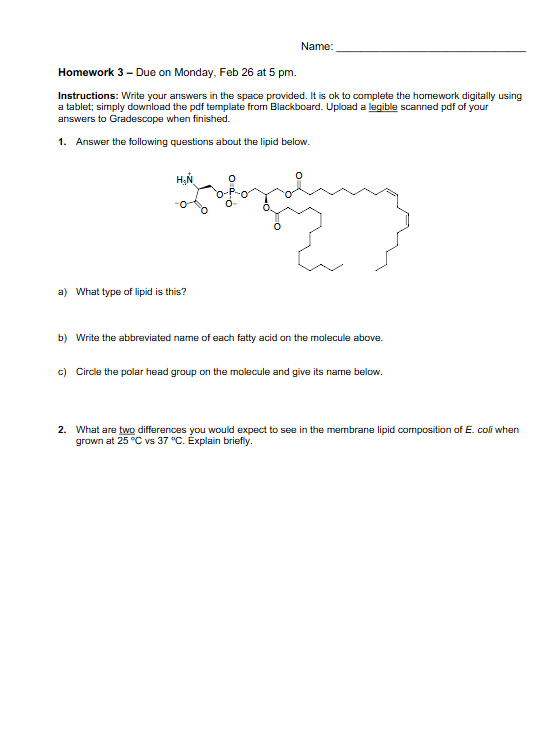
- answer the following questions about the lipid below.
a) what type of lipid is this?
b) write the abbreviated name of each fatty acid on the molecule above.
c) circle the polar head group on the molecule and give its name below.
- what are two differences you would expect to see in the membrane lipid composition of e. coli when grown at 25 \\(^{\circ}\text{c}\\) vs 37 \\(^{\circ}\text{c}\\). explain briefly.
🆕 New Concept Discovered: Lipid Structure and Membrane Adaptation
Identifying lipid components and how temperature affects membrane composition.
Step 1: Identify the lipid type (1a)
To determine the type of lipid, we look at its structural backbone and attached groups:
- Backbone: A three-carbon glycerol backbone.
- Fatty Acids: Two hydrophobic fatty acid tails are ester-linked to the first two carbons of the glycerol backbone (at the $sn\text{-}1$ and $sn\text{-}2$ positions).
- Head Group: A phosphate group is ester-linked to the third carbon ($sn\text{-}3$), which in turn is attached to a serine head group (identifiable by its carboxylate group, protonated amino group, and central carbon).
Because it contains a glycerol backbone, two fatty acids, and a phosphate-linked head group, it is a glycerophospholipid (or simply phospholipid).
---
Step 2: Determine the abbreviated names of the fatty acids (1b)
We count the carbons and identify any double bonds (unsaturations) in each tail, starting from the carbonyl carbon (C1):
- Top tail (at $sn\text{-}1$):
- Counting the carbons starting from the carbonyl carbon: C1 (carbonyl) $
ightarrow$ 2 $
ightarrow$ 3 $
ightarrow$ 4 $
ightarrow$ 5 $
ightarrow$ 6 $
ightarrow$ 7 $
ightarrow$ 8 $
ightarrow$ 9 (first double bond starts here) $
ightarrow$ 10 $
ightarrow$ 11 $
ightarrow$ 12 (second double bond starts here) $
ightarrow$ 13 $
ightarrow$ 14 $
ightarrow$ 15 $
ightarrow$ 16 $
ightarrow$ 17 $
ightarrow$ 18.
- There are 18 carbons and 2 double bonds located at positions 9 and 12 (both are cis).
- Abbreviation: 18:2 ($\Delta^{9,12}$) (commonly known as linoleic acid).
- Bottom tail (at $sn\text{-}2$):
- Counting the carbons starting from the carbonyl carbon: C1 (carbonyl) $
ightarrow$ 2 $
ightarrow$ 3 $
ightarrow$ 4 $
ightarrow$ 5 $
ightarrow$ 6 $
ightarrow$ 7 $
ightarrow$ 8 $
ightarrow$ 9 $
ightarrow$ 10 $
ightarrow$ 11 $
ightarrow$ 12 $
ightarrow$ 13 $
ightarrow$ 14 $
ightarrow$ 15 $
ightarrow$ 16.
- This tail is fully saturated with no double bonds and contains 16 carbons.
- Abbreviation: 16:0 (commonly known as palmitic acid).
---
Step 3: Identify and name the polar head group (1c)
- Identification: The polar head group attached to the phosphate is the amino acid serine, which is linked via its side-chain hydroxyl group.
- Visual location to circle: On the left side of the molecule, circle the group attached to the phosphate oxygen:
- Name: Serine (making the entire lipid phosphatidylserine).
---
Step 4: Analyze membrane adaptation to temperature (2)
Bacteria like E. coli regulate their membrane fluidity homeostatically to maintain optimal function at different environmental temperatures:
- At lower temperatures ($25^\circ\text{C}$ vs $37^\circ\text{C}$): Membranes tend to become more rigid and less fluid. To counteract this and maintain fluidity, E. coli increases the proportion of lipids that prevent tight packing.
- Expected differences at $25^\circ\text{C}$ compared to $37^\circ\text{C}$:
- Increase in unsaturated fatty acids: Introducing double bonds (which create kinks in the hydrocarbon chains) prevents tight packing, lowering the transition temperature and keeping the membrane fluid at lower temperatures.
- Decrease in average fatty acid chain length: Shorter fatty acid chains have fewer van der Waals interactions with neighboring lipids, which increases fluidity at lower temperatures.

Snap & solve any problem in the app
Get step-by-step solutions on Sovi AI
Photo-based solutions with guided steps
Explore more problems and detailed explanations
1. Lipid Analysis
- a) What type of lipid is this?
Glycerophospholipid (or Phospholipid)
- b) Write the abbreviated name of each fatty acid on the molecule above.
- Top tail ($sn\text{-}1$): 18:2 ($\Delta^{9,12}$)
- Bottom tail ($sn\text{-}2$): 16:0
- c) Circle the polar head group on the molecule and give its name below.
- Name: Serine (or Phosphatidylserine for the head group with phosphate)
- Note for circling: Circle the amino acid portion on the far left: $\text{--CH}_2\text{--CH(NH}_3^+\text{)--COO}^-$.
---
2. Membrane Lipid Composition of E. coli ($25^\circ\text{C}$ vs $37^\circ\text{C}$)
When grown at the lower temperature of $25^\circ\text{C}$ compared to $37^\circ\text{C}$, you would expect:
- An increase in the ratio of unsaturated to saturated fatty acids: Unsaturated fatty acids contain cis-double bonds that introduce kinks into the hydrocarbon tails. This prevents tight packing of the membrane lipids, maintaining essential membrane fluidity at lower temperatures.
- A decrease in average fatty acid chain length: Shorter fatty acid chains have less surface area, reducing stabilizing van der Waals interactions between adjacent lipids. This lowers the melting temperature of the membrane, keeping it functional and fluid at $25^\circ\text{C}$.