QUESTION IMAGE
Question
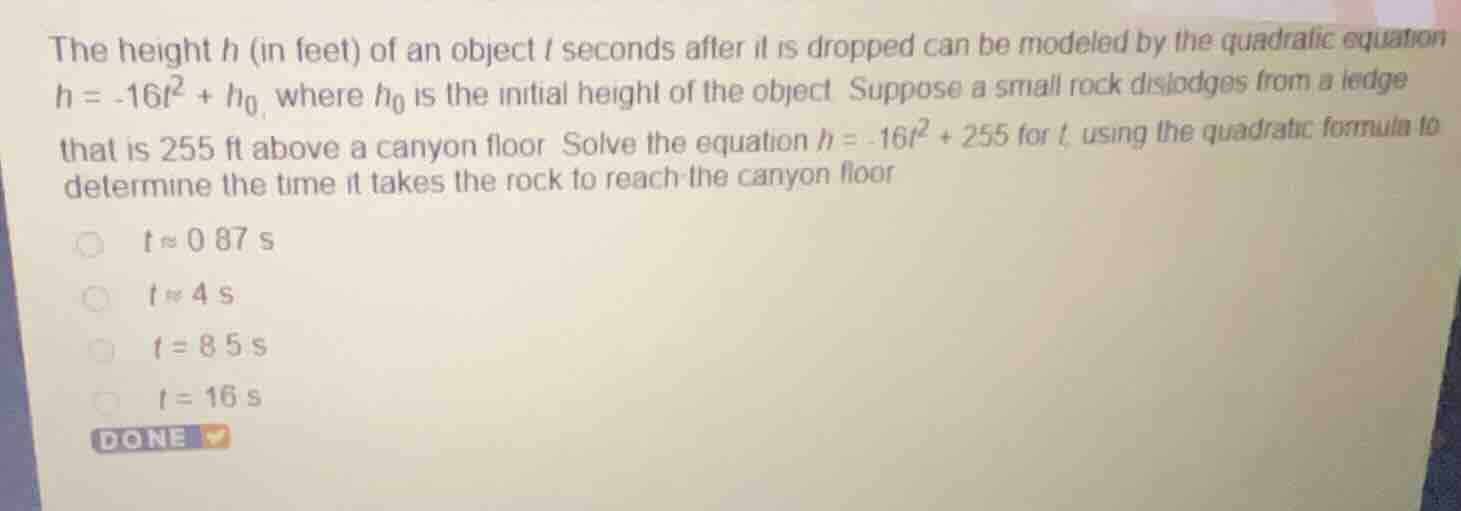
the height (h) (in feet) of an object (t) seconds after it is dropped can be modeled by the quadratic equation (h = -16t^2 + h_0), where (h_0) is the initial height of the object. suppose a small rock dislodges from a ledge that is (255\text{ ft}) above a canyon floor. solve the equation (h = -16t^2 + 255) for (t), using the quadratic formula to determine the time it takes the rock to reach the canyon floor.
(t approx 0.87\text{ s})
(t approx 4\text{ s})
(t = 8.5\text{ s})
(t = 16\text{ s})
Set the height to zero for the canyon floor
$$
0 = -16t^2 + 255
$$
Solve for t using the quadratic formula
$$
LATEXBLOCK0
$$
Round to the nearest tenth or integer
$$
t \approx 4\text{ s}
$$

Snap & solve any problem in the app
Get step-by-step solutions on Sovi AI
Photo-based solutions with guided steps
Explore more problems and detailed explanations
- (A) \(t \approx 0.87\text{ s}\)
- (B) \(t \approx 4\text{ s}\) (Correct answer)
- (C) \(t = 8.5\text{ s}\)
- (D) \(t = 16\text{ s}\)