QUESTION IMAGE
Question
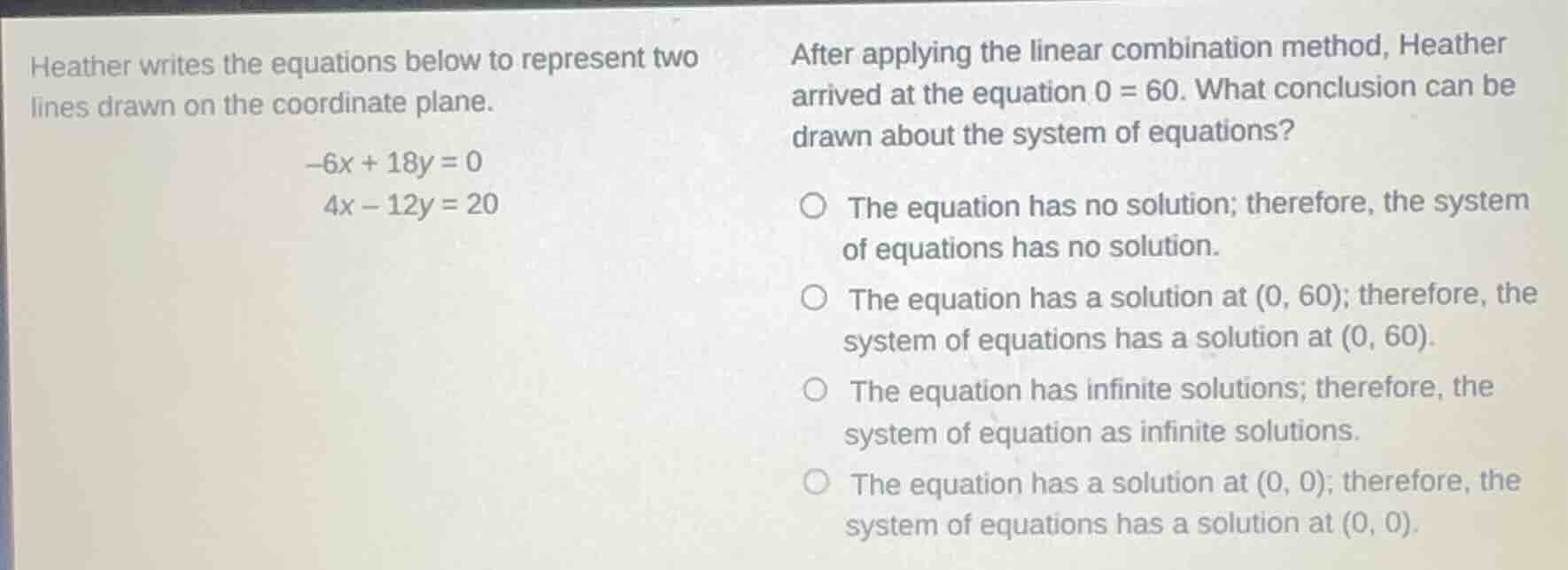
heather writes the equations below to represent two lines drawn on the coordinate plane.\\(-6x + 18y = 0\\)\\(4x - 12y = 20\\)after applying the linear combination method, heather arrived at the equation \\(0 = 60\\). what conclusion can be drawn about the system of equations?\\(\bigcirc\\) the equation has no solution; therefore, the system of equations has no solution.\\(\bigcirc\\) the equation has a solution at \\((0, 60)\\); therefore, the system of equations has a solution at \\((0, 60)\\).\\(\bigcirc\\) the equation has infinite solutions; therefore, the system of equation as infinite solutions.\\(\bigcirc\\) the equation has a solution at \\((0, 0)\\); therefore, the system of equations has a solution at \\((0, 0)\\).
To determine the conclusion about the system of linear equations, we analyze the result of the linear combination method. The system of equations is:
- \(-6x + 18y = 0\)
- \(4x - 12y = 20\)
When applying the linear combination (elimination) method, we aim to eliminate one variable. First, simplify the equations or scale them to align coefficients. Notice that the first equation can be simplified by dividing by \(-6\): \(x - 3y = 0\) (or \(x = 3y\)). The second equation can be divided by \(4\): \(x - 3y = 5\).
Now, the system becomes:
- \(x - 3y = 0\)
- \(x - 3y = 5\)
These are two parallel lines (same slope, different y - intercepts) because they have the same left - hand side (\(x - 3y\)) but different right - hand sides (\(0\) vs. \(5\)). When we use elimination, we might end up with a contradiction like \(0 = 60\) (after manipulating the original equations). A contradiction (a statement that is always false, like \(0 = 60\)) implies that there are no values of \(x\) and \(y\) that satisfy both equations simultaneously.
Let's check the options:
- Option 1: “The equation has no solution; therefore, the system of equations has no solution.” This matches our analysis. A contradiction in the elimination process means the system is inconsistent (no solution) because the two lines are parallel and never intersect.
- Option 2: \(0 = 60\) is a contradiction, not a valid equation with a solution at \((0, 60)\). Substituting \((0, 60)\) into the original equations: For \(-6(0)+18(60)=1080
eq0\), so this is incorrect.
- Option 3: Infinite solutions occur when the two equations are equivalent (represent the same line), but here we have a contradiction, so this is wrong.
- Option 4: Substituting \((0, 0)\) into the second equation: \(4(0)-12(0)=0
eq20\), so \((0, 0)\) is not a solution, and the system does not have a solution here.

Snap & solve any problem in the app
Get step-by-step solutions on Sovi AI
Photo-based solutions with guided steps
Explore more problems and detailed explanations
The equation has no solution; therefore, the system of equations has no solution.