QUESTION IMAGE
Question
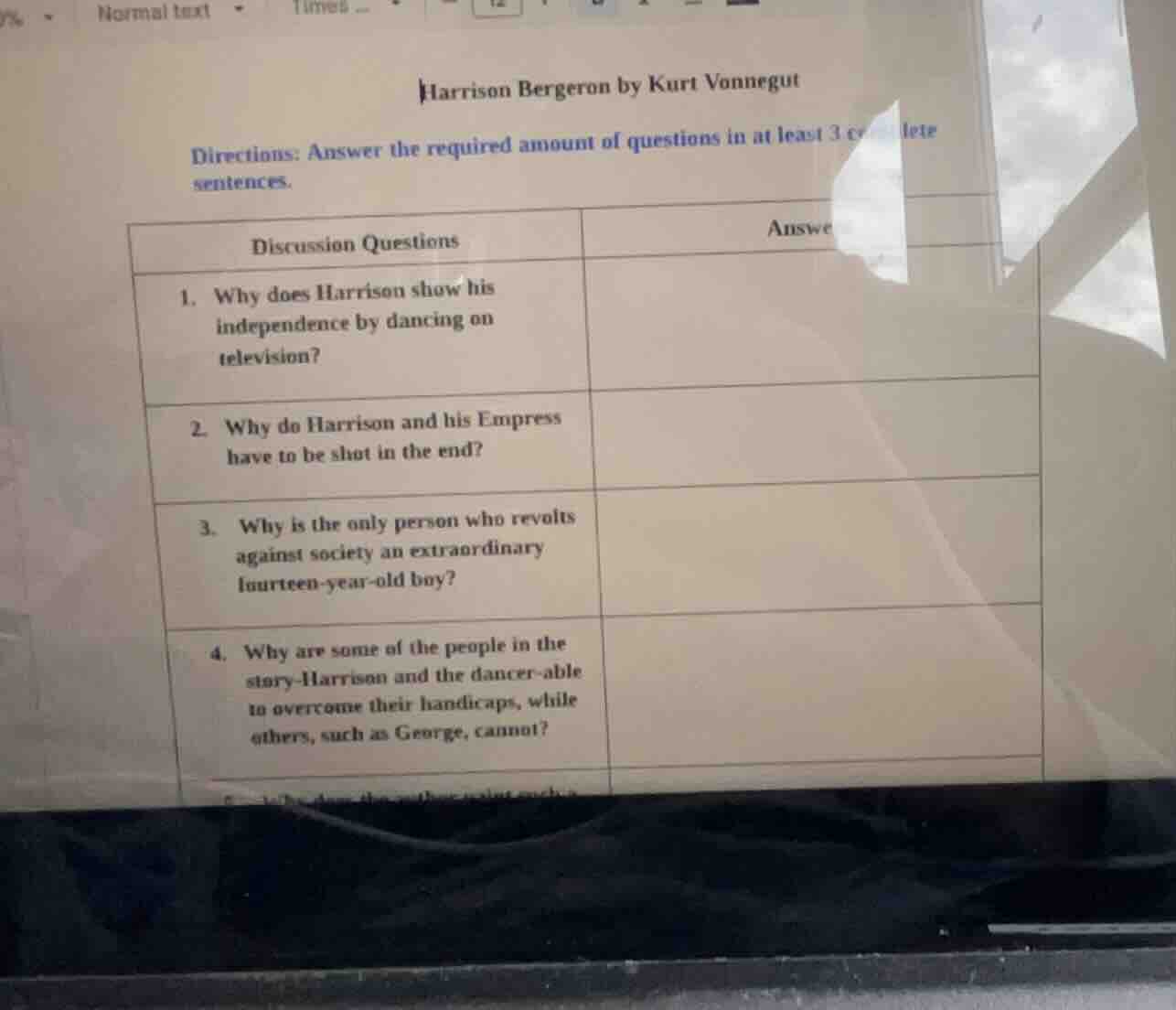
harrison bergeron by kurt vonnegut
directions: answer the required amount of questions in at least 3 complete sentences.
discussion questions
- why does harrison show his independence by dancing on television?
- why do harrison and his empress have to be shot in the end?
- why is the only person who revolts against society an extraordinary fourteen-year-old boy?
- why are some of the people in the story-harrison and the dancer-able to overcome their handicaps, while others, such as george, cannot?
Analyze Harrison's televised dance
Harrison's dance on television is a public act of defiance against a repressive regime. By shedding his physical handicaps and dancing beautifully, he demonstrates the power of individual expression and human potential. This performance serves as a Satirical Critique of forced equality, showing that true excellence cannot be permanently suppressed.
Examine the tragic ending
Harrison and his Empress must be shot to preserve the dystopian social order. The Handicapper General, Diana Moon Glampers, uses lethal force to instantly eliminate any threat to the state's absolute control. This extreme reaction is a hallmark of Dystopian Literature, illustrating how authoritarian regimes rely on fear and violence to maintain uniformity.
Interpret the youth of the rebel
The rebel being a fourteen-year-old boy highlights the innocence and raw instinct required to see through societal brainwashing. Unlike older citizens who have been thoroughly conditioned, Harrison retains an uncorrupted desire for freedom and self-actualization. This choice emphasizes how deeply the rest of society has surrendered its critical thinking and individuality.
Compare ability to overcome handicaps
Harrison and the ballerina possess extraordinary natural talents and an internal drive that makes them physically and mentally stronger than their constraints. In contrast, George has been fully broken by the system; his constant mental disruptions prevent him from sustaining any rebellious thoughts. This division shows that while some individuals retain a spark of defiance, others have been completely neutralized by systematic conditioning.

Snap & solve any problem in the app
Get step-by-step solutions on Sovi AI
Photo-based solutions with guided steps
Explore more problems and detailed explanations
Question 1
Harrison chooses to dance on television because it is the most public and powerful medium to broadcast his rebellion against the state. By shedding his government-imposed handicaps and dancing with grace, he showcases the beauty of individual excellence and human potential. This dramatic, televised act serves as a direct challenge to the society's forced uniformity, proving that true talent and freedom cannot be completely suppressed.
Question 2
Harrison and his Empress are shot because their public display of freedom and beauty threatens the very foundation of the egalitarian society. The Handicapper General must act swiftly and violently to restore order and show the viewing public that defiance will not be tolerated. Their immediate execution demonstrates how authoritarian regimes rely on absolute control, fear, and lethal force to suppress individuality and maintain forced equality.
Question 3
The only person who revolts is a fourteen-year-old boy because youth represents a state of mind that has not yet been fully conditioned by societal rules. Harrison possesses a raw, uncorrupted desire for self-expression and greatness that older, more thoroughly brainwashed citizens have lost. His young age highlights the tragedy of a society where mature adults have completely surrendered their critical thinking, leaving only an idealistic child to fight for freedom.
Question 4
Harrison and the dancer can overcome their handicaps because their extraordinary physical and intellectual gifts, combined with a powerful will, make them naturally stronger than the devices designed to suppress them. George, on the other hand, represents the average citizen who has been successfully broken by continuous mental and physical conditioning. George's thoughts are constantly scattered by his radio transmitter, leaving him unable to sustain the deep reflection or emotional drive required to rebel.