QUESTION IMAGE
Question
a group of 220 patients tested a new medication.
some tried the new medication, and the rest took the old medication.
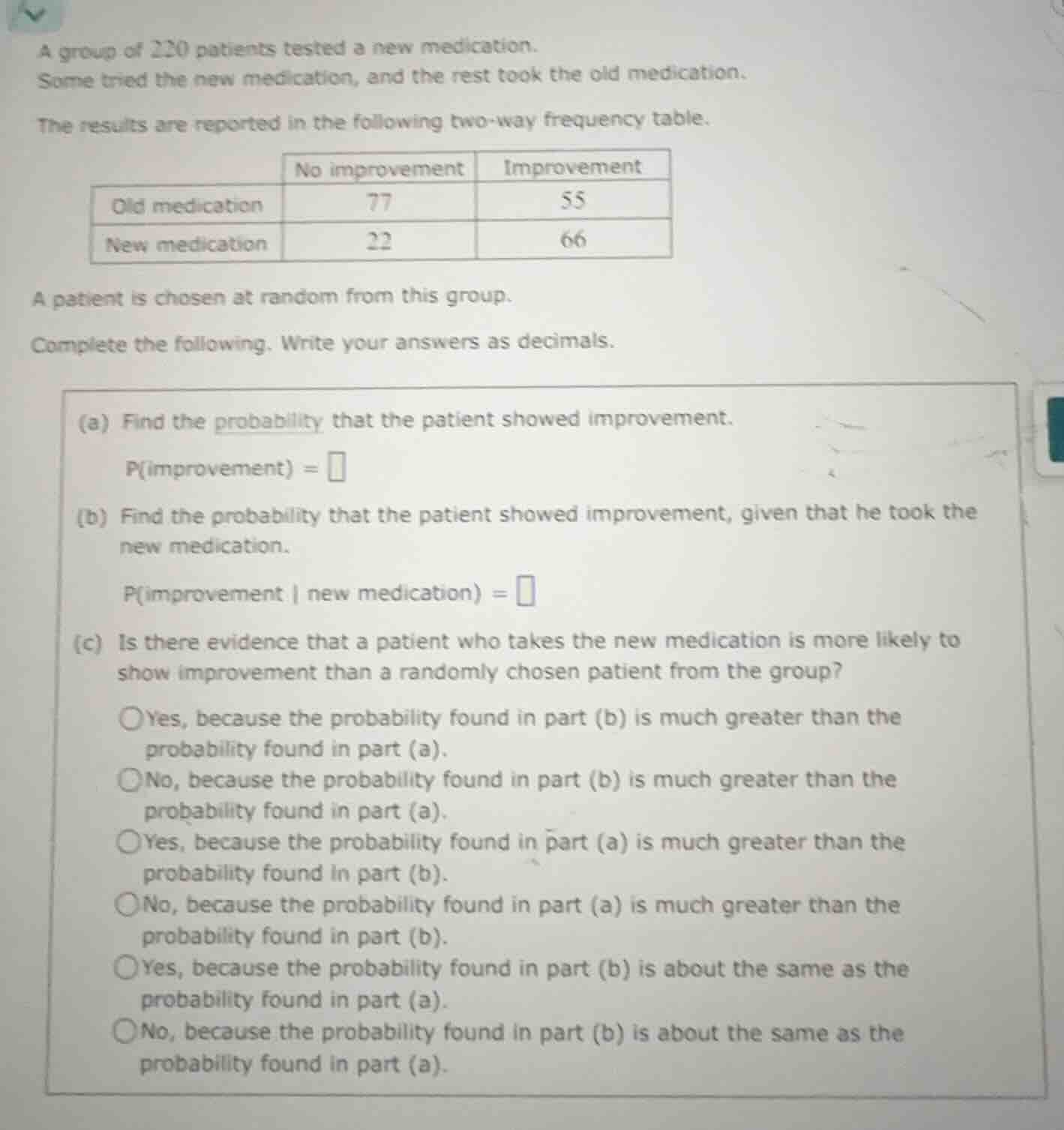
the results are reported in the following two-way frequency table.
\
a patient is chosen at random from this group.
complete the following. write your answers as decimals.
(a) find the probability that the patient showed improvement.
\\(p(\text{improvement}) = \\)
(b) find the probability that the patient showed improvement, given that he took the new medication.
\\(p(\text{improvement} \mid \text{new medication}) = \\)
(c) is there evidence that a patient who takes the new medication is more likely to show improvement than a randomly chosen patient from the group?
- yes, because the probability found in part (b) is much greater than the probability found in part (a).
- no, because the probability found in part (b) is much greater than the probability found in part (a).
- yes, because the probability found in part (a) is much greater than the probability found in part (b).
- no, because the probability found in part (a) is much greater than the probability found in part (b).
- yes, because the probability found in part (b) is about the same as the probability found in part (a).
- no, because the probability found in part (b) is about the same as the probability found in part (a).
Calculate overall probability of improvement
Calculate conditional probability of improvement given new medication
Compare probabilities for evidence of effectiveness

Snap & solve any problem in the app
Get step-by-step solutions on Sovi AI
Photo-based solutions with guided steps
Explore more problems and detailed explanations
(a) \(P(\text{improvement}) =\) <blank>0.55</blank>
(b) \(P(\text{improvement} \mid \text{new medication}) =\) <blank>0.75</blank>
(c) Is there evidence that a patient who takes the new medication is more likely to show improvement than a randomly chosen patient from the group?
- Yes, because the probability found in part (b) is much greater than the probability found in part (a). (Correct answer)
- No, because the probability found in part (b) is much greater than the probability found in part (a).
- Yes, because the probability found in part (a) is much greater than the probability found in part (b).
- No, because the probability found in part (a) is much greater than the probability found in part (b).
- Yes, because the probability found in part (b) is about the same as the probability found in part (a).
- No, because the probability found in part (b) is about the same as the probability found in part (a).