QUESTION IMAGE
Question
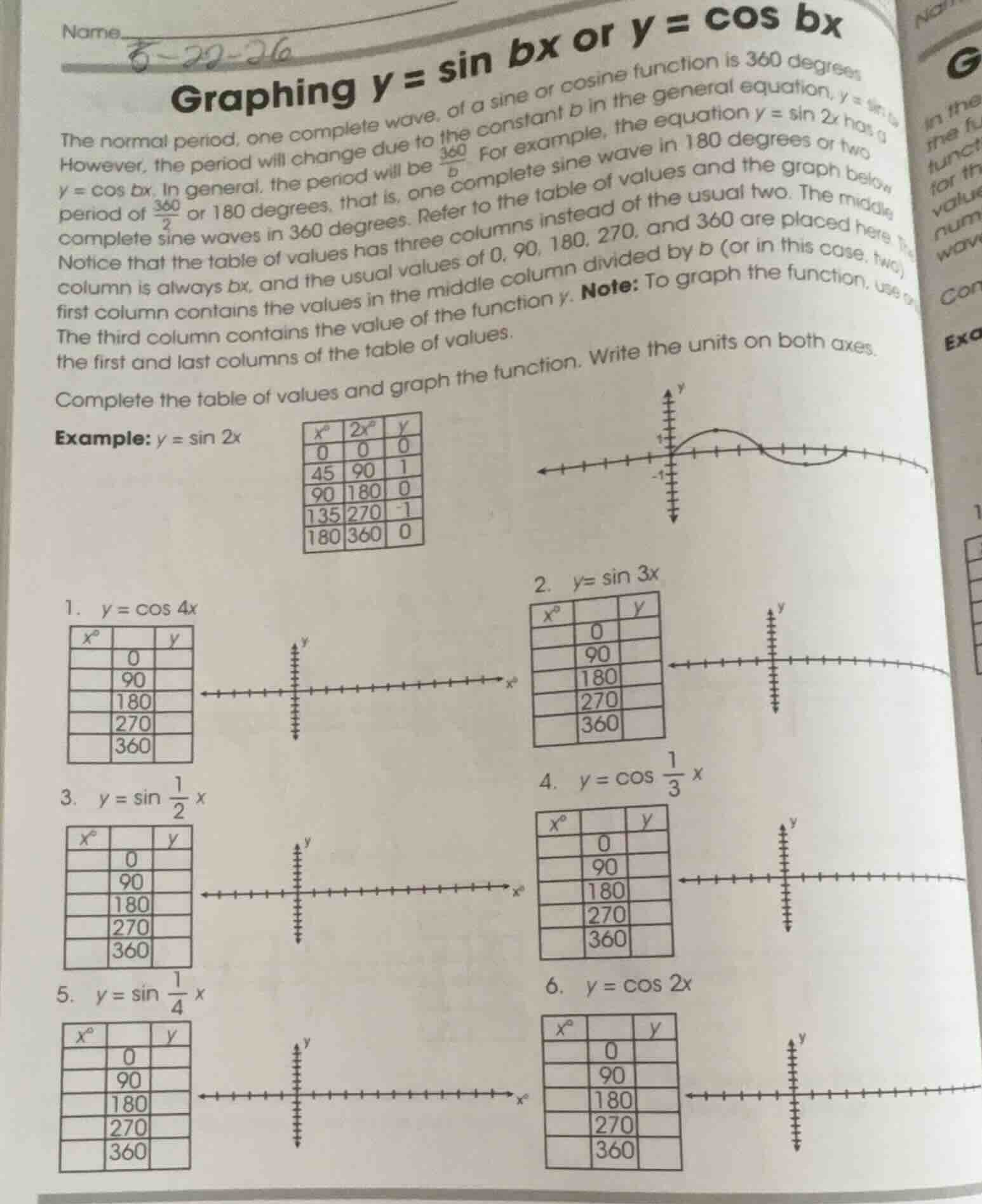
graphing \\(y = \sin bx\\) or \\(y = \cos bx\\)
the normal period, one complete wave, of a sine or cosine function is 360 degrees. however, the period will change due to the constant \\(b\\) in the general equation, \\(y = \sin bx\\) or \\(y = \cos bx\\). in general, the period will be \\(\frac{360}{b}\\). for example, the equation \\(y = \sin 2x\\) has a period of \\(\frac{360}{2}\\) or 180 degrees, that is, one complete sine wave in 180 degrees or two complete sine waves in 360 degrees. refer to the table of values and the graph below. notice that the table of values has three columns instead of the usual two. the middle column is always \\(bx\\), and the usual values of 0, 90, 180, 270, and 360 are placed here. the first column contains the values in the middle column divided by \\(b\\) (or in this case, two). the third column contains the value of the function \\(y\\). note: to graph the function, use only the first and last columns of the table of values.
complete the table of values and graph the function. write the units on both axes.
example: \\(y = \sin 2x\\)
- \\(y = \cos 4x\\)
- \\(y = \sin 3x\\)
- \\(y = \sin \frac{1}{2}x\\)
- \\(y = \cos \frac{1}{3}x\\)
- \\(y = \sin \frac{1}{4}x\\)
- \\(y = \cos 2x\\)
Determine the values for Question 1
For \(y = \cos 4x\), we calculate the values of \(4x\) and \(y\) for each given \(x\):
- For \(x = 0\): \(4x = 0^{\circ}\), \(y = \cos 0^{\circ} = 1\). The first column \(x\) is calculated by dividing the standard angles \(0, 90, 180, 270, 360\) by \(b = 4\).
- The standard angles in the middle column are \(0^{\circ}, 90^{\circ}, 180^{\circ}, 270^{\circ}, 360^{\circ}\).
- Dividing by \(4\), the \(x\) values are:
- \(0 / 4 = 0\)
- \(90 / 4 = 22.5\)
- \(180 / 4 = 45\)
- \(270 / 4 = 67.5\)
- \(360 / 4 = 90\)
- The corresponding \(y\) values are:
- \(\cos 0^{\circ} = 1\)
- \(\cos 90^{\circ} = 0\)
- \(\cos 180^{\circ} = -1\)
- \(\cos 270^{\circ} = 0\)
- \(\cos 360^{\circ} = 1\)
Determine the values for Question 2
For \(y = \sin 3x\), the middle column contains standard angles \(3x = 0^{\circ}, 90^{\circ}, 180^{\circ}, 270^{\circ}, 360^{\circ}\).
- Dividing by \(3\), the \(x\) values are:
- \(0 / 3 = 0\)
- \(90 / 3 = 30\)
- \(180 / 3 = 60\)
- \(270 / 3 = 90\)
- \(360 / 3 = 120\)
- The corresponding \(y\) values are:
- \(\sin 0^{\circ} = 0\)
- \(\sin 90^{\circ} = 1\)
- \(\sin 180^{\circ} = 0\)
- \(\sin 270^{\circ} = -1\)
- \(\sin 360^{\circ} = 0\)
Determine the values for Question 3
For \(y = \sin \frac{1}{2}x\), the middle column contains standard angles \(\frac{1}{2}x = 0^{\circ}, 90^{\circ}, 180^{\circ}, 270^{\circ}, 360^{\circ}\).
- Multiplying by \(2\), the \(x\) values are:
- \(0 \times 2 = 0\)
- \(90 \times 2 = 180\)
- \(180 \times 2 = 360\)
- \(270 \times 2 = 540\)
- \(360 \times 2 = 720\)
- The corresponding \(y\) values are:
- \(\sin 0^{\circ} = 0\)
- \(\sin 90^{\circ} = 1\)
- \(\sin 180^{\circ} = 0\)
- \(\sin 270^{\circ} = -1\)
- \(\sin 360^{\circ} = 0\)
Determine the values for Question 4
For \(y = \cos \frac{1}{3}x\), the middle column contains standard angles \(\frac{1}{3}x = 0^{\circ}, 90^{\circ}, 180^{\circ}, 270^{\circ}, 360^{\circ}\).
- Multiplying by \(3\), the \(x\) values are:
- \(0 \times 3 = 0\)
- \(90 \times 3 = 270\)
- \(180 \times 3 = 540\)
- \(270 \times 3 = 810\)
- \(360 \times 3 = 1080\)
- The corresponding \(y\) values are:
- \(\cos 0^{\circ} = 1\)
- \(\cos 90^{\circ} = 0\)
- \(\cos 180^{\circ} = -1\)
- \(\cos 270^{\circ} = 0\)
- \(\cos 360^{\circ} = 1\)
Determine the values for Questions 5 and 6
For \(y = \sin \frac{1}{4}x\):
- Multiplying standard angles by \(4\), the \(x\) values are: \(0, 360, 720, 1080, 1440\).
- The corresponding \(y\) values are: \(0, 1, 0, -1, 0\).
For \(y = \cos 2x\):
- Dividing standard angles by \(2\), the \(x\) values are: \(0, 45, 90, 135, 180\).
- The corresponding \(y\) values are: \(1, 0, -1, 0, 1\).

Snap & solve any problem in the app
Get step-by-step solutions on Sovi AI
Photo-based solutions with guided steps
Explore more problems and detailed explanations
Question 1
For \(y = \cos 4x\):
| \(x^{\circ}\) | \(4x^{\circ}\) | \(y\) |
|---|---|---|
| \(22.5\) | \(90\) | \(0\) |
| \(45\) | \(180\) | \(-1\) |
| \(67.5\) | \(270\) | \(0\) |
| \(90\) | \(360\) | \(1\) |
Question 2
For \(y = \sin 3x\):
| \(x^{\circ}\) | \(3x^{\circ}\) | \(y\) |
|---|---|---|
| \(30\) | \(90\) | \(1\) |
| \(60\) | \(180\) | \(0\) |
| \(90\) | \(270\) | \(-1\) |
| \(120\) | \(360\) | \(0\) |
Question 3
For \(y = \sin \frac{1}{2}x\):
| \(x^{\circ}\) | \(\frac{1}{2}x^{\circ}\) | \(y\) |
|---|---|---|
| \(180\) | \(90\) | \(1\) |
| \(360\) | \(180\) | \(0\) |
| \(540\) | \(270\) | \(-1\) |
| \(720\) | \(360\) | \(0\) |
Question 4
For \(y = \cos \frac{1}{3}x\):
| \(x^{\circ}\) | \(\frac{1}{3}x^{\circ}\) | \(y\) |
|---|---|---|
| \(270\) | \(90\) | \(0\) |
| \(540\) | \(180\) | \(-1\) |
| \(810\) | \(270\) | \(0\) |
| \(1080\) | \(360\) | \(1\) |
Question 5
For \(y = \sin \frac{1}{4}x\):
| \(x^{\circ}\) | \(\frac{1}{4}x^{\circ}\) | \(y\) |
|---|---|---|
| \(360\) | \(90\) | \(1\) |
| \(720\) | \(180\) | \(0\) |
| \(1080\) | \(270\) | \(-1\) |
| \(1440\) | \(360\) | \(0\) |
Question 6
For \(y = \cos 2x\):
| \(x^{\circ}\) | \(2x^{\circ}\) | \(y\) |
|---|---|---|
| \(45\) | \(90\) | \(0\) |
| \(90\) | \(180\) | \(-1\) |
| \(135\) | \(270\) | \(0\) |
| \(180\) | \(360\) | \(1\) |