QUESTION IMAGE
Question
graphing a logarithmic function after a transformation
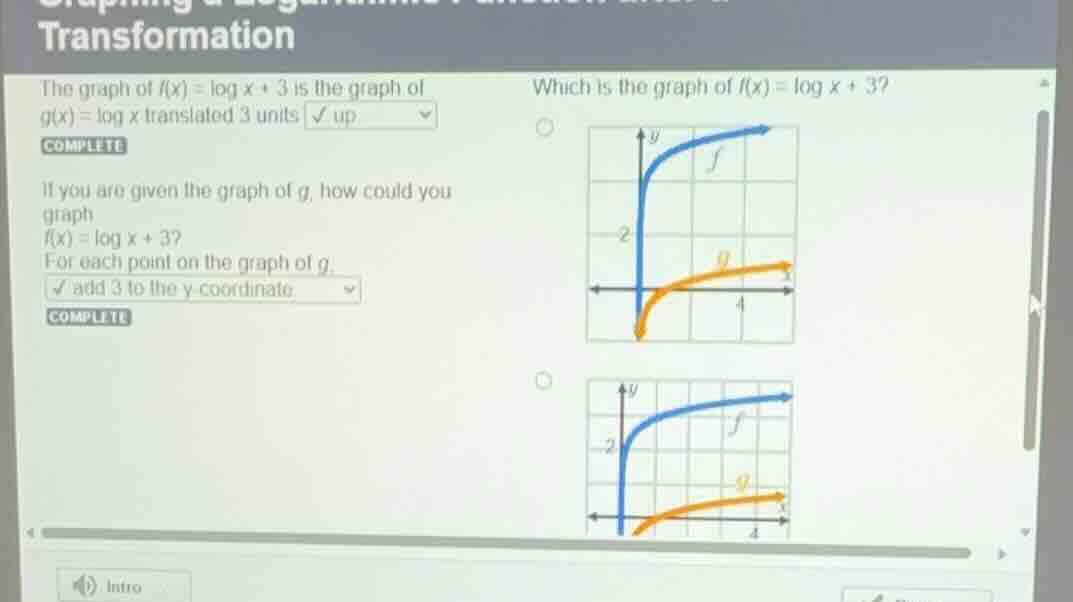
the graph of \\(f(x) = \log x + 3\\) is the graph of \\(g(x) = \log x\\) translated 3 units up.
if you are given the graph of \\(g\\), how could you graph \\(f(x) = \log x + 3\\)?
for each point on the graph of \\(g\\), add 3 to the y-coordinate.
which is the graph of \\(f(x) = \log x + 3\\)?
Analyze the transformation
Using the Logarithmic Function Transformations knowledge point
This represents a vertical translation of the parent graph \(g(x) = \log x\) upward by 3 units.
Evaluate coordinates of the parent function
Using the Logarithmic Functions knowledge point
Determine coordinates of the transformed function
Using the Logarithmic Function Transformations knowledge point
Identify the correct graph
Using the Logarithmic Function Transformations knowledge point
- The parent graph \(g(x)\) (orange curve) passes through \((1, 0)\).
- The transformed graph \(f(x)\) (blue curve) must pass through \((1, 3)\).
- In the first option, the blue curve \(f\) passes through \((1, 3)\) (exactly 3 units above the x-axis at \(x = 1\)).
- In the second option, the blue curve \(f\) passes through \((1, 2)\), which is a vertical shift of only 2 units.
- Therefore, the first graph is correct.

Snap & solve any problem in the app
Get step-by-step solutions on Sovi AI
Photo-based solutions with guided steps
Explore more problems and detailed explanations
- (A) The first graph, where the blue curve \(f(x)\) is shifted 3 units up from the orange curve \(g(x)\) and passes through \((1, 3)\). (Correct answer)
- (B) The second graph, where the blue curve \(f(x)\) is shifted 2 units up from the orange curve \(g(x)\) and passes through \((1, 2)\).