QUESTION IMAGE
Question
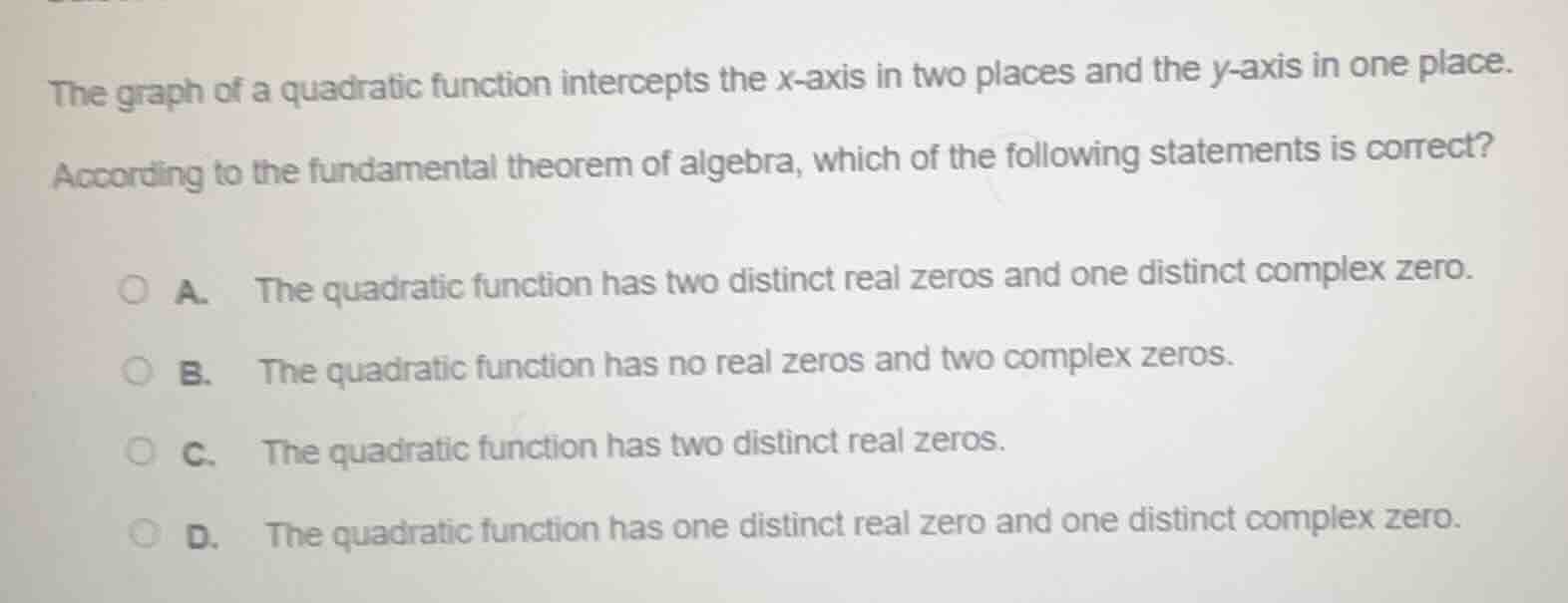
the graph of a quadratic function intercepts the x-axis in two places and the y-axis in one place. according to the fundamental theorem of algebra, which of the following statements is correct? a. the quadratic function has two distinct real zeros and one distinct complex zero. b. the quadratic function has no real zeros and two complex zeros. c. the quadratic function has two distinct real zeros. d. the quadratic function has one distinct real zero and one distinct complex zero.
The fundamental theorem of algebra states a degree-$n$ polynomial has exactly $n$ complex zeros (counting multiplicities). A quadratic function is degree 2, so it has 2 total zeros. Since its graph crosses the x-axis twice, these correspond to two distinct real zeros (real numbers are a subset of complex numbers, so these satisfy the theorem without needing additional complex zeros).

Snap & solve any problem in the app
Get step-by-step solutions on Sovi AI
Photo-based solutions with guided steps
Explore more problems and detailed explanations
C. The quadratic function has two distinct real zeros.