QUESTION IMAGE
Question
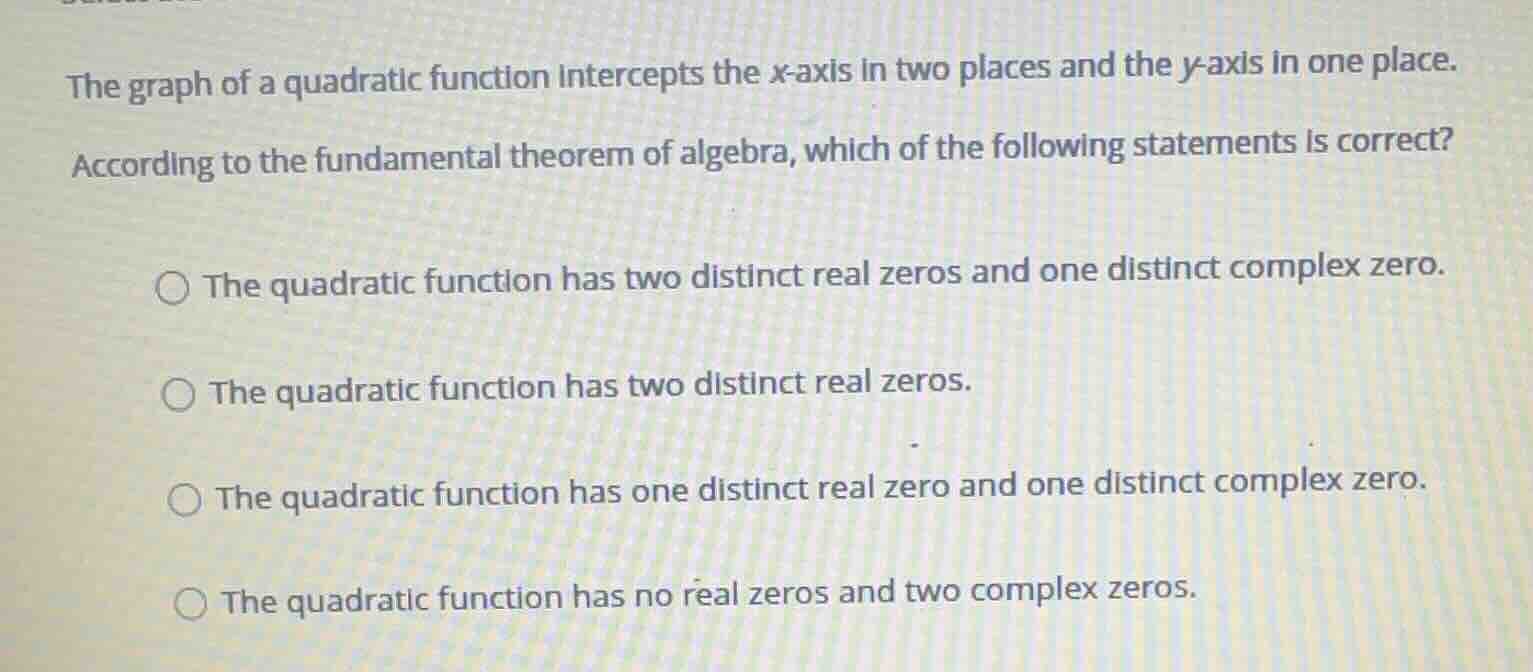
the graph of a quadratic function intercepts the \\(x\\)-axis in two places and the \\(y\\)-axis in one place.
according to the fundamental theorem of algebra, which of the following statements is correct?
- the quadratic function has two distinct real zeros and one distinct complex zero.
- the quadratic function has two distinct real zeros.
- the quadratic function has one distinct real zero and one distinct complex zero.
- the quadratic function has no real zeros and two complex zeros.
Identify the degree of the function and the number of zeros
$$
LATEXBLOCK0
$$
Analyze the given x-intercepts
$$
LATEXBLOCK1
$$
Determine the remaining zeros
$$
LATEXBLOCK2
$$

Snap & solve any problem in the app
Get step-by-step solutions on Sovi AI
Photo-based solutions with guided steps
Explore more problems and detailed explanations
- The quadratic function has two distinct real zeros and one distinct complex zero.
- The quadratic function has two distinct real zeros. (Correct answer)
- The quadratic function has one distinct real zero and one distinct complex zero.
- The quadratic function has no real zeros and two complex zeros.